
ART
BEAUTY & WELLNESS
CRAFT
CULTURE & HISTORY
ENTERTAINMENT
ENVIRONMENT
FOOD & DRINKS
GREEN FUTURE
REVERSE ENGINEERING
SCIENCES
SPORTS
TECHNOLOGY
WEARABLES
Jute Harvesting and Retting — Extracting Jute Fiber in Bangladesh
English
ApuShapla

Created by

ApuShapla

23. April 2026BD
0
0
0
0
0

Jute Harvesting and Retting — Extracting Jute Fiber in Bangladesh

Detailed instructions on cultivation, harvesting, retting, and fiber extraction of jute (Corchorus capsularis and Corchorus olitorius) in Bangladesh. Bangladesh produces approximately 33% of the world's total jute. Jute grows in warm, humid climates, is sown in March-May and harvested in July-September. This blueprint describes every step including jute identification, determining harvest time, bundling, selecting retting sites, the retting process, fiber separation, washing, drying, grading, and storage.

Intermediate
3-5 days (including retting)

Instructions

1

Understanding the Jute Plant

Jute is a fiber crop of the genus Corchorus. There are two main species: tossa jute (Corchorus olitorius) and white jute (Corchorus capsularis). Tossa jute is golden in color, stronger, and smoother — it is called the Golden Fiber. White jute is comparatively coarser and less lustrous. Bangladesh produces approximately 33% of the world's total jute and is the second largest jute-producing country in the world. The jute plant grows 2-4 meters tall and fiber is extracted from its bark.
2

Understanding Jute Land and Climate Requirements

Jute grows best in hot and humid climates. A temperature of 24-37 degrees Celsius and relative humidity of 70-90% are required. Annual rainfall of 1500-2500 mm yields good harvests. Low-lying alluvial soil rich in silt (silty loam) is ideal for jute — the Ganges-Brahmaputra-Meghna delta in Bangladesh is the best in the world for this reason. Seeds are usually sown in March-May (Chaitra-Baishakh).
3

Determining the Harvest Time

The jute plant is ready for harvesting 120-150 days after sowing, usually in July-September (Shraban-Bhadra). Signs of the right time: small flowers begin to bloom (yellow on tossa jute, white on white jute). Harvesting at the onset of flowering yields the best fiber quality — soft, smooth, and strong. Delaying too long makes fiber hard and coarse.
4

Cutting the Jute Plants

Jute plants are cut close to the ground (2-5 cm above soil level) in a single stroke with a sharp sickle (da). Morning is best — less sun intensity and worker fatigue. Cut plants are left in the field 2-3 days for leaves to fall off, which reduces water pollution during retting.

Tools needed:

Steel Sickle (দা)Steel Sickle (দা)
5

Bundling the Jute Plants

After leaves have fallen, jute plants are tied into small bundles of 20-30 plants. Butt ends are aligned evenly. They are tied tightly near the base with jute bark or rope. Bundles too large cause uneven retting since water cannot reach inner plants. Each bundle should be hand-carryable.

Materials for this step:

Jute TwineJute Twine1 bundle
6

Selecting the Retting Site

For retting, select a clean water body with slow current — ponds, canals, wetlands, or calm river sections. Water depth must be at least 1-1.5 meters. Clean, slightly acidic water (pH 6-7) gives better results. Stagnant polluted water causes poor fiber color and odor. Sunlit open water bodies are preferable as temperature accelerates bacterial activity.
7

Retting the Jute

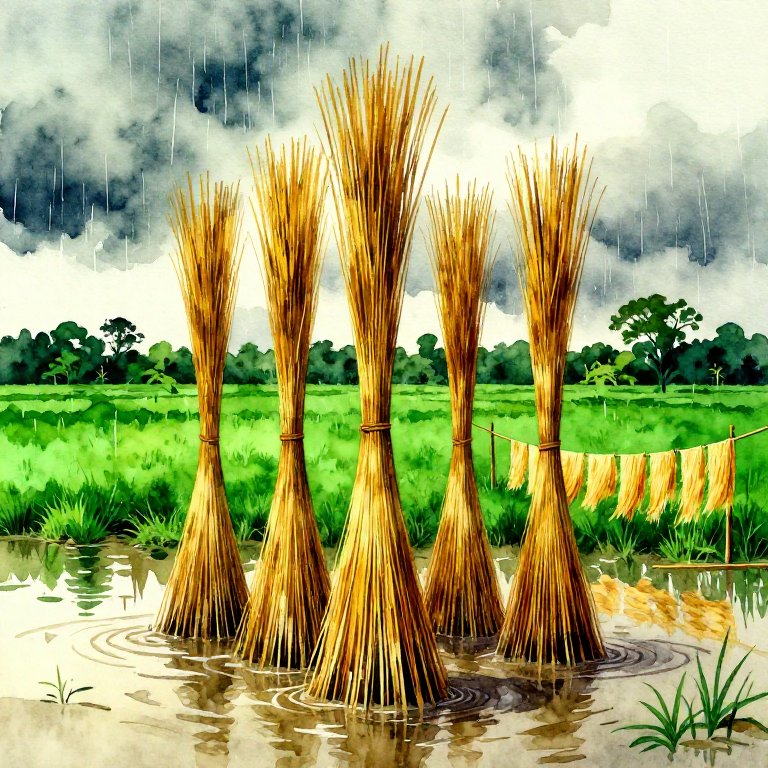
Bundles are completely submerged in water, weighted down with wooden logs, banana stems, or earthen weights. The retting process takes 10-20 days depending on temperature and water quality. Warm water (30-34 degrees Celsius) accelerates the process. Clostridium and other anaerobic bacteria break down pectin and lignin, loosening fiber from the woody core (pith).

Materials for this step:

Banana Stem WeightsBanana Stem Weights5 pieces
8

Checking the Retting Progress

From 8-10 days after retting, check progress daily. Lift a plant and pull the bark at the butt end — if it separates easily from wood, retting is complete. Over-retting weakens fiber and darkens color. Under-retting leaves woody pieces attached. Cessation of surface bubbles signals completion.
9

Stripping the Fiber

Once retting is complete, bundles are lifted from water. The worker stands waist-deep and pulls bark from each plant's butt end. Fiber comes out like long threads. The woody core (shola/pith) is discarded. Fiber is rinsed by shaking in water to remove residual pectin and wood particles. A skilled worker strips 25-30 kg raw fiber per day.
10

Washing the Fiber

Stripped fiber must be thoroughly washed in clean water 2-3 times. Submerging and shaking by hand removes dirt, residual pectin, and mud. Well-washed fiber takes on a bright golden color — a sign of high quality. Foul-smelling or darkish fiber is considered low quality.

Materials for this step:

Clean WaterClean Water50 liters
11

Drying the Fiber

Washed fiber is dried in the sun, hung on bamboo frames or ropes for air circulation. Direct sunlight for 2-3 days fully dries the fiber. Never dry on the ground — soil contamination reduces quality. Cover during rain. When moisture drops below 12-14%, fiber is ready for storage.

Tools needed:

Bamboo Drying FrameBamboo Drying Frame
Hanging RopeHanging Rope
12

Grading the Fiber

Dried fiber is classified by quality using two grading systems: Bangla White (BW) for white jute and Bangla Tossa (BT) for tossa jute. Criteria: color (bright golden is best), strength, smoothness, cleanliness (woody particles/dirt), and length (longer is more valuable). BT-A and BW-A are the highest grades.

Tools needed:

Sorting TableSorting Table
13

Bundling and Storing the Fiber

Fiber is tied into separate bundles by grade, each weighing 5-8 kg. Store in a dry, cool, well-ventilated warehouse on elevated pallets to protect from floor moisture. Excessive moisture causes fungal growth and weakens fiber. Farmers sell fiber at local markets (haats) or jute trading depots (arats).

Materials for this step:

Jute TwineJute Twine1 bundle
Wooden Storage PalletWooden Storage Pallet2 pieces

Tools needed:

Weighing ScaleWeighing Scale
14

Uses of Jute Pith (Shola)

The remaining woody stem (jute stick or shola) is not discarded — it serves multiple purposes. Used as cooking fuel, for building house fences, and for charcoal production. Modern applications include particle board and activated carbon manufacturing. No part of the jute plant goes to waste — a completely zero-waste crop.

Materials

4

Tools Required

5

CC0 Public Domain

This blueprint is released under CC0. You are free to copy, modify, distribute, and use this work for any purpose, without asking permission.

Support the Maker by purchasing products through their Blueprint where they earn a Maker Commission set by Vendors, or create a new iteration of this Blueprint and include it as a connection in your own Blueprint to share revenue.

Discussion

(0)

Log in to join the discussion

Loading comments...