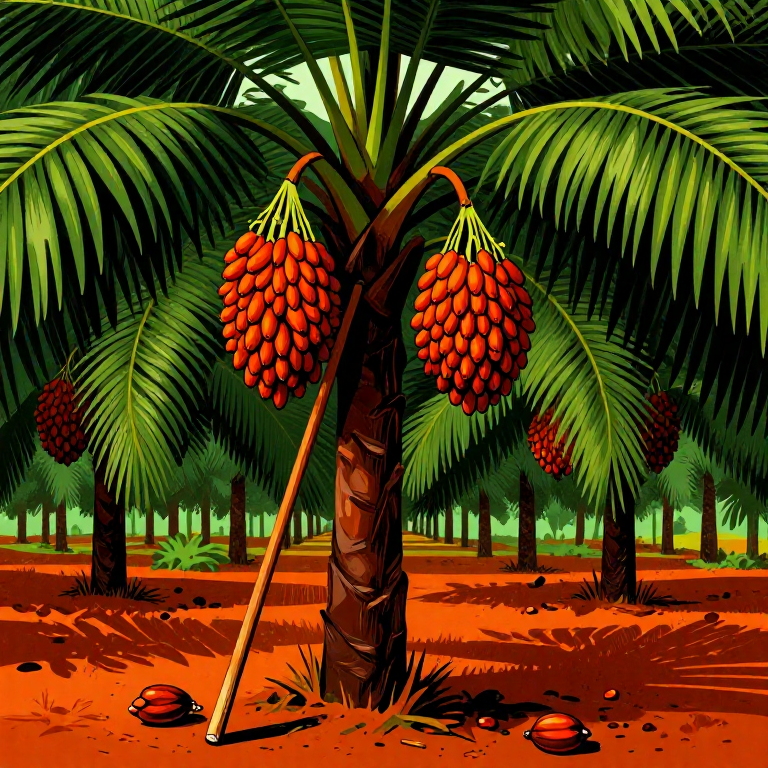


Oil Palm Harvesting — Harvesting Fresh Fruit Bunches from the Field
A comprehensive guide to harvesting fresh fruit bunches (FFB) from oil palm trees (Elaeis guineensis) in Malaysia. Malaysia is the world's second-largest palm oil producer. Each tree produces 8-12 bunches per year, with each bunch weighing 20-30 kg. This blueprint covers identifying ripe bunches (2-3 loose fronds + 10+ loose fruits on the ground), cutting techniques using a long-handled blade (for trees 35+ feet tall), sickles for young trees, collection of loose fruits, and
Instructions
Know the oil palm tree (Elaeis guineensis)
Know the oil palm tree (Elaeis guineensis)
The oil palm (Elaeis guineensis) originates from West Africa and was brought to Southeast Asia in the early 20th century. Malaysia is currently the second largest palm oil producer in the world after Indonesia, with approximately 5.6 million hectares of palm plantations. Oil palms begin bearing fruit at 2.5-3 years after planting and can be harvested economically for 25-30 years. Each tree produces 8-12 fresh fruit bunches (FFB) per year. Each FFB weighs 20-30 kg and contains 1,000-3,000 individual fruits. Mature trees can reach heights of 15-20 meters (50-65 feet).
Identify ripe bunches for harvesting
Identify ripe bunches for harvesting
Determining bunch ripeness is the most important skill in palm oil harvesting. Ripe bunches are indicated by: (1) Fruit color changes from blackish green to reddish orange, (2) 10 or more loose fruits have fallen to the ground beneath the tree — this is the primary indicator of optimum ripeness, (3) 2-3 fronds supporting the bunch begin to curve downward and loosen. Under-ripe bunches produce low oil with low free fatty acid (FFA) levels but low oil yield. Over-ripe bunches have high FFA (exceeding 5%) which lowers oil quality. Optimum harvesting target: FFA below 2%.
Prepare harvesting equipment
Prepare harvesting equipment
Tools needed:
 Harvesting Chisel (for short palms)
 Sickle on Pole (3-5 meter)
 Aluminium Chisel Pole / Dodos (8-12 meter)
 Safety Helmet
Cut obstructing fronds
Cut obstructing fronds
Tools needed:
Aluminium Chisel Pole / Dodos (8-12 meter)Safety HelmetCut the fresh fruit bunch (FFB)
Cut the fresh fruit bunch (FFB)
Tools needed:
Aluminium Chisel Pole / Dodos (8-12 meter)Safety Helmet Safety Boots (steel-toed)
Collect loose fruits
Collect loose fruits
Materials for this step:
 Perforated Loose Fruit Collection Bag1 piece per block
Tools needed:
 Loose Fruit Scraper
Trim the bunch stalk short
Trim the bunch stalk short
Tools needed:
Harvesting ChiselTransport TBS to the edge of the field road
Transport TBS to the edge of the field road
Lift TBS (20-30 kg each) into a wheelbarrow and push to the nearest edge of the field road (collection point). For large fields, each block has designated transport routes and collection points. In modern farms, mini tractors with trailers are used to collect TBS from several collection points. Arrange TBS on flat ground — do not allow TBS to be buried in high piles because pressure and heat accelerate the formation of FFA. Pour ripe fruit that has been collected into separate baskets next to TBS.
Tools needed:
 Wheelbarrow
 Loading Ramp
Check FFB quality before transport
Check FFB quality before transport
Load TBS onto transport lorry
Load TBS onto transport lorry
Load TBS into the transport lorry (3-ton or 5-ton) using a mini crane or manually. Arrange TBS neatly inside the lorry body — do not stack too high because TBS falling from the lorry during transport causes crop loss. Loose fruits are placed in separate bags and laid on top of TBS. Record the number of TBS, estimated weight, original block, and harvest date on the delivery form. This information is important for the traceability system and payment to growers.
Materials for this step:
 Dispatch Record Form1 piece per load
Tools needed:
 Transport Truck (5-ton)
Deliver FFBs to the mill within 24 hours
Deliver FFBs to the mill within 24 hours
Tools needed:
Transport Truck (5-ton)Maintain trees and harvesting schedule
Maintain trees and harvesting schedule
Harvesting equipment maintenance
Harvesting equipment maintenance
Materials for this step:
 Diesel Fuel (for blade cleaning)200 milliliter
Tools needed:
 Sharpening Stone (whetstone)
 Spanner Set (for pole connections)
Safety and best harvesting practices
Safety and best harvesting practices
Safety is a priority in palm oil harvesting work. Main hazards include: (1) TBS falling from height — always stand to the side, not underneath the bunch while cutting, (2) Palm thorns — fruit and palm fronds have sharp thorns 2-5 cm that can pierce skin; wear thick gloves and safety boots, (3) Snakes and insects — check the base of the tree before approaching, especially cobras and white-lipped pit vipers which are common in plantations, (4) Heat exhaustion — bring sufficient drinking water, rest every 2 hours, and avoid harvesting between 12-2 pm during peak heat. Wear a safety helmet, leather gloves, steel-soled safety boots, and long-sleeved shirt at all times in the field.
Tools needed:
Safety Helmet Leather Work GlovesSafety Boots (steel-toed)
 Water Bottle (1.5 liter)
Materials
3- 1 piece per blockPlaceholder
- 1 piece per loadPlaceholder
- 200 milliliterPlaceholder
Tools Required
13- Placeholder
- Placeholder
- Placeholder
- Placeholder
- Placeholder
- Placeholder
- Placeholder
- Placeholder
- Placeholder
- Placeholder
- Placeholder
- Placeholder
- Placeholder
CC0 Public Domain
This blueprint is released under CC0. You are free to copy, modify, distribute, and use this work for any purpose, without asking permission.
Support the Maker by purchasing products through their Blueprint where they earn a Maker Commission set by Vendors, or create a new iteration of this Blueprint and include it as a connection in your own Blueprint to share revenue.