

ART
BEAUTY & WELLNESS
CRAFT
CULTURE & HISTORY
ENTERTAINMENT
ENVIRONMENT
FOOD & DRINKS
GREEN FUTURE
REVERSE ENGINEERING
SCIENCES
SPORTS
TECHNOLOGY
WEARABLES
Guérande Salt Harvesting — The Expertise of the Breton Salt Farmer
English
MrBaguette

Created by

MrBaguette

23. April 2026FR
0
0
0
0
0

Guérande Salt Harvesting — The Expertise of the Breton Salt Farmer

Complete guide to traditional salt harvesting in the salt marshes of Guérande, in Loire-Atlantique (Brittany). This ancestral tradition dates back more than 1,500 years. The paludier (salt farmer) uses an ingenious system of successive basins to concentrate seawater through natural evaporation: vasière (reservoir), cobier (heating basin), fards, adernes, then œillets (crystallization basins). Seawater passes from 35 g/L salinity to approximately 250 g/L before crystallization.

Advanced
Full day harvest session

Instructions

1

Understanding the Salt Marsh System

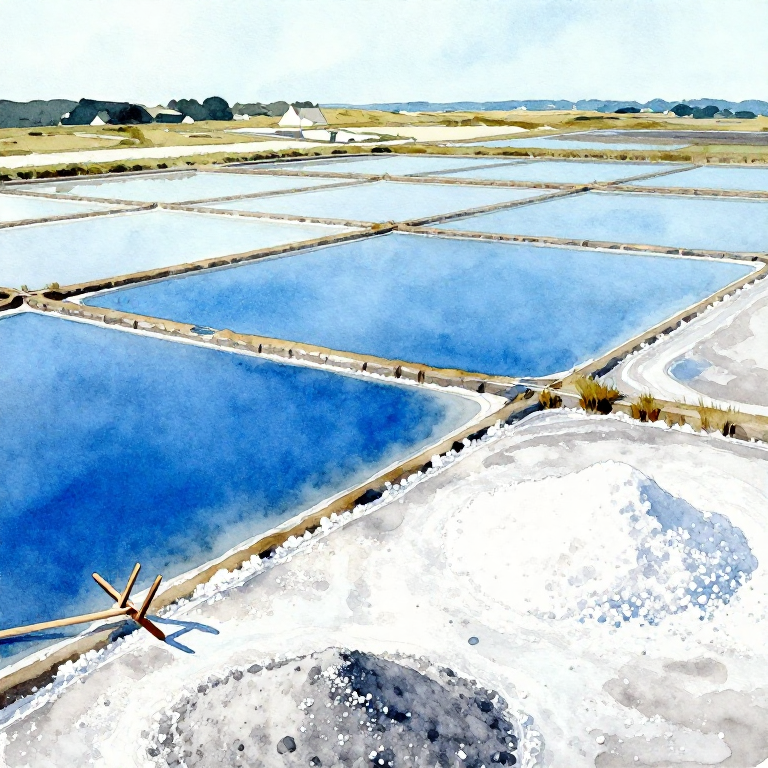
The Guerande salt marshes span approximately 2,000 hectares between Le Croisic and Guerande on the Guerande peninsula (Loire-Atlantique, Brittany). The system exploits natural seawater evaporation through shallow basins connected by channels. Seawater enters via a main channel (etier) and passes through: vasiere (storage reservoir), cobier (first heating basin), fards and adernes (intermediate concentration basins), and oeillets (crystallization basins of approximately 70 square meters). Salinity increases from 35 g/L to approximately 250 g/L.
2

Seasonal Preparation of the Basins

From March to May, the paludier (salt worker) prepares the basins. After winter, oeillets and channels contain sediment, algae, and debris. Each basin is drained and the clay bottom scraped perfectly level. The oeillet bottom must be absolutely flat for uniform water depth (approximately 5 mm during crystallization). Talus (clay banks between basins) are inspected and repaired. Channels are dredged. This restoration takes approximately two months.

Materials for this step:

Argile de réparation pour talusArgile de réparation pour talus50 kg

Tools needed:

Pelle plate de curagePelle plate de curage
BrouetteBrouette
3

Managing Water Flow in the Channels

The paludier regulates seawater flow using small wooden or slate gates (trapons). Water enters via the etier during high tides and fills the vasiere. Trapons control passage between basins. Residence time in each basin is crucial for evaporative concentration. Vasiere: several days. Cobiers: concentration to 50-70 g/L. Fards and adernes: 150-200 g/L. A paludier typically manages 50-80 oeillets.

Tools needed:

Trapon (vanne en bois)Trapon (vanne en bois)
4

Monitoring Concentration and Crystallization

The paludier monitors brine concentration daily. When salinity exceeds approximately 250 g/L (sodium chloride saturation point), salt begins to crystallize. Water depth must not exceed 5 mm at this stage. Concentration is assessed visually (iridescent water, visible crystals) and by touch (viscous brine). Crystallization depends on weather: sunshine for evaporation and moderate east wind. Rain is the enemy — it dilutes brine and can destroy days of concentration.
5

Recognizing Conditions for Fleur de Sel

Fleur de sel forms only under very specific conditions: hot sunny afternoon, light steady east wind, and low humidity. Rapid surface evaporation creates fine salt crystals on the water surface, forming a delicate fragile crust. Too much wind sinks crystals to the bottom (becoming grey salt). Too much humidity prevents formation. Fleur de sel is white because it never touches the clay bottom. It represents only about 5% of total production — 1 to 3 kg per oeillet per season.
6

Harvesting Fleur de Sel

Fleur de sel is harvested in late afternoon when the crystal crust has formed well. The paludier uses a lousse a fleur de sel: a wooden tool with a long handle ending in a thin flat board (approximately 30 cm wide). The surface is gently skimmed to scoop the crystal film without touching the bottom. The motion must be very delicate — too much force breaks crystals and sinks them. Harvested fleur de sel is deposited on the ladure (packed-earth drying platform). It has a moist, slightly crunchy texture with a subtle violet fragrance.

Tools needed:

Lousse à fleur de sel (écumoire plate en bois)Lousse à fleur de sel (écumoire plate en bois)
7

Harvesting Grey Salt (Coarse Salt)

Grey salt crystallizes at the bottom of the oeillet, in contact with clay that gives its characteristic grey color. Harvested after fleur de sel, using a lousse a sel gris (las): a large wooden rake with approximately 5-meter handle and 40-60 cm wide board. The bottom is scraped, pushing salt toward the basin edge to form a mulon (mound). Scraping must be firm but without digging into the clay. Each oeillet yields 1-3 kg of grey salt per day in good season.

Tools needed:

Lousse à sel gris (las, râteau en bois à long manche)Lousse à sel gris (las, râteau en bois à long manche)
8

Draining and Forming Mulons

Harvested grey salt is pushed onto the ladure (raised area at the oeillet edge) to drain for several hours. Then the paludier forms mulons: conical salt mounds approximately 1 meter high, arranged along paths between oeillets. Salt continues drying in the mulons for several days. The salt is never washed — this gives it its mineral richness (magnesium, potassium, calcium) and trace elements from clay and seawater.

Tools needed:

Pelle de mise en mulonPelle de mise en mulon
9

Initial Drying on the Ladures

Fleur de sel is dried separately from grey salt, directly on the ladures. It remains spread in a thin layer for 24-48 hours, turned gently once or twice for even drying. Grey salt dries in mulons for days to a week. Drying is entirely natural — no oven or dehydrator. Fleur de sel retains approximately 5-10% residual moisture, giving its characteristic slightly moist texture.
10

Transfer to the Salorge

Once sufficiently dry, salt is transported to the salorge: a large stone or wood storage building at the marsh edge. Grey salt is moved by wheelbarrow from mulons. Fleur de sel is transported separately in food-grade bins. Salt continues losing moisture over several months in the salorge. Grey salt is stored in large floor piles; fleur de sel in separate bins protected from moisture. A salorge holds an entire season's production — several tons per paludier.

Tools needed:

BrouetteBrouette
Bacs de transport alimentaireBacs de transport alimentaire
11

Sorting and Quality Control

Before sale, salt is sorted and inspected. Grey salt is sieved to remove debris (small pebbles, clay fragments, plant matter). Fleur de sel is visually inspected and hand-sorted — crystals must be white, fine, and regular. Any grey crystal is reclassified as grey salt. Guerande salt holds IGP (Protected Geographical Indication) since 2012. No chemical treatment, no anti-caking agents, no bleaching — sold as harvested.

Tools needed:

Tamis à mailles moyennesTamis à mailles moyennes
12

Packaging and Labeling

Salt is packaged in burlap, kraft paper, or food-grade plastic bags. Fleur de sel: small pots/sachets of 125g, 250g, or 500g. Grey salt: bags of 1kg, 5kg, or 25kg. Each package bears the IGP Sel de Guerande designation, paludier/cooperative name, salt type, and harvest vintage. Guerande salt keeps indefinitely when stored dry and away from light. Fleur de sel should be kept in a closed container to preserve its moisture and delicate fragrance.

Materials for this step:

Sacs de conditionnement alimentaireSacs de conditionnement alimentaire20 pieces

Étiquettes IGPÉtiquettes IGP20 pieces

Tools needed:

Balance de peséeBalance de pesée

Materials

3

Tools Required

9

CC0 Public Domain

This blueprint is released under CC0. You are free to copy, modify, distribute, and use this work for any purpose, without asking permission.

Support the Maker by purchasing products through their Blueprint where they earn a Maker Commission set by Vendors, or create a new iteration of this Blueprint and include it as a connection in your own Blueprint to share revenue.

Discussion

(0)

Log in to join the discussion

Loading comments...