

Harvesting Lavender — From Field to Dried Bouquet
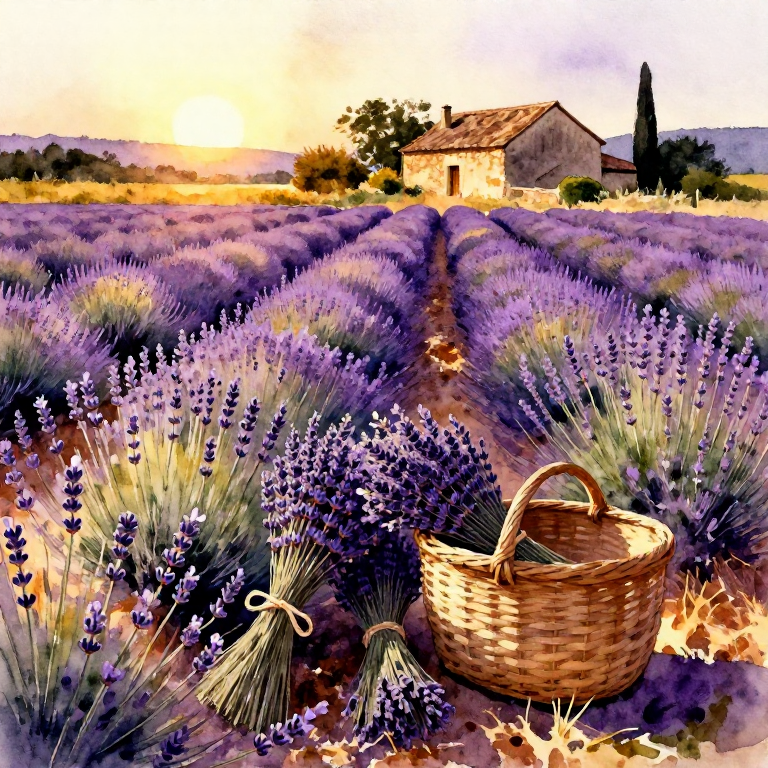
Complete guide to harvesting true lavender (Lavandula angustifolia) in Provence. From choosing the optimal cutting time to assembling bouquets, drying and storage — the first step in the lavender chain toward essential oil, soap and scented sachets.
Instructions
Identifying true lavender
Identifying true lavender
True lavender (Lavandula angustifolia) is distinguished from lavandin (hybrid) by its short stems (30-60 cm), unbranched, bearing a single floral spike. The leaves are narrow, gray-green, 3-5 cm long. Lavandin has longer stems with branching at the extremity. The essential oil of true lavender is the finest and most sought-after.
Choose the harvest time
Choose the harvest time
Harvesting takes place in July, when approximately 50% of the flowers on the spike are open. This is the stage when the essential oil concentration is at its peak. Too early: little oil. Too late: the flowers drop and the oil evaporates. In Provence, the period falls between July 10 and July 30 depending on altitude.
Harvest in dry weather
Harvest in dry weather
Harvest in the morning after the dew has evaporated, between 9 AM and 11 AM. Moisture promotes mold growth during drying. Never harvest after rain — wait at least 24 hours until the plants are perfectly dry.
Prepare cutting tools
Prepare cutting tools
Sharpen your sickle or pruning shears. Dull blades crush stems instead of cutting them cleanly, which damages the plant and slows regrowth. Disinfect blades with 70% alcohol before starting — this prevents the spread of diseases.
Materials for this step:
 Rubbing Alcohol (70%)50 milliliter
Tools needed:
 Sickle or Pruning Shears
Cut the stems
Cut the stems
Grasp a handful of stems (15-20 stems) and cut 2-3 cm above the woody part (hardwood). Never cut into the old wood — lavender does not regrow from old wood. Always leave a few centimeters of green foliage below the cut.
Materials for this step:
 Fresh Lavender Stems1 field section
Tools needed:
Sickle or Pruning ShearsGather into bundles
Gather into bundles
Group the cut stems into small bundles of 30-40 stems. Place them gently in a basket or flat crate. Avoid compressing the flowers — the essential oil glands are located on the petals and break easily.
Tools needed:
 Flat Harvesting Basket
Form the bouquets
Form the bouquets
Gather 50-80 stems into a bouquet. Align the bases of the stems and tie firmly with an elastic band or jute twine 5 cm from the base. The stems shrink as they dry — use an elastic band that tightens, or plan to tighten the twine after 3 days.
Materials for this step:
 Rubber Bands or Jute Twine20 pieces
Hang the bouquets
Hang the bouquets
Tools needed:
 Drying Line or Hooks
Choose the drying location
Choose the drying location
The ideal drying location is dark, dry and well-ventilated: an attic, barn or open shelter. Direct sunlight fades the flowers and degrades essential oils. The ideal temperature is 20-30°C with good air circulation.
Space out the bouquets
Space out the bouquets
Leave at least 10 cm between each bouquet so air circulates freely. Tightly packed bouquets dry poorly in the center and risk molding. Turn them a quarter turn every 2-3 days for even drying.
Dry for 2 to 3 weeks
Dry for 2 to 3 weeks
Test the drying
Test the drying
Strip the flowers (optional)
Strip the flowers (optional)
Tools needed:
 Large Bowl
 Fine Mesh Sieve
Store whole bouquets
Store whole bouquets
Materials for this step:
 Newspaper5 sheets
Store loose flowers
Store loose flowers
Materials for this step:
 Glass Storage Jar3 pieces
Prune the plants after harvest
Prune the plants after harvest
Tools needed:
 Pruning Shears
Materials
5- 50 milliliterPlaceholder
- 1 field sectionPlaceholder
- 20 piecesPlaceholder
- 5 sheetsPlaceholder
- 3 piecesPlaceholder
CC0 Public Domain
This blueprint is released under CC0. You are free to copy, modify, distribute, and use this work for any purpose, without asking permission.
Support the Maker by purchasing products through their Blueprint where they earn a Maker Commission set by Vendors, or create a new iteration of this Blueprint and include it as a connection in your own Blueprint to share revenue.