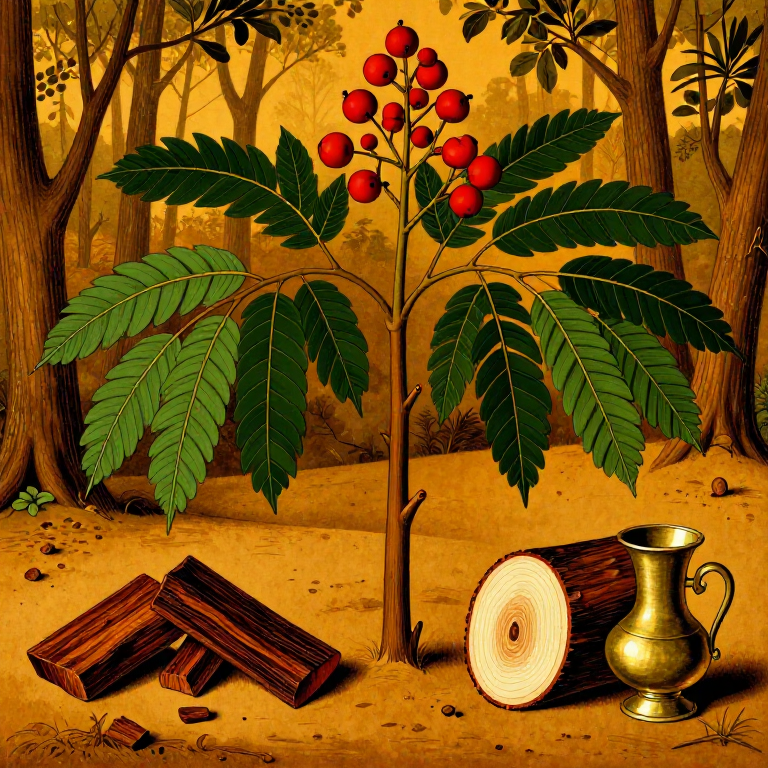


Sandalwood Tree Harvesting and Heartwood Processing — Sandalwood of Karnataka
A comprehensive guide to harvesting and processing the heartwood of the precious sandalwood tree (Santalum album) of Karnataka. Indian sandalwood is a native tree of South India, with Karnataka being its major growing region. In the state of Karnataka, all sandalwood trees are government property — even those grown on private land. This guide covers the tree's biology, semi-parasitic nature, heartwood development (15-30+ years), government licensing requirements, uprooting the tree (not just felling — the root wood contains extremely high sandalwood oil content...
Instructions
Understand the biology of the sandalwood tree
Understand the biology of the sandalwood tree
Indian sandalwood (Santalum album) is an evergreen tree native to southern India. It is a hemiparasite, with its roots attaching to the roots of nearby host trees (via haustoria) to obtain water and nutrients. The tree grows to 12-15 meters in height. The two main parts of the wood are: sapwood — the light-colored, unscented outer portion; and heartwood — the brown, fragrant inner portion. The heartwood only develops sufficiently after 15-30+ years.
Identify mature trees
Identify mature trees
A sandalwood tree suitable for harvesting must be at least 15 years old, but trees 20-30+ years old have the best heartwood. The trunk circumference at 1.3 meters above ground level should be at least 30 cm. The bark can be lightly scraped and smell-tested — a mature tree emits a distinctive sweet, woody fragrance. Dried, diseased, or dead trees are also suitable for harvesting — sandalwood heartwood retains its fragrance even after the tree dies.
Government permits and legal requirements
Government permits and legal requirements
In the state of Karnataka, all sandalwood trees are government property — even those growing on private land. A felling permit must be obtained from the Karnataka Forest Department. Unauthorized felling or transportation of sandalwood is a severely punishable offense (under the Karnataka Forest Act, 1963 and the Indian Forest Act, 1927). Only the Marayoor region of Kerala has slightly different regulations. A separate transit pass is required for transportation.
Materials for this step:
 Government Felling Permit1 piece
 Transit Pass for Transport1 piece
Harvesting team and equipment preparation
Harvesting team and equipment preparation
Tools needed:
 Mattock
 Axe
Axe Crosscut Saw
 Digging Spade
 Heavy-Duty Rope
Uprooting a tree — Digging process
Uprooting a tree — Digging process
Begin digging in a circular pattern around the tree with a diameter of 1-1.5 meters. Dig deeply while exposing the roots. Find each major root and cut it at its very tip — to collect all the wood of the root. Carefully cut the haustoria connections attached to the roots of host trees. After all roots are loosened, gently tilt the tree and lay it on the ground.
Tools needed:
MattockDigging Spade Root-Cutting AxeHeavy-Duty Rope
Removing Branches and Bark
Removing Branches and Bark
After felling the tree to the ground, first cut all the branches. Then remove the bark. Under the bark, sapwood appears — this is light-colored, odorless wood. When removing bark, be careful not to damage the heartwood. In small branches, there is little or no heartwood — these contain mostly sapwood only.
Tools needed:
Axe Draw KnifeCrosscut Saw
Chip away sapwood to expose heartwood
Chip away sapwood to expose heartwood
Tools needed:
 Wood Chisel Set
 Wooden MalletDraw Knife
Grade the heartwood
Grade the heartwood
Materials for this step:
 Marking Tags (Grade A, B, C)1 set
Understanding the compounds of sandalwood oil
Understanding the compounds of sandalwood oil
Sandalwood oil yields 4-6% from the heartwood and roots. The key aromatic compounds of the oil are: alpha-santalol (alpha-santalol, >40%) and beta-santalol (beta-santalol, >16%). These compounds are responsible for the characteristic sweet, woody, and creamy fragrance of sandalwood. Because the roots and wood contain the highest oil content, the trees are uprooted entirely without felling. Historically, this oil has been used in temple carvings, fragrance materials, and Ayurvedic medicine.
Weighing heartwood
Weighing heartwood
Weigh and record the heartwood of each grade separately. A mature tree (20-30+ years) typically yields 15-40 kg of heartwood (based on tree size and age). Current market price: $100-300+ per kg based on grade and quality. Official weight and grade assessment is done at government auctions.
Materials for this step:
 Record Book1 piece
Tools needed:
 Platform Weighing Scale
Initial Drying
Initial Drying
Dry heartwood pieces in the shade — direct sunlight can crack the wood and evaporate volatile oil components. Place the wood elevated from the ground in a well-ventilated location (using stacking racks). Leave sufficient space between pieces. Drying period 2-4 weeks, until moisture reduces to 12-15%. Protect from rain.
Tools needed:
 Timber Stacking Rack
 Moisture Meter
Collect sapwood chips
Collect sapwood chips
Materials for this step:
 Jute Collection Sack3 pieces
Controlled storage conditions
Controlled storage conditions
Tools needed:
 Wooden Storage Pallet
 Hygrometer
Final documentation and sales channels
Final documentation and sales channels
Materials for this step:
 Documentation File1 piece
Materials
6- 1 piecePlaceholder
- 1 piecePlaceholder
- Placeholder
- 1 piecePlaceholder
- 3 piecesPlaceholder
- 1 piecePlaceholder
Tools Required
14- Placeholder
- Placeholder
- Placeholder
- Placeholder
- Placeholder
- Placeholder
- Placeholder
- Placeholder
- Placeholder
- Placeholder
- Placeholder
- Placeholder
- Placeholder
CC0 Public Domain
This blueprint is released under CC0. You are free to copy, modify, distribute, and use this work for any purpose, without asking permission.
Support the Maker by purchasing products through their Blueprint where they earn a Maker Commission set by Vendors, or create a new iteration of this Blueprint and include it as a connection in your own Blueprint to share revenue.