ART
BEAUTY & WELLNESS
CRAFT
CULTURE & HISTORY
ENTERTAINMENT
ENVIRONMENT
FOOD & DRINKS
REVERSE ENGINEERING
SCIENCES
SPORTS
TECHNOLOGY
WEARABLES
English


Tasar Silk Cocoon Collection — Wild Silk of Odisha
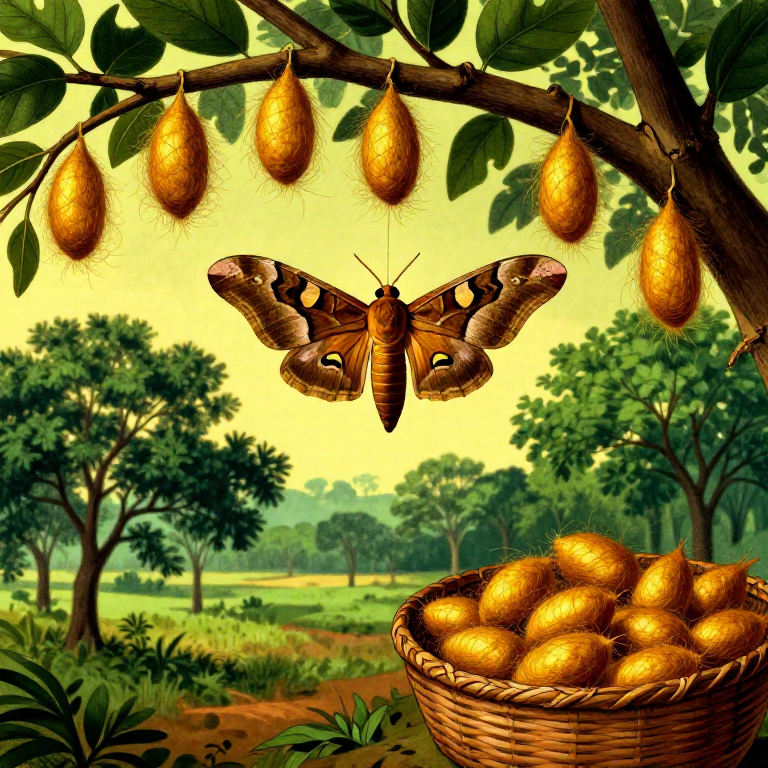
Complete guide to collecting tasar silk cocoons (Antheraea mylitta) from Asan and Arjun trees in the forests of Odisha. India is the world's largest tasar silk producer. Tasar silk is wild or semi-cultivated — unlike mulberry silk, it is not reared indoors. Covers host tree identification, seasonal timing, cocoon location, careful collection, pupa preservation, and grading.
Intermediate
4-6 hours per collection session
Instructions
1
1
Understanding the Tasar Silkworm
Understanding the Tasar Silkworm
The tasar silkworm (Antheraea mylitta) is a wild silkworm found in the warm, humid forests of India, belonging to the Saturniidae family. Unlike the mulberry silkworm (Bombyx mori), it is not domesticated — it lives and feeds on leaves of forest trees. Tasar silk is golden-brown in color with thicker, stronger thread than mulberry silk. India is the world's only major tasar producer — approximately 2,500 metric tons annually. Jharkhand, Chhattisgarh, Odisha, West Bengal, and Madhya Pradesh are the principal producing states.
2
2
Identifying Host Trees
Identifying Host Trees
Tasar silkworms are primarily reared on two types of trees: Asan (Terminalia tomentosa) and Arjun (Terminalia arjuna). Asan is common in Odisha's dry deciduous forests — it grows 20-30 meters tall with broad, rough leaves and dark brown cracked bark. Arjun grows along riverbanks and moist areas with whitish-green bark that peels in layers. Arjun-reared silkworms produce better quality silk. Mayurbhanj, Keonjhar, Sundargarh, Sambalpur, and Deogarh districts of Odisha are famous for tasar production.
Tools needed:
 Field Identification Guide (Indian Trees)
3
3
Determining the Season and Collection Time
Determining the Season and Collection Time
Tasar silk has two crops per year. First crop: July-September — larvae feed on new monsoon foliage and spin cocoons in 40-50 days. Second crop: October-December — cocoons mature during winter; these are generally larger and better quality. Wait 10-15 days after larvae finish spinning before collecting, allowing the pupa to form properly inside.
4
4
Preparing Collection Equipment
Preparing Collection Equipment
Prepare essential equipment for forest cocoon collection. Use bamboo ladders or long bamboo poles with hooks for reaching high branches. Use ventilated bamboo baskets (dali) — never plastic bags, which trap moisture and spoil cocoons. Wear tall boots and thick clothing for protection against snakes and insects in the forest.
Materials for this step:
 Bamboo Basket (ventilated)3 pieces
 Cotton Cloth Liner3 pieces
 Jute Twine10 meters
Tools needed:
 Bamboo Ladder (4 meter)
 Long Bamboo Pole with Hook
 Pruning Shears
Work Gloves
 Rubber Boots (knee-high)
5
5
Locating Cocoons on Trees
Locating Cocoons on Trees
Tasar cocoons hang among tree branches and leaves. The silkworm wraps one or two leaves with silk thread and spins its cocoon inside. These leaf-wrapped cocoons are firmly attached to branches by silk peduncles — they do not fall even in strong winds. Cocoons are typically 4-6 cm long and oval-shaped, golden-brown in color. More cocoons are found on middle and lower branches. Golden cocoons are most visible in morning sunlight.
Tools needed:
 Binoculars (8x magnification)
6
6
Identifying Live and Dead Cocoons
Identifying Live and Dead Cocoons
Identifying live versus dead cocoons during collection is crucial. Live cocoons contain a living pupa: slight movement felt when gently shaken, heavier weight, and no emergence hole. Dead cocoons have a dead pupa or the moth has already emerged: lightweight, dry, with an emergence hole visible. Live cocoons must be preserved for breeding. Dead or stifled cocoons are used for reeling (thread extraction).
7
7
Carefully Collecting Cocoons
Carefully Collecting Cocoons
Handle cocoons very carefully — pulling hard breaks the thread and reduces reeling quality. Use pruning shears to cut cocoons with a small branch piece (keeping the peduncle intact). Do not squeeze cocoons — the pupa inside can be damaged. For high branches, use bamboo pole hooks to bend branches down and cut with shears. Place collected cocoons in bamboo baskets immediately — arrange in a single layer, do not pile up.
Tools needed:
Pruning ShearsLong Bamboo Pole with HookBamboo Ladder (4 meter)Work Gloves
8
8
Separating Live Cocoons for Breeding
Separating Live Cocoons for Breeding
Select the best quality live cocoons for breeding — large, heavy, flawless shape — which improves the next generation's quality. Typically 20-30% of collected cocoons are kept for breeding. Store these in cool, shaded, well-ventilated areas on bamboo mats. When moths emerge, males and females mate and lay eggs — these are the foundation for the next crop.
Materials for this step:
 Bamboo Mat2 pieces
 Cotton Cloth Cover (mosquito net)2 pieces
Tools needed:
Bamboo Basket (ventilated)9
9
Stifling Cocoons for Reeling
Stifling Cocoons for Reeling
Cocoons selected for reeling must have the pupa killed — otherwise the moth will emerge and tear through the cocoon, breaking the thread. This is called stifling. The traditional Odisha method is sun drying for 2-3 days. Spread cocoons in a single layer on bamboo mats in direct sunlight. The pupa dies at temperatures above 60 degrees Celsius. Cover at night to prevent moisture absorption.
Materials for this step:
 Bamboo Mat (drying)4 pieces
 Cotton Sheet (night cover)2 pieces
10
10
Cocoon Quality Testing and Grading
Cocoon Quality Testing and Grading
Grade stifled cocoons by quality. Criteria: Size — large cocoons (4.5-6 cm) yield more thread. Color — bright golden is best, dark brown is lower quality. Shape — uniform oval is good, deformed shapes cause reeling problems. Shell ratio — shell (outer covering) weight should be 12-15% of total cocoon weight. Grade A: large, golden, well-shaped. Grade B: medium size, average color. Grade C: small, stained, or deformed.
Tools needed:
 Digital Weighing Scale (0.1g precision)
 Vernier Caliper
 Sorting Trays
11
11
Cocoon Storage and Warehousing
Cocoon Storage and Warehousing
Improper storage causes mold and insect attack. Storage rules: dry, cool, well-ventilated warehouse. Keep humidity below 65%. Store in jute bags on bamboo racks — never use plastic bags. Place dried neem leaves inside bags to repel Dermestes beetles — a traditional and effective method. Inspect cocoons weekly — isolate any showing mold or insect damage immediately.
Materials for this step:
 Jute Storage Bags10 pieces
 Neem Leaves (dried)2 kilogram
Tools needed:
 Bamboo Storage Rack
 Hygrometer
12
12
Record-Keeping and Sale Preparation
Record-Keeping and Sale Preparation
Record detailed data for each collection session: date, location, host tree type (Asan/Arjun), total cocoon count, grade-wise breakdown, live and dead counts. Odisha tasar cocoons are sold through Central Silk Board cocoon markets — mainly at Baripada (Mayurbhanj) and Bhubaneswar. Prices vary by quality — Grade A cocoons fetch 800-1,200 rupees per kg. Registering with the Directorate of Textiles, Odisha simplifies the sales process.
Materials for this step:
 Record-Keeping Notebook1 piece
Tools needed:
Digital Weighing Scale (0.1g precision)Materials
10- 3 piecesPlaceholder
- 3 piecesPlaceholder
- 10 metersPlaceholder
- 2 piecesPlaceholder
- Placeholder
- 4 piecesPlaceholder
- 2 piecesPlaceholder
- 10 piecesPlaceholder
- 2 kilogramPlaceholder
- 1 piecePlaceholder
Tools Required
13- Placeholder
- Placeholder
- Placeholder
- Placeholder
- Placeholder
- Placeholder
- Placeholder
- Placeholder
- Placeholder
- Placeholder
- Placeholder
CC0 Public Domain
This blueprint is released under CC0. You are free to copy, modify, distribute, and use this work for any purpose, without asking permission.
Support the Maker by purchasing products through their Blueprint where they earn a Maker Commission set by Vendors, or create a new iteration of this Blueprint and include it as a connection in your own Blueprint to share revenue.