
ART
BEAUTY & WELLNESS
CRAFT
CULTURE & HISTORY
ENTERTAINMENT
ENVIRONMENT
FOOD & DRINKS
GREEN FUTURE
REVERSE ENGINEERING
SCIENCES
SPORTS
TECHNOLOGY
WEARABLES
Camel Wool Combing — Preparing Bactrian Camel Down Fibre
English
Temuujinmonkey

Created by

Temuujinmonkey

23. April 2026MN
0
0
0
0
0

Camel Wool Combing — Preparing Bactrian Camel Down Fibre

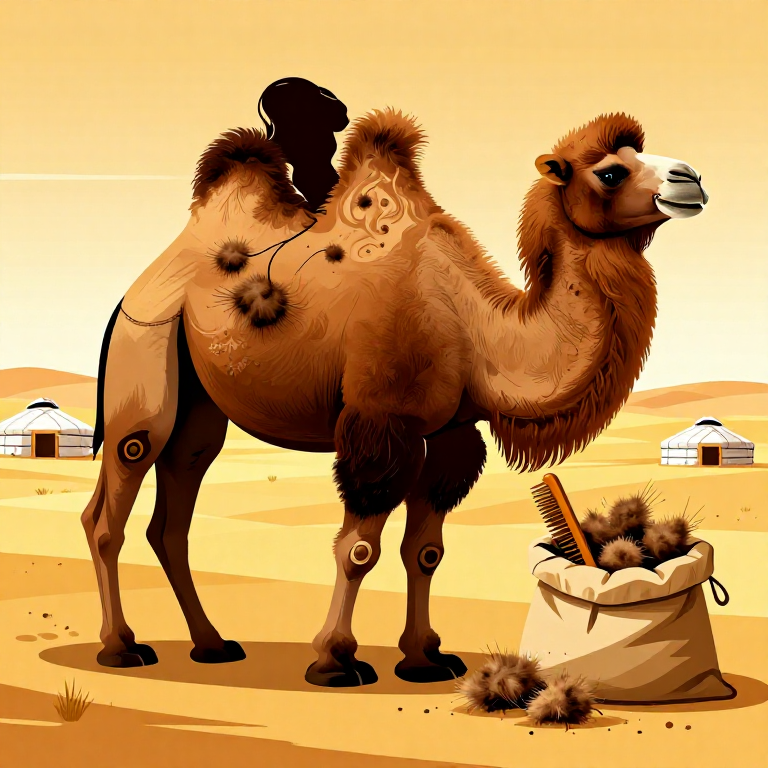
Detailed guide to combing and preparing Mongolian Bactrian camel (Camelus bactrianus) down fibre during the spring season (April–June). Mongolia has approximately 470,000 camels, most living in the Gobi region. Camel down fibre is fine (18–20 microns), warm, lightweight, and commands high prices on the global textile market.

Intermediate
2-3 цаг нэг тэмээнд

Instructions

1

Understanding Bactrian Camel Fiber

The Mongolian Bactrian camel (Camelus bactrianus) is a two-humped species adapted to Central Asia's cold climate. Its fiber has two layers: coarse outer guard hair (20-120 microns diameter, 15-40 cm long) and fine inner down (17-20 microns diameter, 3-12 cm long). The down is the most valuable part — as fine as cashmere but longer and more durable. One camel yields 3-5 kg raw fiber (down + guard hair) annually, of which 1.5-3.5 kg is pure down. Approximately 470,000 camels live in Mongolia's Gobi region.
2

Determining the Molting Time

Bactrian camels naturally shed their thick winter down every spring (early April to mid-June). Shedding starts from the head and neck, spreading to shoulders, sides, and back. Clumps of down hanging loosely from the body signal it is time to comb. Combing too early (March) leaves the camel unprotected against spring cold. Too late (July) means down is lost on the ground. Begin when daytime temperatures consistently exceed +10 degrees Celsius.
3

Preparing the Tools

Required tools: a large steel comb (15-20 cm wide) with round-tipped teeth spaced 2-3 mm apart — sharp tips will wound the camel's skin. Prepare 4-5 cloth bags to collect fiber separated by color (brown, light yellow, white, grey). Sharp scissors for cutting tangled fiber knots.

Materials for this step:

Cloth Collection Bags (per color)Cloth Collection Bags (per color)5 pieces

Tools needed:

Large Steel Comb (Round-Tipped, 2-3mm teeth spacing)Large Steel Comb (Round-Tipped, 2-3mm teeth spacing)
Sharp ScissorsSharp Scissors
4

Preparing the Camel

Before combing, keep the camel calm and stress-free. Bring it into an enclosure and let it rest for 30-60 minutes. A stressed camel may spit (a defensive behavior) and complicate the work. Remove large debris — dirt, straw, wild grass seeds, dried dung — by hand from the fiber. Do not comb a wet camel — wait one day after rain.

Tools needed:

Livestock PenLivestock Pen
5

Positioning the Camel

The camel is combed while sitting (kushed). Mongolian herders have the camel lie down and softly hobble the front and rear legs. Camels are very large animals (450-700 kg), so two people working together is safest. One person stays near the head to calm the camel while the other combs. Speaking gently and making steady movements calms the camel.

Materials for this step:

Soft Cotton Rope (for leg hobbling)Soft Cotton Rope (for leg hobbling)2 meters
6

Hand-Collecting Loose Fiber Clumps

Before combing, pull off loose shed clumps by hand from the neck, shoulders, sides, belly, and between humps. These clumps come off easily when pulled gently in the growth direction. Do not force — pulling hard causes pain. This method can collect 30-50% of the total fiber.
7

Combing Out the Down

Insert the comb into the fiber close to the skin (but not touching it). Pull in the direction of hair growth (top to bottom) with a gentle, steady speed. The comb catches the down while letting coarse guard hair pass through. Repeat 3-5 times per area. Camel skin is thicker than goat skin so slightly more pressure is acceptable, but avoid abrupt, fast movements. Be especially careful on thin-skinned areas (belly, inner thigh).

Tools needed:

Large Steel Comb (Round-Tipped, 2-3mm teeth spacing)Large Steel Comb (Round-Tipped, 2-3mm teeth spacing)
8

Combing All Body Parts in Sequence

Comb in this sequence: (1) Neck — finest, most abundant down, (2) Shoulders, (3) Sides, (4) Back, (5) Belly — comb gently, thin skin, (6) Upper legs, (7) Between humps. Do not comb head, lower legs, or tail — these have very little down and mostly coarse guard hair. A full combing takes 2-3 hours per camel.
9

Sorting Fiber by Color

Sort combed fiber into separate bags by natural color immediately. Bactrian camel fiber colors: brown (most common, approximately 70%), light yellow/sand (approximately 15%), white (rare, approximately 5%), dark brown (approximately 10%). White down is most valuable — easily dyed to any color. Brown down is used in its natural color. Mixed-color fiber loses value, so separating during combing is important.

Materials for this step:

Cloth Collection Bags (per color)Cloth Collection Bags (per color)4 pieces
10

Separating Down from Guard Hair

Combed fiber contains a mix of down and coarse guard hair. Perform preliminary hand separation: pull out coarse, straight, glossy guard hairs (20-120 microns, 15-40 cm long) one by one. Fine down is soft, curly, 3-12 cm long, and matte (not glossy). Complete separation is done later by industrial dehairing machines. Hand sorting can remove 60-70% of guard hair.

Tools needed:

Sorting TableSorting Table
11

Removing Debris and Contaminants

Remove grass, thorns, sand, dried dung, and matted clumps from the sorted down by hand. Work in a well-lit area on white cloth for better visibility of small debris. Matted clumps can be cut with scissors but avoid cutting good down along with them. In Gobi conditions, fine sand is common in camel fiber — this is removed in the subsequent washing step.

Tools needed:

Sorting TableSorting Table
Sharp ScissorsSharp Scissors
12

Washing the Down

Soak down in lukewarm water (35-40 degrees Celsius) for 20-30 minutes. Add pH 7-8 soap (such as castile soap), gently pressing to wash — do not wring, ball up, or scrub vigorously, as this will cause felting. Rinse 2-3 times in clean lukewarm water. Avoid sudden temperature changes — hot water (50+ degrees Celsius) or cold water (below 10 degrees Celsius) causes felting. Camel fiber has low lanolin content so it is easier to wash than goat fiber. After washing, down loses 15-20% of its weight (from dirt and oil removal).

Materials for this step:

Lukewarm Water (35-40C)Lukewarm Water (35-40C)20 liters
Castile SoapCastile Soap1 piece

Tools needed:

Large Washing BasinLarge Washing Basin
13

Drying the Down

Gently squeeze (do not wring) excess water from washed down. Spread in a thin layer on a clean towel or mesh drying screen in a cool, shaded, well-ventilated area. Do not dry in direct sunlight — UV rays degrade down quality and fade color. Drying takes 1-2 days depending on air humidity. Turn the down every 6-8 hours for even drying. Dried down should be soft, fluffy, and completely dry.

Tools needed:

Mesh Drying ScreenMesh Drying Screen
Clean Cotton ClothClean Cotton Cloth
14

Weighing, Packing, and Storing the Down

Weigh the dried down. One Bactrian camel yields 1.5-3.5 kg of clean down (varies by age, breed, and nutrition). Store down by color in separate breathable cotton bags — plastic bags trap moisture and cause mold. Attach labels noting weight, color, date, and camel number. Store in a dry (50-60% humidity), cool (15-20 degrees Celsius), well-ventilated area. Include cedar moth repellent balls. Mongolian camel down is valued at 15-40 USD per kg on the world market (depending on quality and fineness).

Materials for this step:

Breathable Cotton Storage BagBreathable Cotton Storage Bag4 pieces
Paper LabelsPaper Labels4 pieces
Cedar Moth Repellent BallsCedar Moth Repellent Balls4 pieces

Tools needed:

Kitchen ScaleKitchen Scale

Materials

7

Tools Required

8

CC0 Public Domain

This blueprint is released under CC0. You are free to copy, modify, distribute, and use this work for any purpose, without asking permission.

Support the Maker by purchasing products through their Blueprint where they earn a Maker Commission set by Vendors, or create a new iteration of this Blueprint and include it as a connection in your own Blueprint to share revenue.

Discussion

(0)

Log in to join the discussion

Loading comments...