
Lacquer tapping — Natural lacquer collection for Myanmar lacquerware
Step-by-step instructions for collecting lacquer (thitsi) from lacquer trees for Myanmar lacquerware production. The lacquer tree (Gluta usitata, formerly Melanorrhoea usitata) is a natural lacquer source in Myanmar, and the lacquerware tradition centered around Bagan has a history of over 1000 years.
This guide includes selecting appropriate time periods for tapping lacquer trees over 10 years old, tapping at night and early morning (lacquer flows better in cool temperatures), collecting with bowls, filtering the lacquer, and storing in airtight containers. Lacquer contains the chemical compound laccol, and contact with skin can cause severe itching, so special safety precautions are necessary.
Instructions
Understanding the thitsi (lacquer) tree
Understanding the thitsi (lacquer) tree
The thitsi tree (Gluta usitata, formerly Melanorrhoea usitata) belongs to the Anacardiaceae family and grows in Myanmar, Thailand, Laos, and Cambodia. The tree reaches 15-25 meters in height and thrives in tropical and subtropical forests. When the bark is scored, a black, viscous sap emerges — this is called thitsi (lacquer). This sap is the primary raw material for Myanmar''s lacquerware production. The lacquerware tradition centered in Bagan has a history spanning over 1,000 years.
Safety preparation
Safety preparation
Thitsi sap contains laccol (a catechol-derived chemical) which is related to urushiol and causes severe contact dermatitis (skin rash) in most people. Although chemically different from Japanese urushi (from Toxicodendron vernicifluum), the allergic reaction can be even more severe. You must wear long gloves (rubber or nitrile), long-sleeved clothing, long socks, boots, and goggles. If skin contact occurs, wash immediately with soap and water. Keep clean water and soap readily available in the vicinity during tapping.
Materials for this step:
 Bar Soap1 piece
Tools needed:
 Safety Goggles
 Long-Sleeved Work Shirt
 Rubber Boots
Select a suitable tree for tapping
Select a suitable tree for tapping
A thitsi tree must be at least 10 years old for tapping. Trees aged 15-25 years have the best sap yield. Select a healthy, vigorous tree with a trunk circumference of at least 30 cm. Choose a tree with bark color ranging from gray to brown and smooth bark. If there are scars from previous tapping on the bark, avoid those areas and select fresh bark. Do not tap diseased or unhealthy-looking trees.
Tools needed:
 Measuring Tape
Scraping Tool Preparation
Scraping Tool Preparation
Prepare the necessary tools required for scraping. A sharp scraping knife is needed — with blade length of 5-8 centimeters and a curved shape. Prepare 3-5 bamboo cups for collecting phlegm — the bamboo cup is installed on a stand and receives the phlegm. Use clay or string to attach the cup. Clean muslin cloth is also required for filtering.
Materials for this step:
 Bamboo Cups5 pieces
 Clay for Sealing500 gram
 Muslin Cloth1 meter
Tools needed:
 Curved Scraping Knife (5-8cm blade)
 Whetstone
Choose the tapping season
Choose the tapping season
Lacquer tapping should be done at night or very early morning (4-7 AM). Sap flows better at cooler temperatures and there is less evaporation. The post-monsoon period (October-December) is the best tapping season — the tree is fully hydrated and sap yield is highest. Avoid tapping under intense sunlight — the sap will dry too quickly.
Tools needed:
 Headlamp
Clean and prepare the bark
Clean and prepare the bark
Clean the bark area to be tapped in advance. Remove dirt, mold, and moss from the bark. Mark the tapping area at a height of 0.5-1.5 meters from the ground. Select a width of 30-50 cm around the trunk for tapping — only tap one half of the trunk circumference at a time. Leaving the other half intact keeps the tree alive.
Tools needed:
 Wire Brush
Make herringbone pattern cuts
Make herringbone pattern cuts
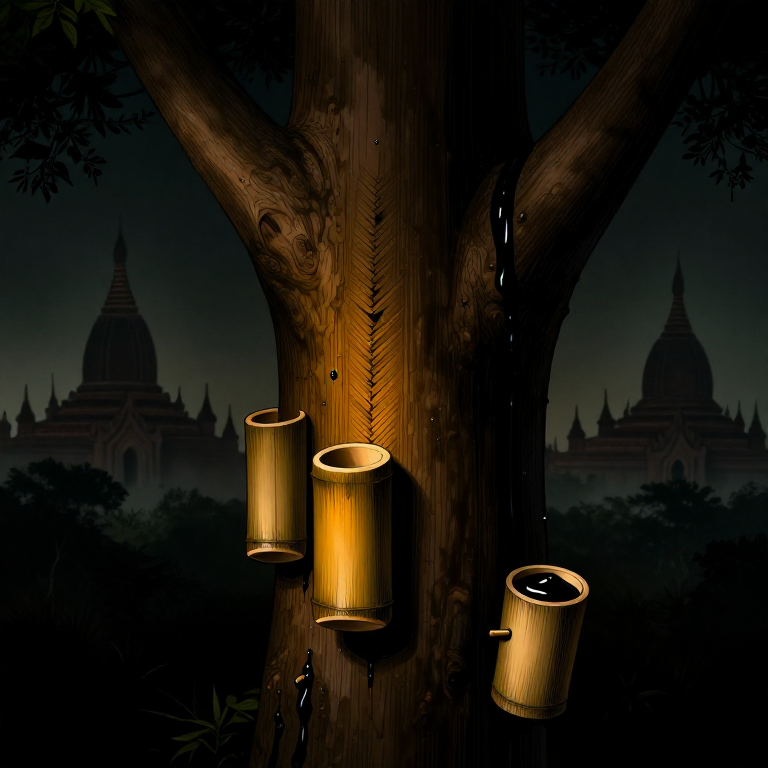
Using the tapping knife, score the bark in a herringbone pattern. First cut a vertical channel down the center, then make diagonal cuts branching left and right from it — at a 30-45 degree angle. The cut depth must be only 2-3 millimeters — cut through the bark only, not into the wood. Damaging the cambium layer beneath the bark will harm the tree. Space each cut 2-3 cm apart. The sap flows along the cuts and drips down into the bamboo cup below.
Tools needed:
Curved Scraping Knife (5-8cm blade)Collect sap with a bamboo cup
Collect sap with a bamboo cup
Attach the bamboo cup below the cuts using clay or rope. Position the top of the cup against the trunk to catch the flowing sap. The sap flows gradually overnight. A single tapping session yields 100-300 ml of sap per tree. Collect the cup in the morning — if left too long, sunlight will cause the sap to dry out.
Materials for this step:
Bamboo Cups5 pieces Hemp Cord3 meters
Filter the sap
Filter the sap
Filter the collected raw sap (raw thitsi) through muslin cloth. Remove bark fragments, dust, and insects. Filter quickly — exposure to air causes the sap to oxidize, changing from gray to black. After filtering, scrape any remaining sap from the bamboo cups using the tapping knife — do not waste any sap.
Materials for this step:
Muslin Cloth1 meterTools needed:
 Filtering Bowl
Check sap quality
Check sap quality
Good quality thitsi sap has a uniform black color, is dense and viscous. It should stretch into thread-like strands when pulled. The smell is strong and distinctive. Discard sap that is mixed with water or has mold. The chemical laccol polymerizes in a humid environment — this property makes lacquerware hard and durable. Unlike Japanese urushi, Myanmar thitsi contains laccol as the primary chemical, whereas Japanese lacquer contains urushiol.
Store in an airtight bamboo container
Store in an airtight bamboo container
Store the filtered sap in an airtight bamboo container or dark glass jar. Air exposure causes oxidation and dries the sap prematurely. Fill the container completely and seal the lid tightly — minimize the air space inside. Store in a cool, dark place. Properly stored raw sap can be used for several weeks.
Materials for this step:
 Airtight Bamboo Container2 pieces
Rest the tree
Rest the tree
For sustainable tapping, the tree must be rested after each season. The tapped bark regenerates within 2-3 years. Tap only one half of the trunk per season and the other half the following season. Using this rotation, a tree can be tapped for decades. Excessive tapping weakens the tree and can cause death. Maintain the thitsi resource by planting new seedlings.
First aid for skin contact
First aid for skin contact
If thitsi sap contacts the skin, wash immediately and thoroughly with soap and water. Use plenty of water and wash for at least 15 minutes. Urushiol-related chemicals penetrate the skin rapidly. Allergic reaction symptoms (redness, swelling, itching, blistering) can appear within 12-72 hours. Seek hospital treatment for severe reactions. If sap enters the eyes, flush immediately with water and seek emergency medical treatment. First-time tappers must work alongside experienced practitioners.
Materials for this step:
Bar Soap1 piece Distilled Water (1 Liter)5 liters
Tools needed:
 First Aid Kit
Basic preparation of sap for lacquerware
Basic preparation of sap for lacquerware
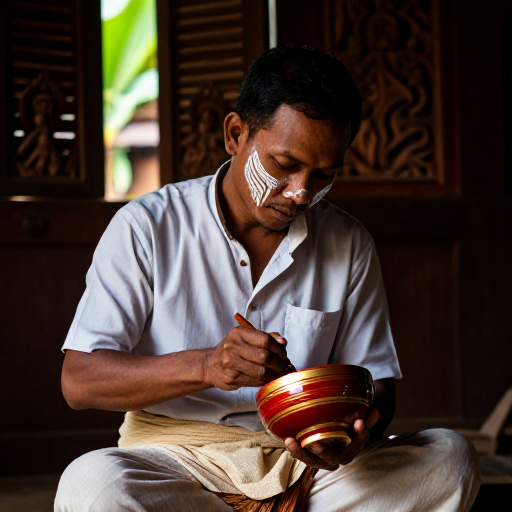
Raw sap (raw thitsi) requires further processing for use in lacquerware. Place the sap in an open cup and stir gently to evaporate moisture — this process is called making naya thitsi (cooked lacquer). In Myanmar lacquerware production, thitsi is applied in layers over a woven bamboo framework — each layer is cured in a humid environment (laccol polymerizes with moisture). Myanmar lacquerware (yun) is a durable and beautiful cultural heritage that is recognized worldwide.
Tools needed:
 Stirring Rod (wooden)
 Open Drying Tray
Materials
8- 10 piecesPlaceholder
- 500 gramPlaceholder
- 2 metersPlaceholder
- 2 piecesPlaceholder
- 5 litersPlaceholder
Tools Required
12- Placeholder
- Placeholder
- Placeholder
- Placeholder
- Placeholder
- Placeholder
- Placeholder
- Placeholder
- Placeholder
- Placeholder
- Placeholder
CC0 Public Domain
This blueprint is released under CC0. You are free to copy, modify, distribute, and use this work for any purpose, without asking permission.
Support the Maker by purchasing products through their Blueprint where they earn a Maker Commission set by Vendors, or create a new iteration of this Blueprint and include it as a connection in your own Blueprint to share revenue.