ART
BEAUTY & WELLNESS
CRAFT
CULTURE & HISTORY
ENTERTAINMENT
ENVIRONMENT
FOOD & DRINKS
REVERSE ENGINEERING
SCIENCES
SPORTS
TECHNOLOGY
WEARABLES
English

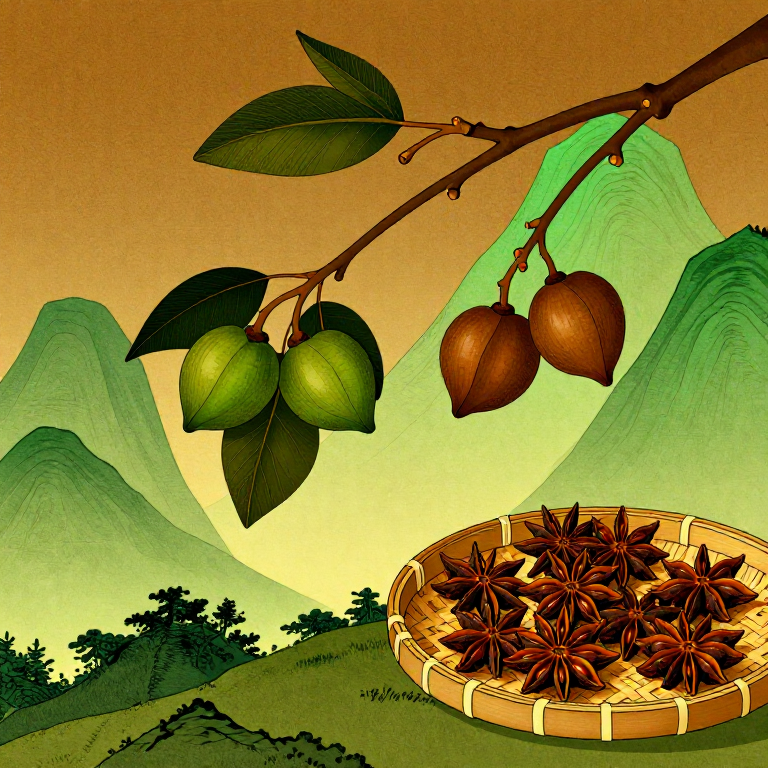
Star Anise Harvest in Lang Son — From Tree to Fragrant Star
Guide to harvesting star anise (Illicium verum) from the Lang Son region of northern Vietnam — the world's largest star anise producer. Covers tree assessment, picking with hooked poles, sun drying, and quality grading. Star anise trees live 80-100 years, bearing fruit from year 6-8, with main harvest in August-September.
Intermediate
5-7 days (harvesting + drying)
Instructions
1
1
Assessing the Star Anise Orchard Before Harvest
Assessing the Star Anise Orchard Before Harvest
Survey the star anise orchard 2-3 weeks before harvest. Star anise (Illicium verum) is an evergreen tree 8-15 meters tall with thick oval leaves. Ripe fruit transitions from green to yellow-green then light brown — typically August-September for the main crop and January-March for the secondary crop. When 70-80% of fruit has turned yellow-green or light brown, it is optimal harvest time. Ripe fruit has 8 carpels (sometimes 5-13), each containing a shiny brown seed. Essential oil content peaks at this stage, with approximately 85-90% anethole — the compound creating the characteristic aroma.
Tools needed:
 Field Notebook
 Pruning Shears
2
2
Preparing Harvesting Tools
Preparing Harvesting Tools
Prepare a harvesting pole — a 4-6 meter bamboo pole with a small curved iron hook (sickle-shaped) at the end, used to pull and break fruit-bearing branches. Check the joint between pole and hook is secure. Prepare bamboo baskets, jute sacks, binding rope, and ground tarpaulins to catch fallen fruit. Sharpen a machete for pruning small branches. Wear non-slip soled shoes as star anise orchards are typically on steep hillsides at 200-800 meters elevation.
Materials for this step:
 Woven Bamboo Basket3 pieces
Jute Sack10 pieces
 Ground Tarpaulin (4m x 4m)2 pieces
Tools needed:
 Bamboo Harvesting Pole with Iron Hook (4-6m)
 Machete
 Non-slip Work Boots
3
3
Harvesting Star Anise with the Pole Hook
Harvesting Star Anise with the Pole Hook
Spread a tarpaulin under the tree to catch falling fruit. Standing firmly on the ground, use the bamboo pole to hook small fruit-bearing branches. Pull firmly and decisively to snap them — avoid jerking which can break larger branches and affect the next crop. A mature tree (15-20 years) yields about 20-40 kg of fresh fruit per harvest. Trees over 50 years can yield 50-60 kg. Work from lower to higher branches, moving the tarpaulin accordingly. Leave about 10-15% of fruit on the tree to maintain tree health.
Tools needed:
Bamboo Harvesting Pole with Iron Hook (4-6m)Work Gloves (Cotton)
4
4
Gathering and Transporting Fresh Star Anise
Gathering and Transporting Fresh Star Anise
Collect fruit from the tarpaulin into bamboo baskets, removing leaves, branch debris, and insects. Fresh star anise is green to light brown, soft, and moisture-rich. Load gently into baskets without compressing — bruising reduces essential oil quality. Transport from the hillside orchard to the drying area (usually a brick or cement courtyard at home) by shoulder yoke or motorbike. Fresh star anise must be processed within 24 hours to prevent fermentation and oil loss.
Materials for this step:
Woven Bamboo Basket5 piecesTools needed:
 Carrying Pole (Shoulder Yoke)
Work Gloves (Cotton)
5
5
Separating Fruit from Branches and Leaves
Separating Fruit from Branches and Leaves
Sit on the drying yard and separate each star anise fruit from branches and stems by hand. Remove leaves, small branches, and any fruit damaged by pests or rot. Good star anise fruit has 8 even carpels, each 1-2 cm long and boat-shaped. Misshapen fruit, missing carpels, or fruit with black fungal spots are sorted separately — still usable for essential oil distillation but not meeting whole-star grade for sale. Branches and leaves also contain essential oil (lower content than fruit) and can be kept for separate distillation.
Tools needed:
 Bamboo Sorting Tray
Work Gloves (Cotton)
6
6
Blanching in Boiling Water to Fix Color
Blanching in Boiling Water to Fix Color
Boil water in a large pot. Dip fresh star anise into boiling water for 2-3 minutes — this is blanching. It fixes the attractive reddish-brown color of the finished product, kills insects and eggs inside the carpels, and helps carpels open more evenly during drying. Do not blanch longer than 5 minutes — essential oil will evaporate with the steam. Scoop out with a bamboo strainer and drain before drying. Blanching water can be reused for subsequent batches on the same day.
Materials for this step:
 Firewood15 kg
Water for Blanching100 liters
Tools needed:
 Large Cast Iron Cauldron (100L)
 Bamboo Strainer Basket
 Long-handled Ladle
7
7
Sun Drying Outdoors
Sun Drying Outdoors
Spread blanched star anise on the drying yard in a thin even layer, approximately 3-5 cm thick. The ideal drying yard is clean brick or cement, open to wind, and receiving direct sunlight. Use a bamboo rake to turn the fruit 3-4 times daily for even drying. Dry continuously for 3-5 sunny days until fully dried — moisture drops from approximately 60-70% to 12-13%. Properly dried star anise snaps crisply when a carpel is broken, turns dark reddish-brown, and the seeds inside are hard and shiny. At night or during rain, pile the fruit together and cover tightly with a tarpaulin.
Materials for this step:
Ground Tarpaulin (4m x 4m)4 piecesTools needed:
 Bamboo Rake
 Moisture Meter
8
8
Checking for Proper Dryness
Checking for Proper Dryness
After 3-5 days, check dryness. Use a moisture meter — star anise meets standard at 12-13% moisture. Without a meter, test by hand: break a carpel — if it snaps crisply with a clear cracking sound, it is dry enough. If it bends without breaking, more drying is needed. Over-dried (below 10%) star anise becomes too brittle and crumbles during transport. Smell it — properly dried star anise has a rich, sweet, concentrated aroma with no musty or sour odor. Weight after drying decreases approximately 60-70% from fresh weight.
Tools needed:
Moisture Meter9
9
Grading by Quality
Grading by Quality
Grade dried star anise by quality. Grade 1 (whole star): intact 8-carpel fruit, thick carpels, even reddish-brown color, no breakage, no pest damage — highest commercial value for spice and pharmaceutical use. Grade 2 (broken carpels): 1-3 carpels broken but still good — used for industrial food processing. Grade 3 (fragments): broken carpel fragments, misshapen fruit — used for essential oil distillation. Loose seeds (separated during drying) are collected separately — they contain less essential oil than carpel shells but still have value. Each kg of whole star anise contains approximately 80-120 fruits depending on size.
Tools needed:
Bamboo Sorting Tray Digital Kitchen Scale
10
10
Removing Impurities and Low-Quality Fruit
Removing Impurities and Low-Quality Fruit
Carefully screen each graded batch. Remove: branch debris, dried leaves, stones, moldy star anise (white or green spots), and pest-damaged fruit (small holes in carpels). Critically, distinguish real star anise (Illicium verum) from toxic Japanese star anise (Illicium anisatum) — the latter is extremely dangerous if mixed in. Real star anise has even carpels with slightly upturned tips and a sweet aroma. Toxic star anise has thinner carpels with pointed hooked tips and an acrid unpleasant smell. In Lang Son province, toxic star anise does not grow naturally, but imported stock from other sources requires careful inspection.
Tools needed:
 Bamboo Sieve (Fine Mesh)
 Magnifying Glass
11
11
Packaging and Storage
Packaging and Storage
Package dried star anise in jute or PP woven sacks, 30-50 kg per bag for wholesale. Whole star retail is packaged in sealed PE bags of 100g-1kg. Seal bags tightly and label clearly: star anise type, weight, harvest date, production region. Store in a dry, cool warehouse below 30 degrees Celsius, away from direct sunlight. Place bags on wooden pallets at least 15 cm off the floor and 30 cm from walls to avoid moisture. Properly stored dried star anise maintains quality for 2-3 years, but essential oil content gradually decreases — best used within the first year.
Materials for this step:
 PP Woven Sack (50kg capacity)20 pieces
 PE Plastic Bag (1kg, resealable)50 pieces
 Wooden Pallet4 pieces
Tools needed:
 Bag Sealer Machine
 Platform Scale (100kg)
12
12
Post-Harvest Tree Care
Post-Harvest Tree Care
After harvesting, prune dead, diseased, and crowded branches with a hand saw or machete. Make clean cuts close to the trunk to help the tree heal quickly. Clear fallen branches and leaves around the base to reduce pest habitat. Apply organic fertilizer (composted cattle manure) around the base, approximately 10-15 kg per mature tree, spread evenly within the canopy drip line and covered with thin soil. Star anise trees need 2-3 years to fully recover after each heavy harvest — so many Lang Son farmers alternate heavy and light harvest years to maintain long-term tree health. A healthy star anise tree can produce continuously for 80-100 years.
Materials for this step:
 Composted Cattle Manure15 kg
Tools needed:
 Hand SawMachete
 Garden Spade
Materials
9- 8 piecesPlaceholder
- 6 piecesPlaceholder
- 20 piecesPlaceholder
- 50 piecesPlaceholder
- 4 piecesPlaceholder
- Placeholder
Tools Required
20- Placeholder
- Placeholder
- Placeholder
- Placeholder
- Placeholder
- Placeholder
- Placeholder
- Placeholder
- Placeholder
- Placeholder
- Placeholder
- Placeholder
- Placeholder
- Placeholder
- Placeholder
- Placeholder
CC0 Public Domain
This blueprint is released under CC0. You are free to copy, modify, distribute, and use this work for any purpose, without asking permission.
Support the Maker by purchasing products through their Blueprint where they earn a Maker Commission set by Vendors, or create a new iteration of this Blueprint and include it as a connection in your own Blueprint to share revenue.