
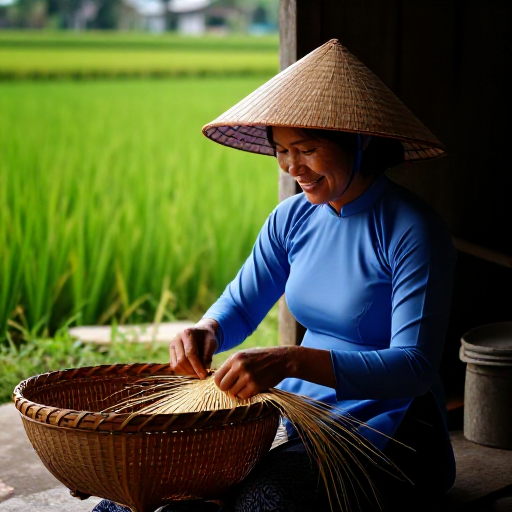

Bamboo harvesting in Vietnam — From variety selection to processing and preservation
Instructions
Learn about Vietnamese bamboo
Learn about Vietnamese bamboo
Bamboo belongs to the grass family (Poaceae), subfamily Bambusoideae. Vietnam has over 200 bamboo species, the most common being tre gia (Bambusa bambos), luong (Dendrocalamus barbatus), nua (Neohouzeaua dullooa), may (Bambusa nutans), and truc (Phyllostachys). Bamboo is a giant grass that can reach 20-30 m in height with a trunk diameter of 8-15 cm. Bamboo grows from underground rhizomes and produces new shoots each year.
Choose bamboo species suitable for the purpose of use
Choose bamboo species suitable for the purpose of use
Each type of bamboo has different characteristics. Bambusa bambos is hard and thick, suitable for construction and making interior furniture. Dendrocalamus barbatus has a large stem, used for house posts, partitions. Phyllostachys is slender, flexible, suitable for making handicrafts, bright, clear. Neohouzeaua is small, flexible, used for mats, baskets. Determine the purpose before harvesting to choose the right type.
Identify mature bamboo
Identify mature bamboo
Mature bamboo (3-5 years old) is best for harvesting. Identification signs: the trunk skin is dark green or yellowish green, the white silica powder coating on the outside has faded, the cross-section is hard and dense, and leaves are smaller and fewer than young bamboo. Bamboo 1-2 years old is bright green, soft-stemmed, with full foliage — it should not be harvested. Bamboo over 6 years old begins to decay from the inside.
Choose harvest time
Choose harvest time
Harvest bamboo shoots in the dry season (October-February in the North, December-April in the South) when water content and starch levels in the shoots are lowest. Bamboo shoots harvested in the rainy season contain a lot of water and sugar, making them susceptible to insects and mold. According to tradition, Vietnamese farmers harvest bamboo shoots on the last days of the waning moon, when shoots have the least sap. Scientific research confirms that starch content decreases in the dry season.
Prepare the tools
Prepare the tools
Prepare a sharp machete or hand saw. The traditional Vietnamese machete (dao rua) is the ideal tool — a heavy, sharp blade that can cut a bamboo trunk in a single stroke. Also bring rope or a cart for transportation. Wear protective gloves because bamboo bark contains silica, which easily causes scratches and infections.
Tools needed:
 Machete
 Hand Saw
 Work Gloves
 Rope (5m)
Staking technique
Staking technique
Stake at a position on the upper surface of the first mound, 15-30 cm above ground level. Stake at a 45-degree angle so rainwater does not accumulate in the remaining corner (causing corner rot). Do not stake close to the ground as it will cause root rot and damage the root system below. When the tree begins to lean, gently push it back with your hand toward the side without people. Trees grow very quickly and heavily — always keep them on the safe side.
Tools needed:
Machete Safety Helmet
Remove branches and leaves
Remove branches and leaves
Tools needed:
Cut to the desired dimensions
Cut to the desired dimensions
Tools needed:
Hand Saw Measuring Tape
Treat by water soaking method
Treat by water soaking method
Materials for this step:
Tools needed:
 Weights (stones)
Alternative method: smoke treatment
Alternative method: smoke treatment
Materials for this step:
 Dry Firewood20 kilogram
Tools needed:
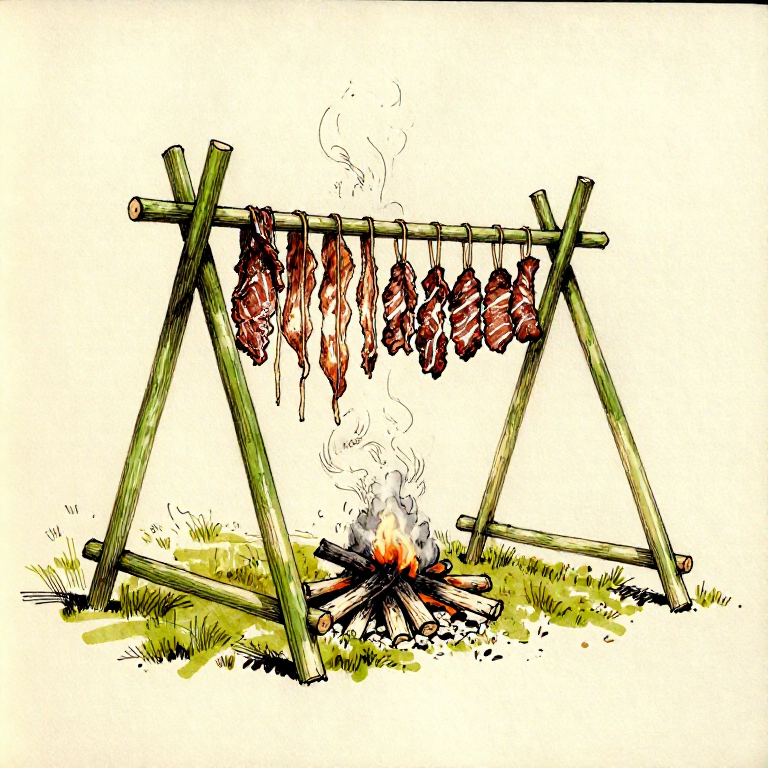 Smoking Rack
Air-dry the bamboo
Air-dry the bamboo
Tools needed:
 Drying Rack
Check the quality of dried bamboo
Check the quality of dried bamboo
Store the finished bamboo
Store the finished bamboo
Materials for this step:
 Wooden Pallets2 pieces
Tools needed:
 Storage Rack
Materials
3- 20 kilogramPlaceholder
- 2 piecesPlaceholder
Tools Required
11- Placeholder
- Placeholder
- Placeholder
- Placeholder
- Placeholder
CC0 Public Domain
This blueprint is released under CC0. You are free to copy, modify, distribute, and use this work for any purpose, without asking permission.
Support the Maker by purchasing products through their Blueprint where they earn a Maker Commission set by Vendors, or create a new iteration of this Blueprint and include it as a connection in your own Blueprint to share revenue.