
ART
BEAUTY & WELLNESS
CRAFT
CULTURE & HISTORY
ENTERTAINMENT
ENVIRONMENT
FOOD & DRINKS
GREEN FUTURE
REVERSE ENGINEERING
SCIENCES
SPORTS
TECHNOLOGY
WEARABLES
Lacquer Tapping — Traditional Technique for Harvesting Natural Lacquer from Toxicodendron vernicifluum
English
HanaChan

Created by

HanaChan

23. April 2026JP
1
0
0
0
0

Lacquer Tapping — Traditional Technique for Harvesting Natural Lacquer from Toxicodendron vernicifluum

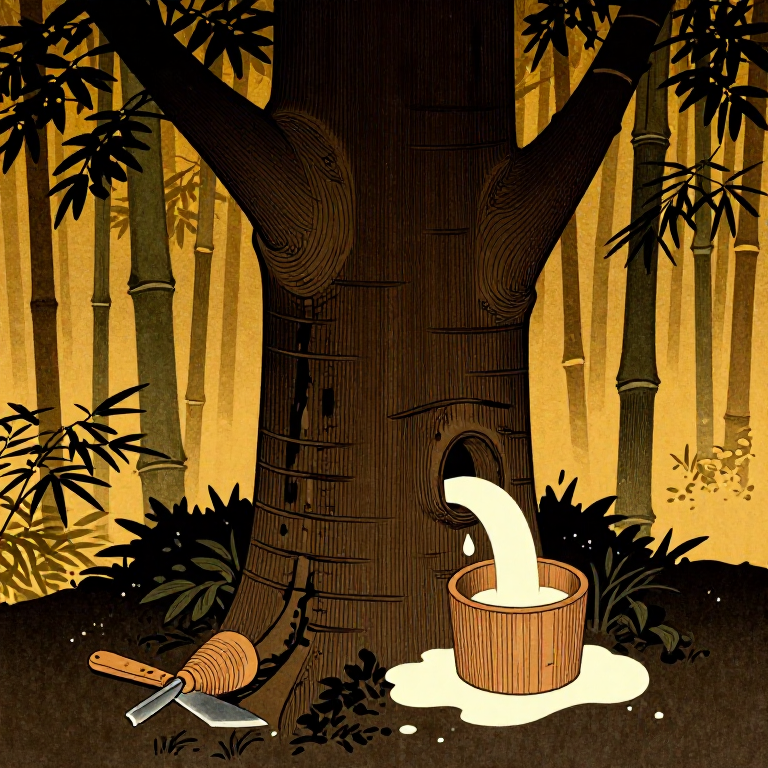
An explanation of the lacquer harvesting technique that forms the foundation of Japanese traditional craftsmanship. "Lacquer tapping" (漆掻き), the process of extracting lacquer sap from Toxicodendron vernicifluum, is a technology with over 9,000 years of history. This covers the entire process from the harvesting season (June through October), the method of cutting horizontal grooves, collection of lacquer sap, filtration, and grading. Only approximately 200ml of this precious natural resin can be obtained from a single tree per season. Since urushiol contained in lacquer sap causes contact dermatitis, protective measures are essential.

Advanced
6-8 hours

Instructions

1

Understanding the Lacquer Tree (Urushi no Ki)

The lacquer tree (Toxicodendron vernicifluum) is a deciduous tree of the Anacardiaceae family, growing 10-20 meters tall. It originated in southern China and the Himalayan region, arriving in Japan during the Jomon period (approximately 9,000 years ago). Its bark is grayish-white and smooth but develops shallow longitudinal fissures with age. Leaves are odd-pinnate compound, with 7-15 leaflets. Lacquer sap is stored in lactiferous cells beneath the bark, composed of urushiol (60-65%), water (20-25%), gum (5-7%), nitrogenous compounds (2-5%), and laccase enzyme (approximately 1%). Urushiol polymerizes through oxidation and laccase enzyme action to form an extremely durable coating.
2

Selecting Suitable Lacquer Trees

Trees suitable for tapping have a trunk diameter of at least 15 cm (breast-height circumference approximately 47 cm or more) and are optimally 10-15 years old. Select trees with straight trunks and bark free of damage or disease. Healthy lacquer tree bark is grayish-white with resilience when lightly pressed. South-facing slope trees with good sunlight tend to produce more sap. Japan's main lacquer-producing areas are Joboji district in Iwate Prefecture (producing approximately 75% of domestic lacquer), Daigo in Ibaraki Prefecture, and Nikko in Tochigi Prefecture.

Tools needed:

Measuring Tape 3mMeasuring Tape 3m
Marking ChalkMarking Chalk
3

Safety Precautions for Lacquer Tapping

Urushiol causes severe allergic contact dermatitis (urushi rash), similar to poison ivy, with intense itching, redness, and blisters that can spread systemically in severe cases. Cover all exposed skin: long sleeves and pants with cuffs tied. Wear double thick rubber gloves with wrists sealed by tape. Protect eyes with safety goggles and cover the forehead with a towel. Wash immediately with soap and cold water after work. Wash lacquer-contaminated clothing separately.

Materials for this step:

Long-Sleeve Cotton Work ShirtLong-Sleeve Cotton Work Shirt1 piece
Long Cotton Work PantsLong Cotton Work Pants1 piece
Nitrile Rubber Gloves (Thick)Nitrile Rubber Gloves (Thick)4 pieces
Adhesive Sealing TapeAdhesive Sealing Tape1 roll
Safety GogglesSafety Goggles1 piece
Cotton Face TowelCotton Face Towel2 pieces
4

Preparing Lacquer Tapping Tools

Lacquer tapping uses three specialized blade tools: The bark-stripping plane (kawahagi kanna) has a flat 3 cm blade for thinly shaving outer bark. The scraping plane (kaki kanna) has a U-shaped curved tip cutting grooves approximately 4 mm wide and 1.5 mm deep. The bamboo spatula (hera) is a thin bamboo scraper with a rounded tip for collecting sap from grooves. The collection cup (urushi oke) is a small wooden cylinder holding 50-100 ml. All tools are wiped with rapeseed oil before and after use to prevent lacquer adhesion.

Materials for this step:

Rapeseed OilRapeseed Oil200 milliliter
Cotton Cleaning ClothCotton Cleaning Cloth3 pieces

Tools needed:

Bark Stripping Plane (Kawahagi Kanna)Bark Stripping Plane (Kawahagi Kanna)
Lacquer Scraping Plane (Kaki Kanna)Lacquer Scraping Plane (Kaki Kanna)
Bamboo Scraping Spatula (Hera)Bamboo Scraping Spatula (Hera)
Wooden Lacquer Collection Cup (Urushi Oke)Wooden Lacquer Collection Cup (Urushi Oke)
Whetstone 1000 GritWhetstone 1000 Grit
5

Understanding the Tapping Season and Schedule

Tapping runs from June to October, with quality varying by period. Hatsuhen (mid-June to early July): the first tapping; sap is watery and milky white, called arami urushi. Sakarihen (mid-July to late August): the highest quality sap period; at 25-30 degrees Celsius and 70%+ humidity, secretion is maximum. This sap (sakari urushi) has highest transparency and is the premium grade. Osohen (September to early October): sap volume decreases. Urame-gaki (mid to late October): the final harvest; in the koroshi-gaki (kill-tapping) method, bark is stripped extensively for the last sap before felling the tree the following year.
6

Shaving the Outer Bark (Medate)

The first operation is medate (marking). Using the bark-stripping plane, thinly shave the outer bark (cork layer) from the planned tapping area — an elliptical section approximately 10 cm wide and 5 cm high. Shave only the outer bark; do not damage the green inner bark (phloem). Stop when the inner bark becomes visible. The shaved surface must be smooth. Medate is performed 3-4 days before actual tapping, allowing a thin film to form on the inner bark surface that helps retain sap in the groove. On one tree, 4-6 medate panels are set along one side from 50 cm to 2 meters height.

Tools needed:

Bark Stripping Plane (Kawahagi Kanna)Bark Stripping Plane (Kawahagi Kanna)
Small Hand BrushSmall Hand Brush
7

Cutting Horizontal Grooves (Urushi-kaki)

Three to four days after medate, perform the main tapping. Using the scraping plane, cut a horizontal groove into the exposed inner bark — slightly angled upward, approximately 4-5 cm long, 1-1.5 mm deep, and 3-4 mm wide. Within seconds, milky white lacquer sap seeps out. The groove must cross the lactiferous cells horizontally — cutting vertically follows the channels and is inefficient. One groove per medate panel per tapping session. The next tapping (usually 4-5 days later) cuts a new groove approximately 5 mm above the previous one. Over one season, 8-10 grooves form a staircase pattern on each panel.

Tools needed:

Lacquer Scraping Plane (Kaki Kanna)Lacquer Scraping Plane (Kaki Kanna)
8

Collecting the Seeped Lacquer Sap

Wait 15-30 minutes after cutting the groove for sap to accumulate. Using the bamboo spatula, carefully scrape collected sap from the groove and transfer it to the collection cup. Lacquer sap begins oxidative polymerization upon air exposure, so it must be promptly transferred to sealed containers. One groove yields only 0.5-1.5 ml. One tree per session yields approximately 5-15 ml from all grooves combined. Over a full season (approximately 20 tappings), one tree yields about 150-200 ml. Early morning (5-8 AM) is optimal — high humidity and cool temperatures stimulate sap secretion.

Tools needed:

Bamboo Scraping Spatula (Hera)Bamboo Scraping Spatula (Hera)
Wooden Lacquer Collection Cup (Urushi Oke)Wooden Lacquer Collection Cup (Urushi Oke)
9

Transferring and Storing Collected Sap

Transfer collected sap from the collection cup to sealed storage containers the same day. Traditionally wooden lacquer barrels were used; today polyethylene airtight containers are also used. Scrape residual sap from cup walls with the bamboo spatula. Store away from light and air with the lid tightly closed, in a dark place. Optimal storage temperature is 15-25 degrees Celsius — extreme heat or cold damages lacquer quality. Record the collection date, tree number, weather, and temperature for later quality management. Raw lacquer (ki-urushi) can maintain quality for several years when properly stored.

Materials for this step:

Polyethylene Airtight Storage Container 500mlPolyethylene Airtight Storage Container 500ml2 pieces
Record NotebookRecord Notebook1 piece

Tools needed:

Bamboo Scraping Spatula (Hera)Bamboo Scraping Spatula (Hera)
10

Filtering the Raw Lacquer (Urushi-koshi)

Raw lacquer contains bark fragments, wood chips, and insect debris. These are removed through filtering (urushi-koshi) using ultra-thin Japanese paper called Yoshino paper. Fold the Yoshino paper in half, spread on a filtering board, place a small amount of raw lacquer on top, and press it through with the palm. Always wear rubber gloves. Different paper grades are used depending on lacquer viscosity: thick paper for rough filtering, ultra-thin for final filtering. Filtered lacquer is called ki-shomi-urushi, with basic coating quality assured at this stage.

Materials for this step:

Yoshino Filtering Paper (Thick Grade)Yoshino Filtering Paper (Thick Grade)10 sheets
Yoshino Filtering Paper (Fine Grade)Yoshino Filtering Paper (Fine Grade)10 sheets

Tools needed:

Filtering Board (Koshidai)Filtering Board (Koshidai)
Nitrile Rubber Gloves (Thick)Nitrile Rubber Gloves (Thick)
Polyethylene Airtight Storage Container 500mlPolyethylene Airtight Storage Container 500ml
11

Stirring to Homogenize (Nayashi)

Filtered lacquer is homogenized through a stirring process called nayashi. Pour raw lacquer into a shallow wooden bowl (urushi bachi) and stir slowly in one direction with a wooden spatula. This distributes moisture uniformly and stabilizes the urushiol-gum mixture. Stirring is done slowly over 2-3 hours — never rush. Keep the spatula submerged in the lacquer to avoid introducing air bubbles. Nayashi increases the lacquer's transparency and produces a more beautiful finish. Room temperature should be 20-25 degrees Celsius with 65-75% humidity.

Tools needed:

Shallow Wooden Lacquer Bowl (Urushi Bachi)Shallow Wooden Lacquer Bowl (Urushi Bachi)
Wooden Mixing SpatulaWooden Mixing Spatula
HygrometerHygrometer
Room ThermometerRoom Thermometer
12

Determining the Lacquer Grade

Lacquer is graded by collection period and quality. The highest grade is sakari urushi from the sakarihen period — high transparency, curing to a deep amber color, used for maki-e and chinkin high-art lacquerwork. Hatsuhen lacquer is watery and milky, used for undercoats and middle coats. Urame lacquer from the final harvest is dark brown with high viscosity, used as adhesive and base hardener. Quality is judged by thinly applying lacquer to a glass plate and evaluating the cured film's transparency, color, hardness, and luster. Curing requires 20-25 degrees Celsius and 70-85% humidity (in a humidity-controlled box called urushi buro) for 24-48 hours. Uniquely among coatings, lacquer cures faster in higher humidity.

Materials for this step:

Glass Test PlateGlass Test Plate5 pieces

Tools needed:

Lacquer Curing Box (Urushi Buro)Lacquer Curing Box (Urushi Buro)
HygrometerHygrometer
Room ThermometerRoom Thermometer
Lacquer Grading Reference ChartLacquer Grading Reference Chart
13

Tool Maintenance and Storage

After all tapping work is complete, thoroughly maintain the tools. Wipe scraping and stripping plane blades with rapeseed oil-soaked cloth to prevent lacquer adhesion. Sharpen dulled blades on a whetstone. Soak the bamboo spatula in rapeseed oil to prevent cracking from drying. Wipe the collection cup interior with rapeseed oil. Dispose of contaminated gloves and tape as general waste — never incinerate (urushiol vapor is harmful to the respiratory system). Hand-wash work clothes with soap and water, confirming lacquer is fully removed before mixing with other laundry. Store all tools away from direct sunlight and high temperatures in a well-ventilated place.

Materials for this step:

Rapeseed OilRapeseed Oil100 milliliter
Cotton Cleaning ClothCotton Cleaning Cloth3 pieces

Tools needed:

Whetstone 1000 GritWhetstone 1000 Grit

Materials

13

CC0 Public Domain

This blueprint is released under CC0. You are free to copy, modify, distribute, and use this work for any purpose, without asking permission.

Support the Maker by purchasing products through their Blueprint where they earn a Maker Commission set by Vendors, or create a new iteration of this Blueprint and include it as a connection in your own Blueprint to share revenue.

Discussion

(0)

Log in to join the discussion

Loading comments...