ART
BEAUTY & WELLNESS
CRAFT
CULTURE & HISTORY
ENTERTAINMENT
ENVIRONMENT
FOOD & DRINKS
REVERSE ENGINEERING
SCIENCES
SPORTS
TECHNOLOGY
WEARABLES
English

Collecting Baltic Amber — From Beach to Collection
Complete guide to collecting Baltic amber on the Polish coast of the Baltic Sea. Amber is fossilized resin from coniferous trees (mainly Pinus succinifera) from 35-55 million years ago, the Eocene epoch. Poland, especially Gdansk and the Bay of Gdansk coast, is famous for rich amber deposits. Covers beach identification, distinguishing from imitations, basic cleaning and sorting.
Beginner
3-5 hours
Instructions
1
1
Understanding What Amber Is
Understanding What Amber Is
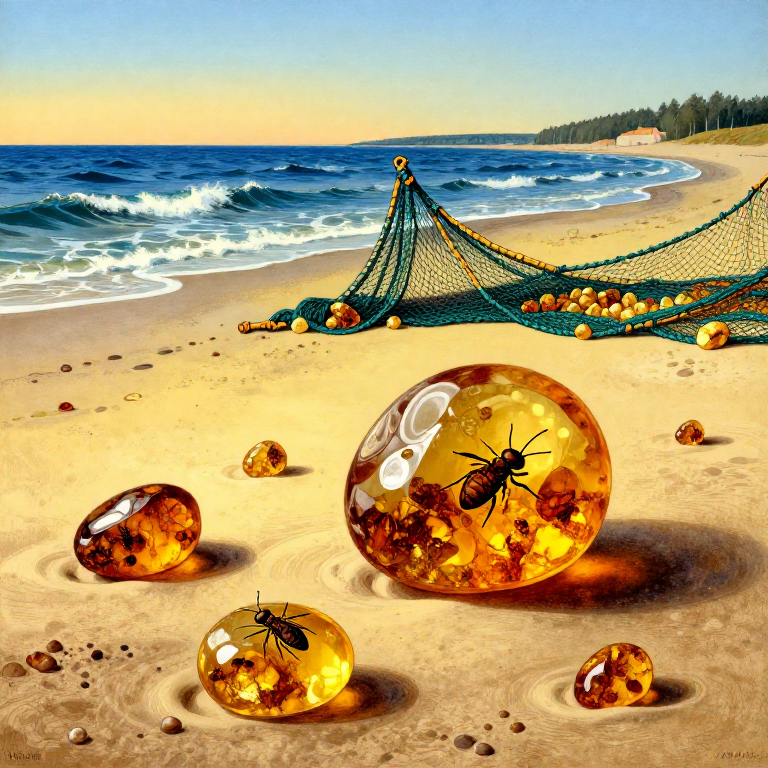
Baltic amber (succinite) is fossilized resin from coniferous trees of the Pinus succinifera species that grew in present-day Scandinavia 35-55 million years ago (Eocene epoch). The resin flowed down trunks, trapping insects and vegetation, then fossilized on the sea floor. Baltic amber is distinguished by its high succinic acid content (3-8%), differentiating it from fossil resins of other world regions. Amber density is 1.05-1.09 g/cm3 — slightly more than seawater (1.025 g/cm3), which is why storms wash it ashore.
2
2
Choosing the Right Time
Choosing the Right Time
The best time to collect amber is autumn and winter (October-March), after strong storms with north or northeast winds. Storms dislodge amber from the sea floor and cast it onto beaches along with seaweed and wood. Best to search 1-2 days after the storm subsides, when the sea has calmed but the washed-up material still lies on the beach. Early morning before dawn is the best time — less competition from other searchers.
3
3
Preparing the Search Equipment
Preparing the Search Equipment
You will need: warm waterproof clothing (Baltic wind is biting), wellington boots or waders, a flashlight with strong light (amber fluoresces under UV light), a small bag or container for finds, and a stick for raking through seaweed. In winter, Baltic air temperature drops to -5 to -10 degrees Celsius, making proper clothing essential.
Tools needed:
 Waterproof Boots (Wellington)
 UV Flashlight (365nm)
 Collection Bag (Cotton)
 Walking Stick for Seaweed
4
4
Knowing Where to Search on the Beach
Knowing Where to Search on the Beach
Amber collects in wrack lines (seaweed and debris lines on the beach) where the sea deposits organic material. Search in strips of dark seaweed, among wood fragments and shells. Best Polish coast locations: Stogi and Sobieszewo near Gdansk, Jantar, Hel, Wladyslawowo, Debki, and Kolobrzeg. Amber often lies among wood pieces and seaweed of similar color — look carefully.
5
5
Visually Identifying Amber
Visually Identifying Amber
Raw Baltic amber comes in various forms and colors: from light honey and yellow, through orange, to dark brown. It is often covered with a matte weathered layer (cortex). Shape is irregular — droplet-shaped, flattened, or lumpy. Beach sizes are typically 1-5 cm, though larger pieces occur. Amber feels light in the hand (density approximately 1.06 g/cm3) and warmer to the touch than stones, because it is a poor heat conductor.
6
6
Using UV Light for Identification
Using UV Light for Identification
Baltic amber fluoresces intensely under ultraviolet light (UV 365 nm), emitting a blue-white or greenish glow. This is the fastest identification method on the beach, especially at dusk or dawn. Shine a UV flashlight on suspect pieces — amber will glow distinctly against dark stones and seaweed. Synthetic resins and copal (immature amber) may also fluoresce but more weakly and in a different shade.
Tools needed:
UV Flashlight (365nm)7
7
Saltwater Test — Distinguishing Amber from Stones
Saltwater Test — Distinguishing Amber from Stones
Prepare a salt solution: dissolve 35-40 grams of table salt in 1 liter of warm water (saturated solution). Amber (density 1.05-1.09 g/cm3) will float in saturated salt solution (density approximately 1.2 g/cm3), while most stones and glass will sink. Synthetic resins (such as bakelite, polystyrene) may also float, so this test alone is not conclusive but eliminates stones and glass.
Materials for this step:
 Table Salt40 gram
Warm Water1 liter
Tools needed:
 Glass Jar (1L)
8
8
Hot Needle Test — Confirming Authenticity
Hot Needle Test — Confirming Authenticity
Heat a needle or pin over a flame and touch an inconspicuous spot on the piece (such as the underside). Real amber will soften, smell of pine resin (a pleasant, resinous scent), and produce white smoke from the contact point. Synthetic materials (plastic, bakelite) will smell chemical or of burning plastic. Copal (immature resin) softens faster than amber and becomes sticky. Perform the test on a hidden spot — it leaves a small mark.
Tools needed:
 Metal Needle
 Lighter
9
9
Checking for Inclusions
Checking for Inclusions
Examine the piece against light — transparent and semi-transparent specimens may contain inclusions. Most common are air bubbles, plant fragments (needles, flowers), and small insects (flies, ants, spiders). Insect inclusions are particularly valuable — amber with a well-preserved insect can have significant collector value. Use a 10x magnifying loupe for detailed observation.
Tools needed:
 Magnifying Loupe (10x)
10
10
Cleaning Raw Amber
Cleaning Raw Amber
Wash finds in lukewarm water with mild soap, removing sand, sea salt, and organic residue. Use a soft-bristle brush (such as a toothbrush) for gentle scrubbing. Do not use hot water or chemical agents — they can damage the surface. The matte weathered layer (cortex) on the surface is a natural feature of raw amber. It can be left or removed by polishing, depending on intended use.
Materials for this step:
 Mild Soap1 piece
Lukewarm Water0.5 liter
Tools needed:
 Soft-Bristle Toothbrush
11
11
Drying the Amber
Drying the Amber
After washing, gently dry amber with a soft cloth. Do not dry in sunlight or near a heat source — amber is temperature-sensitive and can crack with rapid temperature changes. Leave on soft fabric at room temperature (18-22 degrees Celsius) for a few hours. Amber has a hardness of 2-2.5 on the Mohs scale — it is soft and easily scratched, so do not place pieces on hard surfaces.
Tools needed:
 Soft Drying Cloth
12
12
Sorting by Color, Size, and Transparency
Sorting by Color, Size, and Transparency
Categorize finds by: color (light honey, yellow, orange, dark brown, milky white, greenish), transparency (transparent, semi-transparent, opaque), size (under 1 cm, 1-3 cm, over 3 cm), and presence of inclusions. Light, transparent specimens with inclusions are most valued. Milky white amber (bone amber) contains millions of microscopic air bubbles.
13
13
Storing Amber Properly
Storing Amber Properly
Store amber in a soft fabric pouch or a box lined with soft material (cotton, felt). Do not store in plastic bags — amber needs some air, and plastic can cause moisture accumulation. Avoid direct sunlight and extreme temperatures — prolonged sun exposure can cause darkening and surface cracking. Ideal storage temperature is 15-20 degrees Celsius. Amber is an organic material and, when properly stored, will preserve its properties for centuries.
Materials for this step:
 Soft Fabric Pouch3 pieces
 Cotton Padding1 piece
14
14
Observing Legal Regulations
Observing Legal Regulations
In Poland, collecting amber on the beach for personal use is legal. However, digging in dunes, cliffs, or Natura 2000 areas is prohibited. Collecting using mechanical equipment or diving requires a permit. In the Kaliningrad Oblast (Russia), mining amber without a license is illegal. Large finds of scientific significance (such as those with rare inclusions) are worth reporting to the Amber Museum in Gdansk.
Materials
6- 40 gramPlaceholder
- 3 piecesPlaceholder
- 1 piecePlaceholder
Tools Required
10- Placeholder
- Placeholder
- Placeholder
- Placeholder
- Placeholder
- Placeholder
- Placeholder
- Placeholder
- Placeholder
- Placeholder
CC0 Public Domain
This blueprint is released under CC0. You are free to copy, modify, distribute, and use this work for any purpose, without asking permission.
Support the Maker by purchasing products through their Blueprint where they earn a Maker Commission set by Vendors, or create a new iteration of this Blueprint and include it as a connection in your own Blueprint to share revenue.