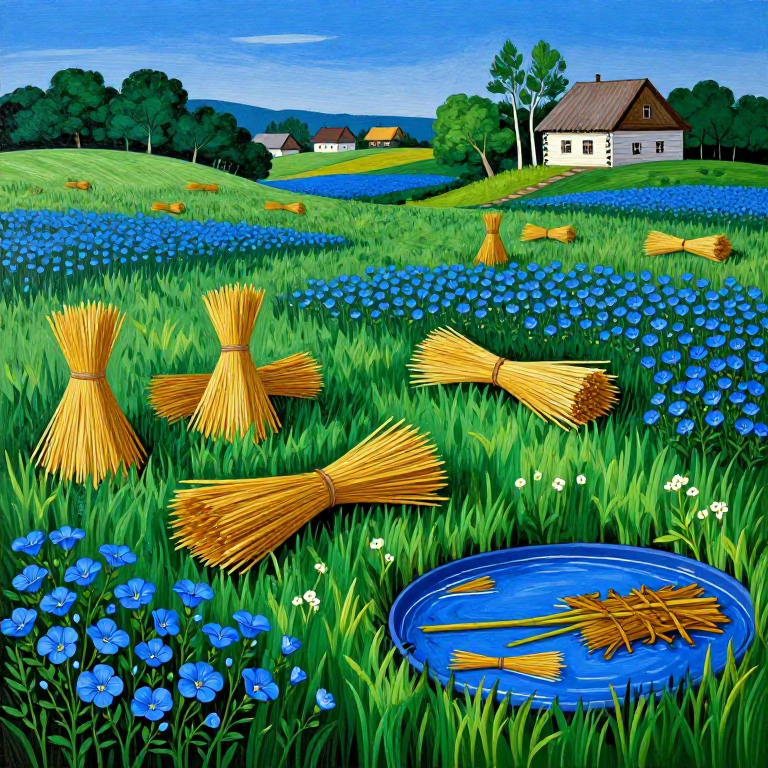


Harvesting and retting of flax — From field to flax fiber
Instructions
Understand the flax plant
Understand the flax plant
Flax (Linum usitatissimum) is an annual plant 80-120 cm tall with a thin straight stem, narrow lanceolate leaves, and blue five-petaled flowers. The fibers are located in the bast of the stem — between the outer bark and the woody core. One stem contains 20-40 bundles of fibers. Fiber flax is grown specifically for fiber, while oil flax is grown for seeds.
Determine flax maturity
Determine flax maturity
Flax is harvested at the early yellow ripeness stage, when the lower third of the stem has turned yellow, the middle part is still greenish, and the top with seed capsules has begun to yellow. Seeds in the capsules should be light brown. Harvesting too early yields weak fiber, too late yields coarse and brittle fiber. This usually occurs 90-100 days after sowing.
Pull flax (do not cut)
Pull flax (do not cut)
Flax is pulled out by the roots, not cut. This preserves the maximum fiber length. Grasp a handful of stems near the ground and pull upward with a smooth motion. Work in rows, pulling stems of equal length together. Shake the soil from the roots. Pulling is physically demanding work — plan for breaks.
Tools needed:
 Work Gloves
Spread out for drying
Spread out for drying
Lay out the pulled stems in a thin even layer on stubble or on mown grass with roots in one direction. Leave for 1-2 days for drying. The stems should lose excess moisture but remain flexible. Turn the layer once for even drying.
Tie into sheaves
Tie into sheaves
Materials for this step:
 Twine1 bundle
Remove seed capsules
Remove seed capsules
Tools needed:
 Pruning Shears
Prepare the retting site
Prepare the retting site
Materials for this step:
 Distilled Water (1 Liter)500 liters
Tools needed:
 Large Retting Container
Ret the sheaves
Ret the sheaves
Materials for this step:
 Weights5 pieces
Check retting readiness
Check retting readiness
Rinse and dry the bundles
Rinse and dry the bundles
After soaking is complete, remove the bundles from the water and rinse them thoroughly in clean running water to remove bacterial residue and mucus. Stand the bundles vertically or spread them on grass to dry for 5-7 days. Turn them over daily. The stems must be completely dry before further processing.
Materials for this step:
Mint stems (scutching)
Mint stems (scutching)
Scutching — breaking of the woody core of the stem (shive) without damaging the fibers. Traditionally, a scutcher is used — a wooden device with a movable lever. The stems are placed across the scutcher and the lever is pressed several times, moving along the stem. The wood breaks into short pieces (shive), while the long fibers remain intact.
Tools needed:
 Flax Brake (m'ialka)
Scutch the fibers (scutching)
Scutch the fibers (scutching)
Tools needed:
 Scutching Knife (tipalka)
 Scutching Board
Hackle the fibers (hackling)
Hackle the fibers (hackling)
Tools needed:
 Hackle Comb (coarse)
 Hackle Comb (fine)
Assess fiber quality
Assess fiber quality
Store the fiber
Store the fiber
Materials for this step:
 Cotton Twine (for bundling)5 meters
Tools needed:
 Storage Shelf
Use tow
Use tow
Tow (oakum) — short fibers remaining on the hackle — is also a valuable material. It is used for making coarse fabrics (burlap), ropes, caulking of log houses, insulation and stuffing. Nothing from flax is discarded — even the shive is used as mulch, fuel or filler for building blocks.
Materials
5- 1 bundlePlaceholder
- 500 litersPlaceholder
- Placeholder
- 5 metersPlaceholder
Tools Required
9- Placeholder
- Placeholder
- Placeholder
- Placeholder
- Placeholder
- Placeholder
- Placeholder
- Placeholder
- Placeholder
CC0 Public Domain
This blueprint is released under CC0. You are free to copy, modify, distribute, and use this work for any purpose, without asking permission.
Support the Maker by purchasing products through their Blueprint where they earn a Maker Commission set by Vendors, or create a new iteration of this Blueprint and include it as a connection in your own Blueprint to share revenue.