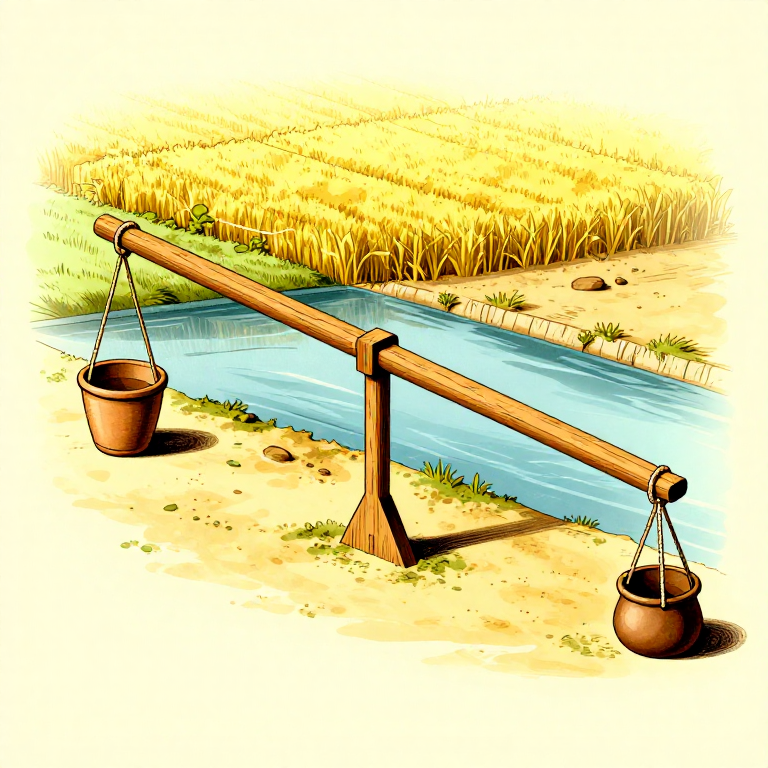


Egyptian Shaduf Irrigation — Operating a Shaduf for Nile Irrigation
निर्देशनहरू
Erect the Upright Support Post
Erect the Upright Support Post
Select a sturdy forked post or construct an A-frame support to serve as the fulcrum for the shaduf beam. The fork should be approximately 2-2.5 meters above ground level. Dig a hole at least 50-60 cm deep at the water's edge and set the post firmly, packing earth and stones tightly around the base. The post must bear the oscillating load of beam, counterweight, and water bucket — a total dynamic force exceeding 50 kg. In ancient Egypt, shaduf supports were often palm trunks, naturally resistant to water damage. Position the support so the beam can swing the bucket from the water source up to the irrigation channel level.
यस चरणका सामग्री:
 बलियो काठको खम्बा1 pole, 3-4 m long, 8-10 cm diameter m
 दुई हाँगे उभिने खम्बा1 post, 2-2.5 m tall m
 जङ्गली माटो15-25 kg केजी
 डोरी3-4 m m
 बाल्टिनको अङ्कुसे1, capacity 10-20 liters टुक्रा
चाहिने औजार:
 खन्ने औजार
 करौँती
 डोरी
डोरीMount the Balance Beam
Mount the Balance Beam
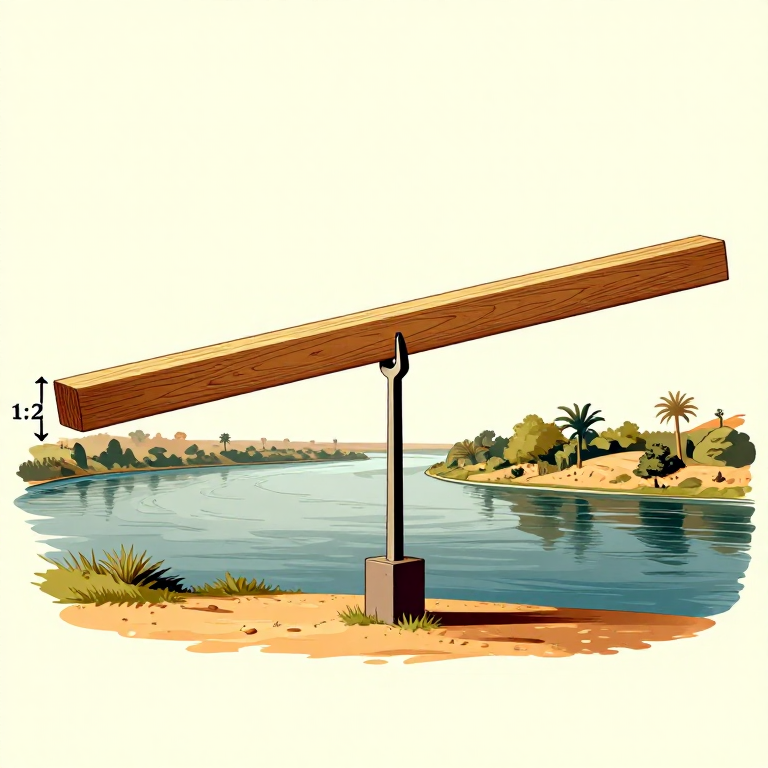
Place the long timber beam across the fork so it pivots freely. Position it off-center: approximately one-third extends on the counterweight side, two-thirds on the bucket side. This unequal division means the counterweight on the short arm must be heavier than the bucket load for mechanical balance — but the counterweight should be slightly less than the filled bucket weight so the operator only needs small downward force to lower the bucket into the water. Tie or pin the beam loosely at the fulcrum to prevent lateral sliding while allowing free pivoting. Test the balance by pressing down on each side to confirm smooth operation.
Attach the Counterweight
Attach the Counterweight
Secure a counterweight of 15-25 kg to the short end of the beam. A large lump of dried Nile mud, a basket of stones, or shaped clay weight was traditionally used. Lash it firmly with rope or enclose it in a woven basket tied to the beam end. Calibrate so the beam naturally tilts toward the counterweight side (raising the bucket end) when the bucket is empty, but can be easily overcome by pulling the bucket end down. This balance point is critical: too much counterweight and the operator struggles to lower the bucket; too little and they must lift the full water weight manually. Test with an empty bucket and adjust accordingly.
Attach the Bucket and Rope
Attach the Bucket and Rope
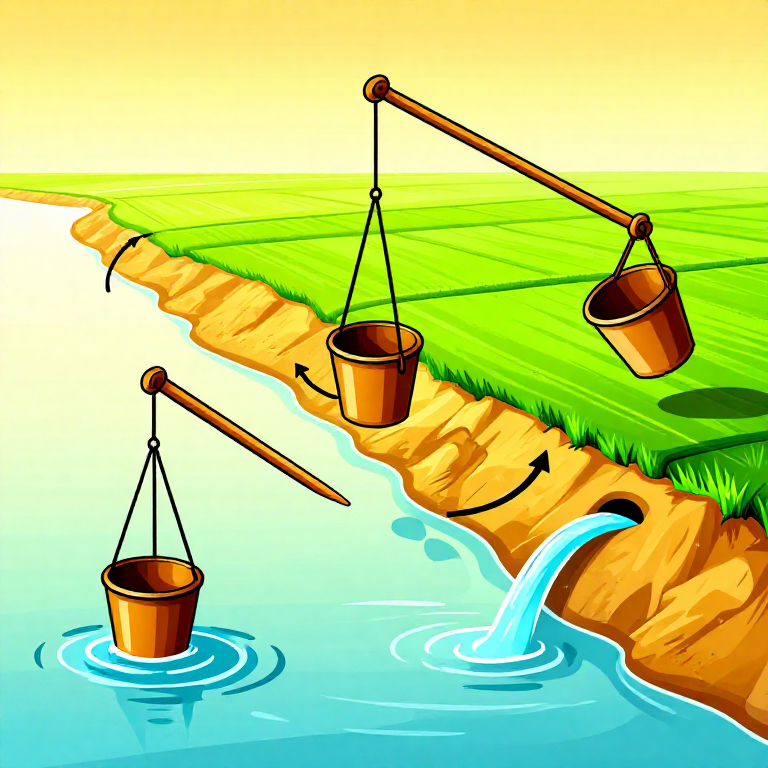
Tie a strong rope to the long end of the beam and attach a bucket or clay pot to its lower end. Calculate the rope length so the bucket reaches the water surface when the beam is tilted down, and clears the irrigation channel edge when tilted up. For a typical installation raising water 2-3 meters, the rope needs to be approximately 2.5-3.5 meters long. Use a clay pot with a narrow mouth if available, as this reduces water sloshing during the swing. Verify the bucket attachment is secure — a bucket coming loose while full would create a dangerous whipping motion from the unbalanced counterweight.
Operate the Shaduf
Operate the Shaduf
To operate, pull down on the rope to lower the bucket into the water, submerging it to fill. Release the downward force and the counterweight naturally lifts the filled bucket upward. Swing the beam to position the bucket over the irrigation channel and tip it to pour the water out. An experienced operator can complete approximately 10-12 cycles per minute, lifting 10-15 liters per cycle — approximately 6,000-10,000 liters per hour, enough to irrigate a small field plot. The shaduf first appears in Egyptian art during the New Kingdom (circa 1500 BCE) in the tomb of Ipuy at Deir el-Medina. Multiple shadufs could be arranged in series on terraced banks to lift water to greater heights.
सामग्री
8- 15-25 kg केजीप्लेसहोल्डर
- 3-4 m mप्लेसहोल्डर
- 1 pole, 3-4 m long, 8-10 cm diameter टुक्राप्लेसहोल्डर
- 1 post, 2-2.5 m tall टुक्राप्लेसहोल्डर
- 15-25 kg टुक्राप्लेसहोल्डर
- 1, capacity 10-20 liters टुक्राप्लेसहोल्डर
- 1 टुक्राप्लेसहोल्डर
- 1 टुक्राप्लेसहोल्डर
CC0 सार्वजनिक डोमेन
यो ब्लुप्रिन्ट CC0 अन्तर्गत जारी गरिएको छ। तपाईं अनुमति नसोधी प्रतिलिपि, परिमार्जन, वितरण र प्रयोग गर्न सक्नुहुन्छ।
ब्लुप्रिन्ट मार्फत उत्पादनहरू किनेर सिर्जनाकर्तालाई सहयोग गर्नुहोस् सिर्जनाकर्ता कमिसन विक्रेताले तोकेको, वा यो ब्लुप्रिन्टको नयाँ संस्करण बनाउनुहोस् र आम्दानी बाँड्न आफ्नो ब्लुप्रिन्टमा जडानको रूपमा समावेश गर्नुहोस्।