SINING
BEAUTY AT WELLNESS
CRAFTS
KULTURA AT KASAYSAYAN
LIBANGAN
KAPALIGIRAN
PAGKAIN AT INUMIN
REVERSE ENGINEERING
AGHAM
ISPORTS
TEKNOLOHIYA
MGA WEARABLE
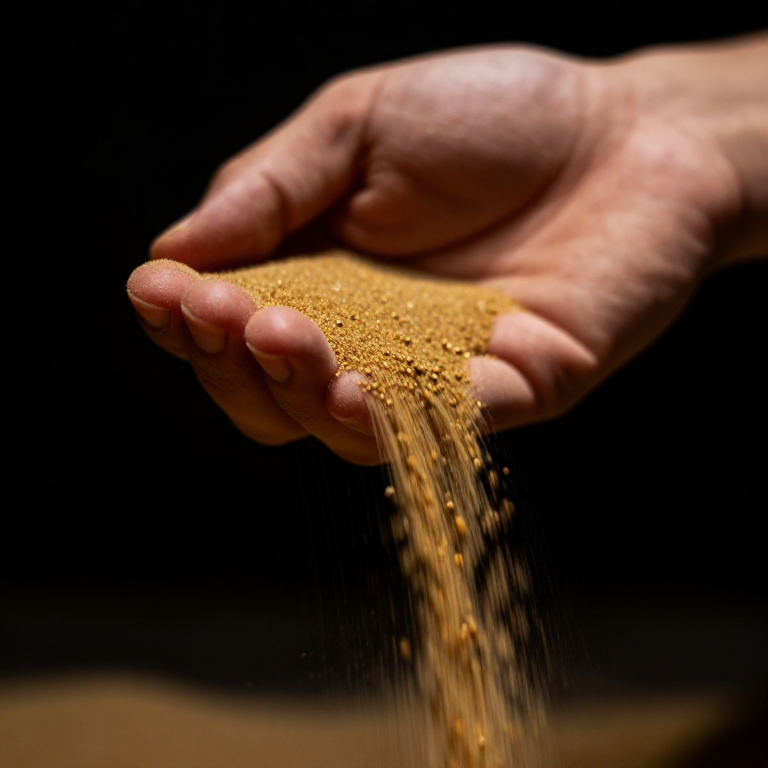


The Sand Reckoner — Count the Grains and Tame Huge Numbers
A hands-on maths project: weigh a pinch of sand, count the grains in a tiny sample, then scale up with powers of ten to estimate the grains in a cup, a bathtub -- even the universe, just as Archimedes did around 250 BC. A Python cell does the giant arithmetic and a compendium shows how exponents were born.
Baguhan
30 minutes
Mga Tagubilin
1
1
Counting the uncountable
Counting the uncountable
Around 250 BC Archimedes set himself a game: to count how many grains of sand would fill the whole universe, and to name that number. He had to invent a new way of writing numbers to do it. You will start the same way -- with real sand.
2
2
Weigh and count a sample
Weigh and count a sample
Weigh out a very small, known amount of dry sand -- say one gram -- on a kitchen scale. Counting every grain is impossible, so count the grains in a TINY measured pinch (a few dozen) and scale up, or estimate. Work out roughly how many grains are in one gram.
Mga materyales para sa hakbang na ito:
 Buhangin1 kg
 Garapong Salamin na May Takip1 piraso
Mga kailangang kasangkapan:
 Digital na Timbangang Pangkusina
3
3
Scale up with powers of ten
Scale up with powers of ten
Now multiply up. If one gram holds a few thousand grains, a cupful (a couple of hundred grams) holds a few hundred thousand, a bag holds millions, a bathtub holds hundreds of millions. Write each answer as a 1 followed by zeros -- and notice you are just counting the zeros. That count is the 'power of ten', or exponent.
Mga kailangang kasangkapan:
 Kalkulador
4
4
Let the computer scale to the universe
Let the computer scale to the universe
Naglo-load ng Jupyter notebook…
Mga kailangang kasangkapan:
 Desktop na KompyuterKalkulador
5
5
Compendium: no largest number
Compendium: no largest number
What the sand teaches. (1) Writing a huge number as 10-to-a-power (scientific notation) turns dozens of zeros into a single small exponent -- exactly how scientists write the sizes of atoms and galaxies today. (2) To MULTIPLY two powers of ten you just ADD their exponents (10^63 times 10^24 is 10^87) -- an idea that, centuries later, became logarithms. (3) Archimedes' real point was philosophical: numbers never run out. However vast a pile of sand, you can always name a bigger number. A game about grains quietly invented one of the most useful ideas in mathematics.
Mga Materyales
3- 1 kgPlaceholder
- 1 pirasoPlaceholder
- 1 pilyegoPlaceholder
Mga Kinakailangang Kasangkapan
4- Placeholder
- Placeholder
- Placeholder
- Placeholder
Kaugnay na Blueprint
Ang mga blueprint na ito ay nagbabahagi ng kaalaman — mga teknik, materyales, o prinsipyo
CC0 Pampublikong Domain
Ang blueprint na ito ay inilabas sa ilalim ng CC0. Malaya kang kumopya, magbago, mamahagi, at gumamit nang walang pahintulot.
Suportahan ang Maker sa pamamagitan ng pagbili ng mga produkto sa kanilang Blueprint Komisyon ng Maker itinakda ng mga Vendor, o lumikha ng bagong bersyon ng Blueprint na ito at isama bilang koneksyon sa iyong Blueprint upang ibahagi ang kita.