Pakikipagtulungan
SINING
BEAUTY AT WELLNESS
CRAFTS
KULTURA AT KASAYSAYAN
LIBANGAN
KAPALIGIRAN
PAGKAIN AT INUMIN
REVERSE ENGINEERING
AGHAM
ISPORTS
TEKNOLOHIYA
MGA WEARABLE
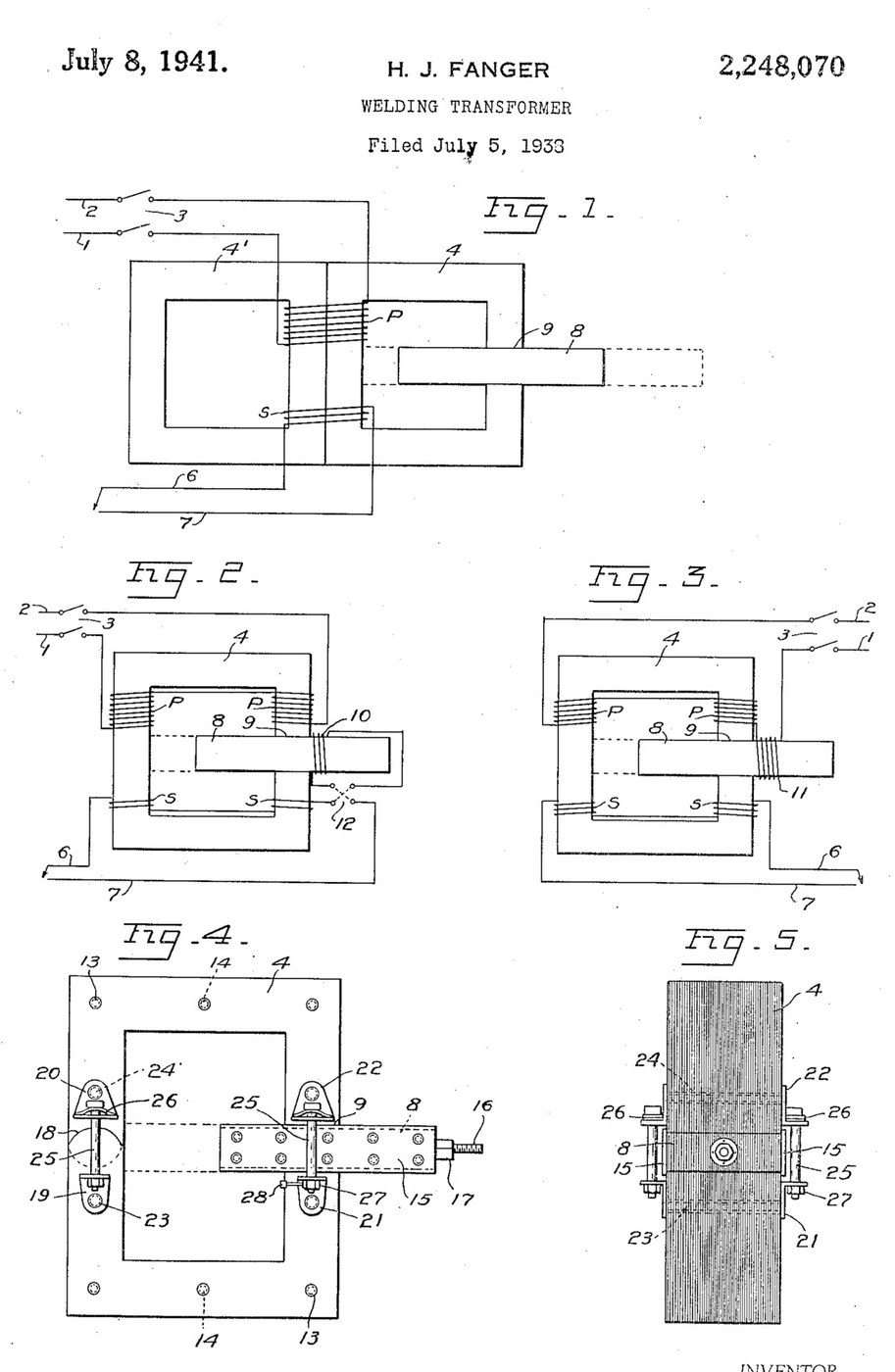


Arc Welder: AC Transformer with a Sliding Shunt Core (Fanger, US 2,248,070)
An AC arc welder is a step-down transformer whose current can be turned up and down. H. J. Fanger (US 2,248,070, 1941) cuts a gap through one leg of a laminated ring core and slides a laminated iron shunt bar through it: pushed in, it carries flux past the secondary and lowers the welding current; pulled out, the current rises.
For arc welding he gives about 60 to 68 volts open circuit, 15 to 200 amps, dropping to 38 or 40 volts at the working arc, with a small coil on the shunt bar in series with the secondary.
Source: H. J. Fanger, "Welding Transformer", US Patent 2,248,070 (filed 1938, granted 1941). Picture: its Figs. 1-5.
Abantado
Unknown
Mga Tagubilin
1
1
Read Fanger
Read Fanger
"With arc welding, infinite control of the volume of the secondary current, between maximum and minimum is obtained by adjustment of the slidable shunt core without altering the welding characteristics of the current, also better ignition of the arc is had at a given voltage, and greater stability of the arc".
2
2
Stack the core
Stack the core
Build a single rectangular ring core of insulated iron laminations, held together with brass (or insulated) bolts or rivets in insulating tubes (Fig. 4). Cut a gap straight through one leg, accurately machined and finished, and make a circular joint through the opposite leg with the segments staggered to overlap in successive laminations. Core size, lamination iron and thickness are not given (ours: the tools).
Mga materyales para sa hakbang na ito:
 Hindi alam na metal1 iron laminations
 Sari-saring hex bolt1 brass bolts
 Hindi alam na materyal na insulator1 insulating tubes
Mga kailangang kasangkapan:
 Gunting na pangyero
 Baradong Nakatayo
 Hanay ng Talim ng Barena
 Kikil (Kikil na Pangkamay)
 Hindi alam na sukat
3
3
Make the shunt bar
Make the shunt bar
Make the sliding shunt section of the same laminated iron, a snug fit in the gap with its laminations edge-to-edge with the core's, and long enough to fill the gap at every position. Sheath both sides with a slightly wider plate of Bakelite that overlaps the edges of the gap to guide it. Fit a threaded rod on its outer end, working in a nut fixed to the section (or move it by hand, with calibration marks along one edge).
Mga materyales para sa hakbang na ito:
Hindi alam na metal1 shunt laminations Bakelite2 side platesSari-saring hex bolt1 brass bolts
 Baras na may sinulid1 piraso
 Tuerkang Heksagonal1 piraso
Mga kailangang kasangkapan:
Baradong NakatayoHanay ng Talim ng BarenaKikil (Kikil na Pangkamay)4
4
Wind the coils
Wind the coils
Wind the primary and secondary windings on both legs of the core (Fig. 2), in series or in parallel to suit the line voltage and the current wanted. Wind a small auxiliary coil round the shunt bar's path, fixed so the bar slides through it, and connect it in series with the secondary through a reversing switch (some jobs weld better with the current through it one way). Turns and wire sizes are not given.
Mga materyales para sa hakbang na ito:
 Kawad na Tanso1 insulation and size not given
Mga kailangang kasangkapan:
Hindi alam na sukat5
5
Spring the joints
Spring the joints
On both sides of the gap and of the circular joint fit pairs of confronting angle plates, held by brass bolts in insulating sleeves and drawn together by spring bolts whose heads rest on slightly arched spring plates, so the joints close snugly on the sliding bar. A small lever on the gap-joint nut gives a half turn to release the bar for moving. The angle-plate material is not given.
Mga materyales para sa hakbang na ito:
 Hindi kilalang materyal4 angle platesSari-saring hex bolt1 brass and spring boltsHindi alam na materyal na insulator1 sleeves
 Guhit na bakal na muwelye1 arched spring platesTuerkang Heksagonal4 piraso
Mga kailangang kasangkapan:
Baradong NakatayoHanay ng Talim ng Barena Llaveng ingles
6
6
Connect and set
Connect and set
Connect the primary to the line through a line switch, and the secondary leads to the electrode holder and the work. Pull the shunt bar out for more current, push it in for less: Fanger gives about 60-68 volts open circuit and 15-200 amps, dropping to 38-40 volts at the arc.
Mga materyales para sa hakbang na ito:
 Switch na pambukas at pamatay1 line switch
Mga kailangang kasangkapan:
Llaveng inglesMga Materyales
10- 1 shunt laminationsPlaceholder
- 1 brass and spring boltsPlaceholder
- 1 sleevesPlaceholder
- 2 side platesPlaceholder
- 1 pirasoPlaceholder
- 5 pirasoPlaceholder
- 1 insulation and size not givenPlaceholder
- 4 angle platesPlaceholder
- 1 arched spring platesPlaceholder
- 1 line switchPlaceholder
Ang blueprint na ito ay gumagawa ng

CC0 Pampublikong Domain
Ang blueprint na ito ay inilabas sa ilalim ng CC0. Malaya kang kumopya, magbago, mamahagi, at gumamit nang walang pahintulot.
Suportahan ang Maker sa pamamagitan ng pagbili ng mga produkto sa kanilang Blueprint Komisyon ng Maker itinakda ng mga Vendor, o lumikha ng bagong bersyon ng Blueprint na ito at isama bilang koneksyon sa iyong Blueprint upang ibahagi ang kita.