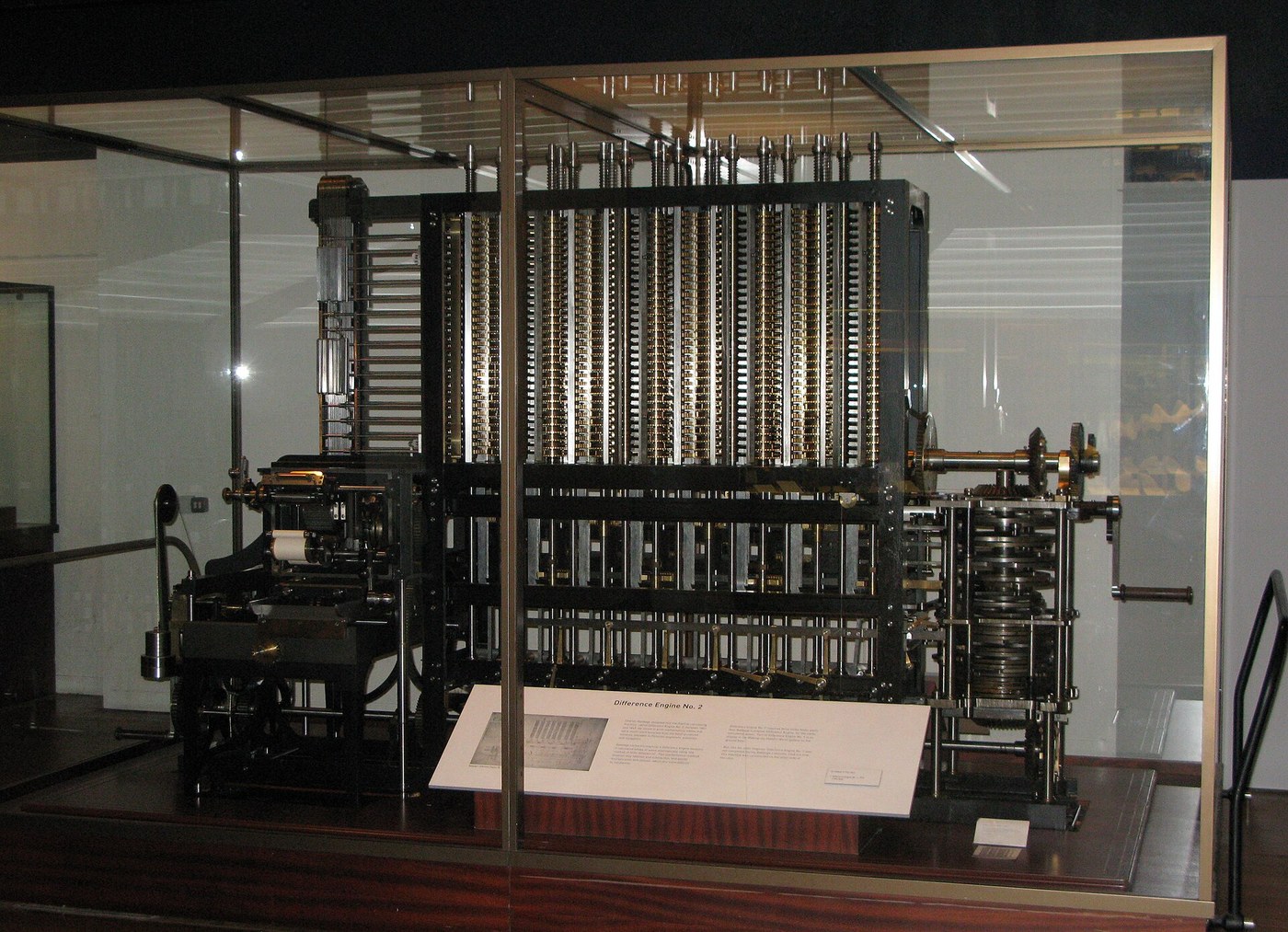


Babbage's Difference Engine
Mga Tagubilin
Work the method of differences by hand
Work the method of differences by hand
Do it on paper first. The trick is so simple it looks like a trap.
- Take the polynomial f(x) = x² + 2x + 3 and tabulate it for x = 0,1,2,3,4,5.
- Write the differences between consecutive values underneath — that is the first difference row.
- Write the differences of THOSE — the second difference row.
- Look at the second difference row.
The second differences are all the same number. For any polynomial of degree n, the nth difference row is constant — and that means you can run the table BACKWARDS: start from the constant, add upward, and generate the next value using only addition.
Extend your table two more rows without ever squaring anything. Add the constant to the last second difference, add that to the last first difference, add that to the last value. Three additions produce the next point of a quadratic.
This is why the machine has one column per difference order and no multiplier anywhere. Babbage did not build a machine that evaluates polynomials; he found a way to evaluate polynomials that needs only a machine that adds.Mga materyales para sa hakbang na ito:
 Papel na Grap1 pad
Mga kailangang kasangkapan:
 Kalkulador
Run the engine in code and watch error propagate
Run the engine in code and watch error propagate
Mga kailangang kasangkapan:
 Desktop na Kompyuter
Cut a digit wheel and a carry cam
Cut a digit wheel and a carry cam
Make the two parts the machine is built from, and feel the precision problem.
- Cut a ten-tooth wheel in brass — index the blank at 36° intervals and cut each tooth.
- Measure the error in each tooth position with a caliper against a dividing plate.
- Make a second wheel with a single carry cam projecting from one face, positioned to act as that wheel passes from 9 to 0.
- Mesh them and turn slowly, watching the carry transfer.
The carry cam must act ONLY between 9 and 0 and never at any other position, which means its angular width and timing are as critical as the tooth spacing.
Reverse-engineering note: Babbage's engines were never completed in his lifetime, and the standard story is that Victorian machining was not accurate enough. That story is wrong. The Science Museum built Difference Engine No. 2 in 1991 from his drawings, to tolerances available in the 1840s, and it worked — 8,000 parts, 5 tonnes, and it computes correctly. The obstacle was cost, management and Babbage's habit of redesigning, not precision.Mga materyales para sa hakbang na ito:
 Bilog na Baras ng Bronse1 piraso
 Lapad na Bronse1 pilyego
Mga kailangang kasangkapan:
 Torno para sa Metal
 Bisi ng Milling 4 na Pulgada
 Digital na Kalibrador 6 Pulgada
 Mikrometro
 Hanay ng Kikil
 Malinaw na Salaming Pangkaligtasan
Print the answer, because the human is the weak link
Print the answer, because the human is the weak link
Trace both paths. The engine's purpose was never to display a number — it was to produce a printing plate, and Babbage understood that a perfect calculation transcribed by a tired clerk is not a perfect table.
That is why roughly half the design is a printing and stereotyping apparatus, and why the machine is enormous. He was not automating arithmetic; he was automating the entire pipeline from computation to printed page, because every human step in that pipeline was a place errors entered.
The principle generalises well beyond tables: a system is only as accurate as its least reliable transcription step, and adding a perfect component in the middle of a chain of sloppy ones buys nothing. It is the same reasoning that made Haldane publish TABLES rather than a physiological model, in the sub-sea batch — the deliverable has to reach the person doing the work in a form they cannot corrupt.Flow
Mga kailangang kasangkapan:
Desktop na KompyuterMga Materyales
3- 1 padPlaceholder
- 1 pirasoPlaceholder
- 1 pilyegoPlaceholder
Mga Kinakailangang Kasangkapan
8- Placeholder
- Placeholder
- Placeholder
- Placeholder
- Placeholder
- Placeholder
- Placeholder
- Placeholder
Kaugnay na Blueprint
Ang mga blueprint na ito ay nagbabahagi ng kaalaman — mga teknik, materyales, o prinsipyo

CC0 Pampublikong Domain
Ang blueprint na ito ay inilabas sa ilalim ng CC0. Malaya kang kumopya, magbago, mamahagi, at gumamit nang walang pahintulot.
Suportahan ang Maker sa pamamagitan ng pagbili ng mga produkto sa kanilang Blueprint Komisyon ng Maker itinakda ng mga Vendor, o lumikha ng bagong bersyon ng Blueprint na ito at isama bilang koneksyon sa iyong Blueprint upang ibahagi ang kita.