Pakikipagtulungan
SINING
BEAUTY AT WELLNESS
CRAFTS
KULTURA AT KASAYSAYAN
LIBANGAN
KAPALIGIRAN
PAGKAIN AT INUMIN
REVERSE ENGINEERING
AGHAM
ISPORTS
TEKNOLOHIYA
MGA WEARABLE
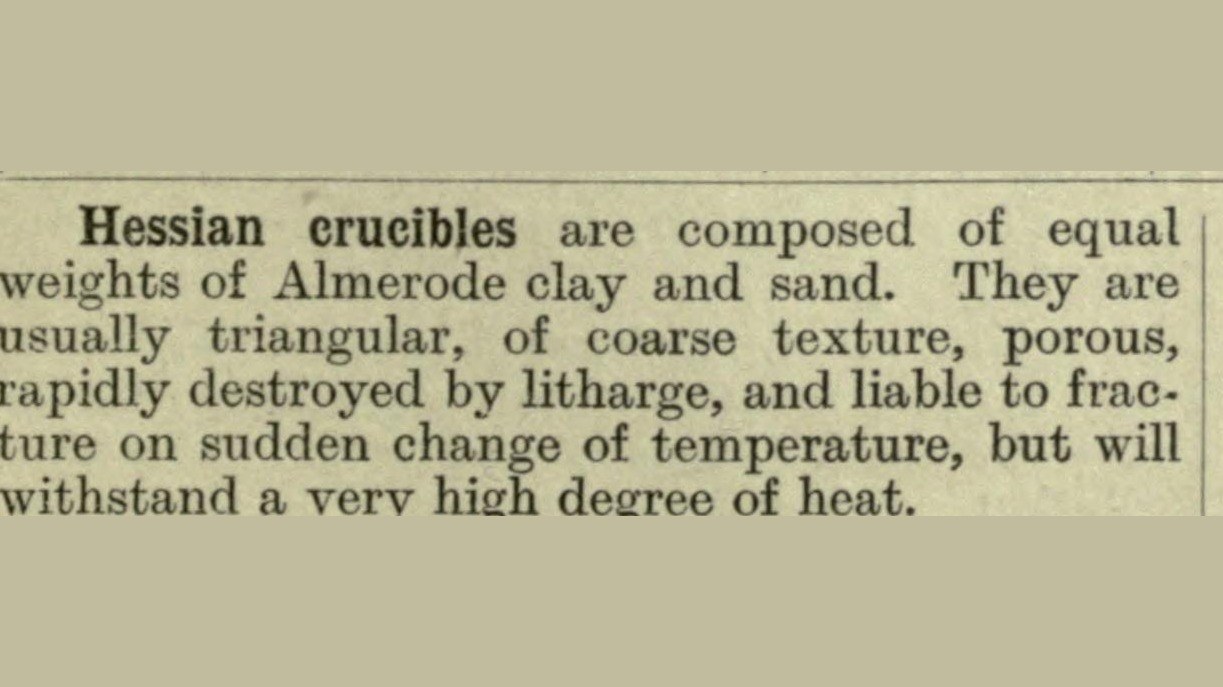


Ceramic Crucible: a Hessian Crucible of Equal Weights of Clay and Sand (Thorpe 1912)
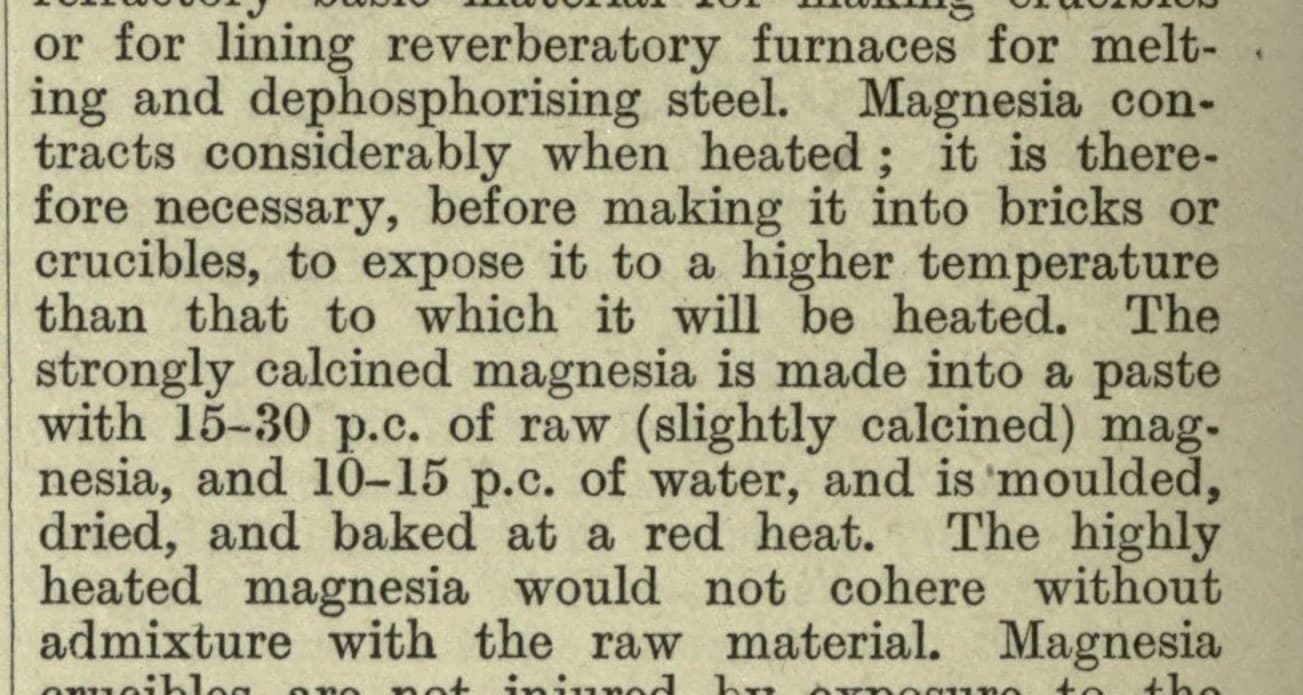
A ceramic crucible is a fired clay pot for melting metal. Thorpe's Dictionary of Applied Chemistry (1912) describes the Hessian crucible: equal weights of clay and sand, usually triangular, coarse and porous; it withstands a very high heat but cracks on sudden changes of temperature and is quickly eaten by litharge.
His general rules for clay crucibles fill in the work: weather the clay, beat it fine to drive out air, mix in the sand, form the crucibles and bake small ones in a kiln. Sizes, forming and baking heat are not given.
Source: Thorpe, Dictionary of Applied Chemistry vol. II (1912), CRUCIBLES, pp. 168-169. Picture: the Hessian paragraph.
Baguhan
Weeks of weathering, then two days
Mga Tagubilin
1
1
Read Thorpe
Read Thorpe
"Hessian crucibles are composed of equal weights of Almerode clay and sand."
2
2
Weather and clean the clay
Weather and clean the clay
Leave the clay exposed to the air in a moist state for some months; it breaks down, grows more plastic and is easier to clean. Pick out foreign matter, above all iron pyrites, which turns into a flux and leaves cavities, and lime.
Mga materyales para sa hakbang na ito:
 Luwad1 half by weight
Mga kailangang kasangkapan:
 Tubig
3
3
Beat and mix
Beat and mix
Beat the clay well, as fine as you can get it, to drive out air bubbles. Weigh it, and mix in an equal weight of sand; Berthier warns that the sand should not be too fine, or it combines with the clay and lowers the melting point.
Mga materyales para sa hakbang na ito:
 Buhangin ng Kuwarso1 half by weight
Mga kailangang kasangkapan:
 Kahoy na Pamukpok
 Tumpak na Digital na Timbangan
4
4
Form the crucibles
Form the crucibles
Form the crucibles; Hessian crucibles are usually triangular. Thorpe gives no sizes and no forming method (unknown).
Mga kailangang kasangkapan:
 Set ng kasangkapan sa luwad
 Hindi alam na sukat
5
5
Bake
Bake
Bake small crucibles in a kiln. Thorpe notes that the higher the baking heat, the more liable the crucible is to crack when heated again; the temperature is not given.
Mga kailangang kasangkapan:
 Pugon
 Guwantes na Matibay sa Init
6
6
History and honest limits
History and honest limits
Thorpe sets the Hessian crucible beside others of his day: French crucibles of raw and burnt clay, Cornish crucibles for copper assaying, Stourbridge crucibles with old glass-pot grog, and graphite crucibles for melting metals. The sand forms a skeleton that keeps the pot from slumping at heats where the clay alone would soften.
He gives the proportions only; the size, the forming and the baking heat are not given, and plain clay and quartz sand stand for Almerode clay and its sand.
Mga Kinakailangang Kasangkapan
7- Placeholder
- Placeholder
- Placeholder
- Placeholder
- Placeholder
- Placeholder
- Placeholder
Ang blueprint na ito ay gumagawa ng
Kaugnay na Blueprint
Ang mga blueprint na ito ay nagbabahagi ng kaalaman — mga teknik, materyales, o prinsipyo
CC0 Pampublikong Domain
Ang blueprint na ito ay inilabas sa ilalim ng CC0. Malaya kang kumopya, magbago, mamahagi, at gumamit nang walang pahintulot.
Suportahan ang Maker sa pamamagitan ng pagbili ng mga produkto sa kanilang Blueprint Komisyon ng Maker itinakda ng mga Vendor, o lumikha ng bagong bersyon ng Blueprint na ito at isama bilang koneksyon sa iyong Blueprint upang ibahagi ang kita.