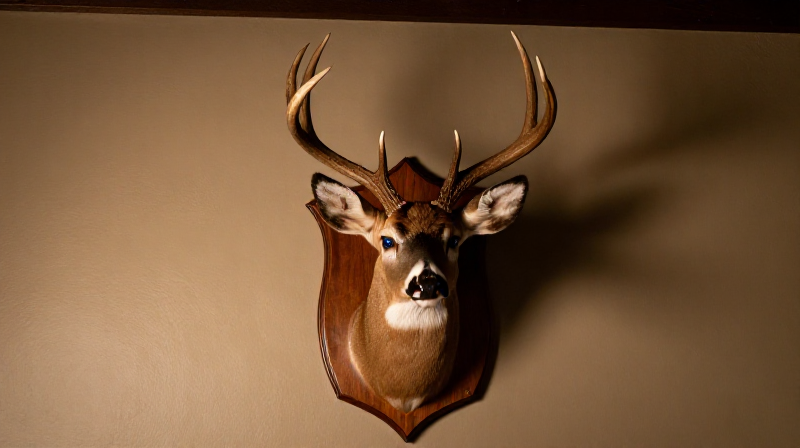

Mounting a Deer Head Trophy — Wall-Mount Taxidermy on a Wooden Shield
Wall-mount deer head taxidermy is the craft of preserving and mounting a deer's head, cape (neck and shoulder skin), and antlers onto a three-dimensional form for permanent display. The practice dates to at least the Victorian era, when naturalists and hunters began mounting specimens on wooden shield plaques as both scientific records and decorative trophies. Modern taxidermy uses commercial polyurethane foam forms that replicate the exact musculature and bone structure of a deer's head and neck, producing far more anatomically accurate results than the straw-stuffed methods of the 19th century.
The process spans several weeks: field-caping the skin immediately after the harvest, salt-preserving and tanning the hide, fitting it onto a correctly sized commercial form with sculpting epoxy and glass eyes, sewing the back seam, sculpting fine facial detail, and slow-drying to a permanent finish. The finished mount is attached to a hand-cut hardwood shield plaque for wall hanging. Done well, a mounted deer head can last over a century without deterioration.
Mga Tagubilin
Field-cape the deer head
Field-cape the deer head
Begin the cape cut in the field as soon as possible after the kill to prevent hair slippage from bacterial decomposition. Make a circumferential cut around the torso behind the front shoulders — you need at least 15 cm of hide below where the shoulder mount will end. Then cut along the back of the neck from the shoulder cut up to a point between the antler bases. Do NOT cut along the throat — the throat skin is the visible front of the finished mount and must remain uncut. Peel the cape forward off the neck muscles, working carefully around the ears, eyes, lips, and nostrils. Cut the ear cartilage free from the skull at the base. Cut around the eyes close to the skull bone to preserve the full eyelid skin. Cut the lips free by slicing close to the gums. Free the nostrils by cutting the cartilage at the tip of the nasal bone. Separate the skull from the spine at the atlas vertebra.
Mga materyales para sa hakbang na ito:
 Usa1 piraso
Mga kailangang kasangkapan:
 Kutsilyo
Salt the cape for preservation
Salt the cape for preservation
Lay the cape skin-side up on a clean surface. Rub coarse non-iodized salt generously into every square centimetre of the flesh side, using approximately 2-3 kg of salt for a deer cape. Pay extra attention to the ears, lips, nose, and eye areas where the skin is thinnest and spoilage starts first. The salt draws moisture out of the skin through osmosis, dehydrating bacteria and halting decomposition. Fold the salted cape flesh-to-flesh, roll it loosely, and place it on an inclined surface so brine can drain freely. After 24 hours, shake off the wet salt, reapply fresh dry salt, and repeat the drain. After a second 24-hour salting the cape should feel stiff and leathery. A properly salted cape can be stored frozen or shipped to a taxidermist without spoilage.
Mga materyales para sa hakbang na ito:
 Magaspang na Asin sa Dagat3 kg
Flesh the cape to remove all tissue
Flesh the cape to remove all tissue
Rehydrate the salted cape by soaking in clean cold water for 1-2 hours until it is pliable again. Drape it over a fleshing beam — a smooth, rounded hardwood or PVC beam at waist height — and use a fleshing tool (a two-handled draw blade with a dull, rounded edge) to scrape away all remaining meat, fat, and membrane from the flesh side. Work from the centre outward in smooth, firm strokes. The goal is a uniformly thin skin of even thickness — about 2-3 mm — with no fatty deposits left. Fat left on the skin will cause grease burns (yellow staining) and odour over time. Turn the ears inside out completely by separating the ear cartilage from the skin using a blunt probe, working from base to tip — this is the most delicate part of fleshing and rushing it will tear the thin ear skin.
Mga materyales para sa hakbang na ito:
 Distiladong Tubig20 litro
Mga kailangang kasangkapan:
 Bigang panhimay ng balat
 Panghimay ng balat
Tan the cape with borax
Tan the cape with borax
Mix a tanning solution of borax (sodium tetraborate) in a large plastic tub — approximately 500 g of borax per 20 litres of water. Submerge the fleshed cape completely, weighting it down so no skin floats above the surface. Soak for 48-72 hours, agitating occasionally. Borax raises the pH to around 9.2, which inhibits bacterial growth, stabilises the collagen fibres in the skin, and produces a dry, moth-resistant hide. After soaking, remove the cape, rinse in clean water for 15 minutes to remove excess borax, and hang to drip-dry until it is damp but no longer dripping — this is the ideal moisture level for mounting. Some taxidermists use commercial tanning kits (chrome or synthetic tan) for a softer, more stretchable result, but borax tanning is the traditional method and produces excellent results for shoulder mounts where the skin is stretched over a rigid form.
Mga materyales para sa hakbang na ito:
 Boraks sa taksidermiya1 pirasoDistiladong Tubig20 litro
Clean and prepare the antler skull plate
Clean and prepare the antler skull plate
Using a hand saw, cut a skull plate — the section of the skull between and immediately surrounding both antler bases — leaving about 5 cm of bone around each antler pedicle. Remove all brain matter and tissue from the underside by scraping and washing. Simmer (do not boil — boiling makes bone brittle and can loosen antlers) the skull plate in water at 70-80°C for 30-45 minutes to soften remaining tissue, then scrape clean with a knife. Allow to dry completely. Whiten the bone by brushing with a paste of borax and water, letting it sit for 24 hours, then wiping clean. The skull plate will be attached to the mannequin form later to position the antlers at their natural angle.
Mga materyales para sa hakbang na ito:
Distiladong Tubig5 litroMga kailangang kasangkapan:
 Lagaring PangkamayKutsilyo
Select and fit the commercial form
Select and fit the commercial form
Select a commercial polyurethane foam deer form that matches the deer's neck circumference, measured at the base of the cape opening. Forms come in sizes based on neck circumference and are available in left-turn, right-turn, semi-sneak, and upright poses. Before mounting, do a dry test-fit by draping the damp cape over the form to check that the eye openings align with the form's eye sockets, the nose skin reaches the end of the form's muzzle, and the cape covers the entire form with excess at the back for tucking. If the cape is slightly small, the form can be shaved down with a rasp; if slightly large, build up areas with sculpting epoxy. The form arrives with pre-cut slots for the skull plate and antler pedicles.
Mga materyales para sa hakbang na ito:
 Hulmahan sa taksidermiya1 piraso
Attach the skull plate and antlers to the form
Attach the skull plate and antlers to the form
Seat the cleaned skull plate into the form's antler slot. The slot is angled to hold the antlers at the natural forward tilt of a live deer — typically 45-50° from horizontal for a white-tailed deer. Secure the skull plate to the foam form using long wood screws driven through the foam from inside the form into the bone. Reinforce the bond by applying two-part sculpting epoxy around the skull plate edges where they meet the foam, building up a smooth transition between bone and form. This joint must be strong — the antlers create significant leverage that can pull a poorly attached plate free of the form. Allow the epoxy to cure fully (typically 4-6 hours) before proceeding.
Mga materyales para sa hakbang na ito:
 Epoksi pang-eskultura sa taksidermiya1 piraso
 Turnilyong pangkahoy #8 x 1"4 piraso
Mga kailangang kasangkapan:
 Walang-Kableng Barena
Apply adhesive and position the cape on the form
Apply adhesive and position the cape on the form
Apply a thin, even coat of hide paste (a water-based taxidermy adhesive) over the entire surface of the form. Work in sections if necessary — hide paste remains tacky for 30-60 minutes. Carefully pull the damp, tanned cape over the form, starting from the nose end and working backward. Align the nose skin over the muzzle tip, position each eye opening over the corresponding eye socket on the form, and pull the cape backward until the back seam edges meet along the back of the neck. The skin should contact the adhesive-coated form surface everywhere with no air pockets. Stretch and smooth the skin around the nose, muzzle, and brow ridge, pressing firmly so the hide paste bonds the skin to the foam contours.
Mga materyales para sa hakbang na ito:
 Panimulang kit sa pagkabit ng taksidermiya1 piraso
Set the glass eyes
Set the glass eyes
Press a small ball of sculpting epoxy into each eye socket on the form to create a bed for the glass eye. Set the glass eye into the epoxy at the correct depth and angle — a deer's eye sits slightly forward and downward in the socket, not centred. The pupil should be oriented horizontally, which is the natural position for deer (horizontal pupils give wide-field predator detection). Tuck the eyelid skin around the glass eye, pressing the thin skin into the epoxy to create a natural-looking lid edge. Use a modelling tool or the blunt end of a paintbrush to define the tear duct (pre-orbital) depression in front of each eye — this anatomical detail separates amateur from professional mounts. Adjust both eyes for symmetry before the epoxy sets.
Mga materyales para sa hakbang na ito:
 Salaming mata sa taksidermiya (maliit na mamalya)1 pirasoEpoksi pang-eskultura sa taksidermiya1 piraso
Sew the back seam closed
Sew the back seam closed
Starting at the base of the skull plate between the antlers, stitch the back seam closed using a curved upholstery needle and strong waxed thread. Use a baseball stitch (also called a ladder stitch) — this pulls the two edges together so the stitch disappears beneath the hair once the hide dries and the hair stands up. Place stitches about 8-10 mm apart, pulling each one firmly but not so tight that the skin tears. The direction of the hair along the back of a deer's neck grows downward, which naturally conceals a well-sewn seam. Continue stitching down to where the cape ends at the back of the form.
Mga materyales para sa hakbang na ito:
 Set ng sinulid at karayom sa taksidermiya1 piraso
Sculpt the nose, lips, and ear detail
Sculpt the nose, lips, and ear detail
The nose, lips, and inner ears define the lifelike quality of the finished mount. Pack sculpting epoxy into the nostrils from the outside, shaping each nostril opening to its natural teardrop shape. Tuck the lip skin into the slot on the form's muzzle and pin it in place with T-pins while the epoxy beneath cures — the lips should show a thin, dark lip line where the outer hair-covered skin meets the inner moist skin of the mouth. Insert commercial plastic ear liners into each turned ear, coat the inside of the ear skin with hide paste, and press the skin onto the liner. Pin the ear edges with T-pins to hold the shape while drying — a deer's ear is cupped forward with a slight outward flare at the tip. Tuck the inner ear hair to show the natural ear tufts.
Mga materyales para sa hakbang na ito:
Epoksi pang-eskultura sa taksidermiya1 pirasoPin, position, and dry the mount
Pin, position, and dry the mount
With the cape glued, sewn, and detailed, insert T-pins along all critical edges — around the eyes, nostrils, lips, ears, and the back seam — to hold everything in position while the hide paste and epoxy cure and the skin dries. Place the mount in a well-ventilated area at room temperature. Drying takes 2-4 weeks depending on humidity. As the skin dries it shrinks slightly onto the form, tightening the fit and making the anatomical contours more defined. Do not use fans or heaters to accelerate drying — uneven drying causes the skin to pull away from the form on one side while the other is still wet, creating wrinkles and drumming (hollow spots). Check daily for any edges lifting and re-pin or re-glue as needed.
Cut and shape the oak shield plaque
Cut and shape the oak shield plaque
Cut a shield-shaped backing plaque from solid oak board (20-25 mm thick). The traditional European trophy shield is a symmetrical pointed-bottom shape approximately 35 cm wide by 50 cm tall — large enough to fully support the back of the form and distribute the wall-hanging load. Transfer the outline onto the board, cut with a hand saw or jigsaw, and round all edges with sandpaper (120 grit, then 220 grit). Stain the plaque with a medium-dark oak stain and apply two coats of polyurethane varnish, sanding lightly between coats with 320-grit sandpaper. Drill a hanging hole or attach a D-ring hanger on the back, 5-8 cm below the top edge. The finished plaque serves both as the wall attachment and as a decorative frame for the mount.
Mga materyales para sa hakbang na ito:
 Mga plakang linden1 piraso
Mga kailangang kasangkapan:
Lagaring PangkamayWalang-Kableng BarenaAttach the mount to the shield and hang
Attach the mount to the shield and hang
Once the mount is fully dry (2-4 weeks), remove all T-pins. Trim any excess cape skin at the back to sit flush against the shield plaque. Centre the back of the form on the plaque and secure it with 3-4 long wood screws driven through the plaque from behind into the dense foam of the form. The screws should penetrate at least 50 mm into the foam but not protrude through the front surface. For heavy mounts with large antlers, add a French cleat on the back of the plaque — a 45° bevelled strip that interlocks with a matching strip on the wall — to distribute the weight safely across the wall stud. Hang the completed trophy at eye level (centre of the mount approximately 150-160 cm from the floor) on a wall stud or appropriate wall anchor rated for the weight.
Mga materyales para sa hakbang na ito:
 Turnilyong pangkahoy #10 x 3"4 piraso
Mga kailangang kasangkapan:
Walang-Kableng BarenaMga Materyales
14- 1 pirasoPlaceholder
- Placeholder
- 45 litroPlaceholder
- 1 pirasoPlaceholder
- 1 pirasoPlaceholder
- Placeholder
- 4 pirasoPlaceholder
- Placeholder
- Placeholder
- Placeholder
- 1 pirasoPlaceholder
- 4 pirasoPlaceholder
- 1 pirasoPlaceholder
- 1 pirasoPlaceholder
Mga Kinakailangang Kasangkapan
7- Placeholder
- Placeholder
- Placeholder
- Placeholder
- 1 vendor sell this, none ship to you yetPlaceholder
- Placeholder
- Placeholder
Mga Materyales ng Nakakonektang Blueprint
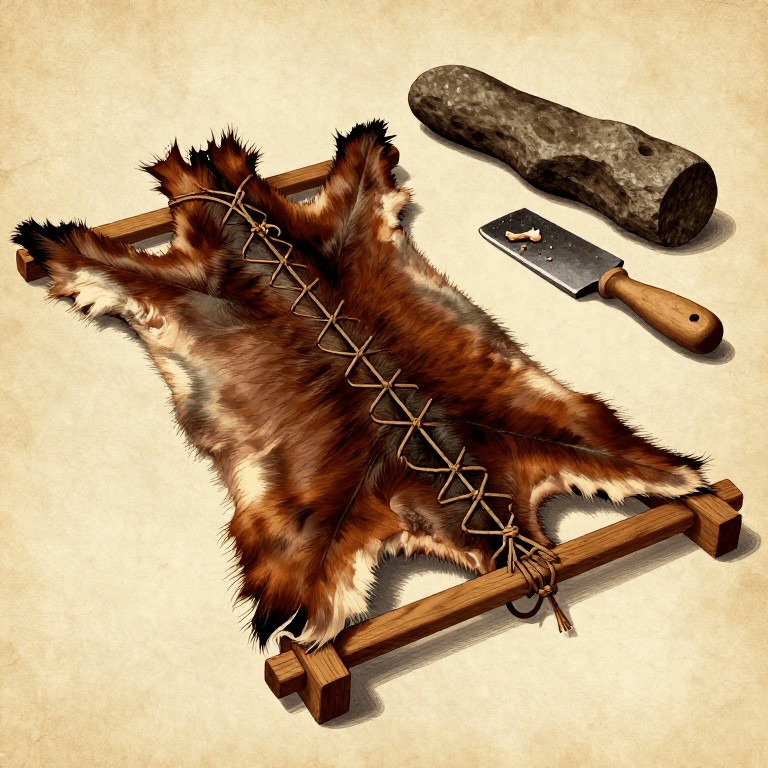
Preparing a Raw Animal Hide — Cleaning and Stretching Before Tanning
ni Mary
Tela at Katad
Making a Bone Hide Scraper — Smooth-Edged Fleshing Tool
ni Mary
Tela at Katad
Bark Tanning Animal Hides — Vegetable Tanned Leather from Oak Bark
ni Mary
Paggawa sa Bato
Ang blueprint na ito ay gumagawa ng

Kaugnay na Blueprint
Ang mga blueprint na ito ay nagbabahagi ng kaalaman — mga teknik, materyales, o prinsipyo
Brain Tanning a Hide — Primitive Leather from Scratch
ni Mary
Kagubatan
Making Hide Glue by Boiling Rawhide Scraps — Prehistoric Collagen Adhesive
ni Bob
Kemistri
Making a Simple Skin Cloak — Fur and Hide Body Covering
ni Tex
Tela at Katad
Making a Stone Scraper for Hide Working — Conchoidal Flake Tool
ni Mary
Paggawa sa Bato
CC0 Pampublikong Domain
Ang blueprint na ito ay inilabas sa ilalim ng CC0. Malaya kang kumopya, magbago, mamahagi, at gumamit nang walang pahintulot.
Suportahan ang Maker sa pamamagitan ng pagbili ng mga produkto sa kanilang Blueprint Komisyon ng Maker itinakda ng mga Vendor, o lumikha ng bagong bersyon ng Blueprint na ito at isama bilang koneksyon sa iyong Blueprint upang ibahagi ang kita.