SINING
BEAUTY AT WELLNESS
CRAFTS
KULTURA AT KASAYSAYAN
LIBANGAN
KAPALIGIRAN
PAGKAIN AT INUMIN
REVERSE ENGINEERING
AGHAM
ISPORTS
TEKNOLOHIYA
MGA WEARABLE


Drying: Capacity and Intensity Are Not the Same Thing
Water is the commonest impurity in the laboratory and the easiest to ignore, because it is invisible, it weighs something, and it comes back.
Drying agents are judged on two separate properties that are routinely confused. **Capacity** is how much water an agent can hold. **Intensity** is how dry it can leave the thing — the residual water it is in equilibrium with. A cheap agent with high capacity and poor intensity is the right first pass; an expensive one with high intensity finishes the job.
Choosing on the wrong one is why a carefully dried solvent still ruins a moisture-sensitive reaction.
Katamtaman
3 hours
Mga Tagubilin
1
1
Drying a liquid
Drying a liquid
**Add the agent to the liquid, swirl, and leave it.** Fifteen minutes is often enough; overnight is better. Then filter or decant it off.
**Anhydrous magnesium sulfate** is the general-purpose first choice: high capacity, moderate intensity, fast, cheap, and it works with almost everything. It is a fine powder, so it needs a proper filtration.
**Anhydrous sodium sulfate** has higher capacity still but only works below about 32 C and is slower. Coarser, so easier to filter off.
**Calcium chloride** is cheap and high capacity, and it reacts with alcohols, amines and some other classes — so it dries hydrocarbons well and ruins other things.
**Molecular sieves** are the high-intensity answer: they take a solvent to genuinely low water, they are regenerable in an oven, and they are slow. This is what dries a solvent for a moisture-sensitive reaction.
**The visual test.** A wet organic liquid is cloudy; a dry one is clear. Add agent until fresh agent stops clumping and swirls freely, and the liquid has gone clear. That is the endpoint, and it needs no instrument.
**Every agent holds some product.** Use the least that does the job, and rinse the agent with a little fresh solvent if the preparation is small.
Mga materyales para sa hakbang na ito:
 Magnesium sulfate (asing Epsom)1 piraso
 Etanol - antas laboratoryo, 95 %1 piraso
Mga kailangang kasangkapan:
 Prasko ng Erlenmeyer
 Papel na Pansala
 Panghalong Salamin
2
2
Drying a solid
Drying a solid
**Air drying** on a watch glass. Free, slow, and it only reaches the humidity of the room — which for a hygroscopic solid means it never dries at all.
**An oven**, well below the melting point and below any decomposition temperature. Fast, and it drives off solvent as well as water. Not for anything that sublimes, melts low, or oxidises in air.
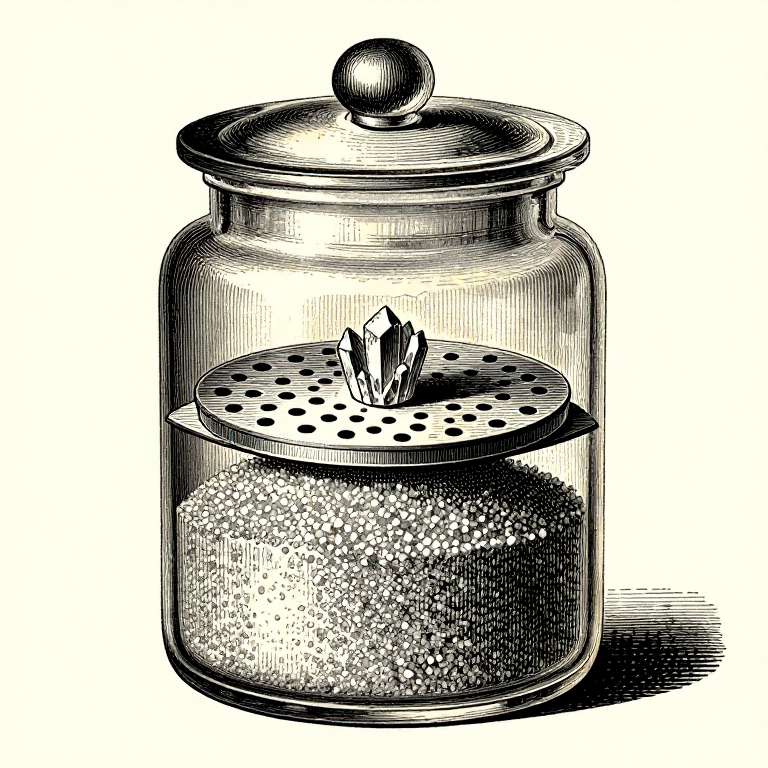
**A desiccator** — a sealed vessel with a drying agent in the bottom and the sample on a shelf above it. The agent lowers the humidity in the enclosed air and the sample equilibrates with it. This is what reaches a genuinely low water content at room temperature.
**A vacuum desiccator** does the same far faster, and also pulls out solvent. Let it down slowly, or the incoming air blows the sample around the inside.
**Drying to constant weight** is the only way to know it is done: weigh, dry an hour, weigh again, repeat until two successive weights agree. Anything else is a guess, and the difference between the first and last weight is a free measurement of how much water there was.
**Cool in the desiccator before weighing.** A warm sample sets up convection currents on the balance and reads light, and it takes up water as it cools on the bench.
Mga materyales para sa hakbang na ito:
 Mga pakete ng silica gel1 piraso
 Tawas (Potassium Alum)1 piraso
Mga kailangang kasangkapan:
 Salaming pang-orasan
 Tumpak na Timbangan
3
3
Capacity against intensity, with numbers
Capacity against intensity, with numbers
The two properties are independent, and the published figures make the point better than any description.
**Residual water left in air at 25 C** — this is intensity, in milligrams of water per litre, lower being drier:
* calcium chloride — about 0.14 to 0.25
* silica gel — about 0.03
* potassium hydroxide — about 0.002
* magnesium perchlorate — about 0.0005
* phosphorus pentoxide — about 0.00002
**Capacity**, roughly how much water an agent holds as a fraction of its own weight, runs in nearly the opposite direction: calcium chloride and magnesium sulfate are high, phosphorus pentoxide is low and is spent quickly.
So the sensible arrangement is two stages: **a cheap high-capacity agent to take out the bulk, then a high-intensity one to finish.** That is exactly how a drying train is built, and why a desiccator charged with silica gel will never reach what one charged with phosphorus pentoxide does — nor need to, for most work.
**Silica gel with a colour indicator** shows when it is spent, and regenerates in an oven. For almost all practical purposes it is the right desiccant.
Mga materyales para sa hakbang na ito:
Mga pakete ng silica gel1 pirasoMagnesium sulfate (asing Epsom)1 pirasoMga kailangang kasangkapan:
Tumpak na Timbangan4
4
Where the water comes back from
Where the water comes back from
A dried substance does not stay dry, and the rate depends entirely on what it is.
**Hygroscopic** substances take water from the air — most anhydrous salts, many organic acids. They must be stored sealed, and weighed quickly.
**Deliquescent** substances take up so much that they dissolve in it. Calcium chloride and sodium hydroxide left open become puddles. This is dramatic and it also means a sample left on a balance is changing while it is weighed.
**Efflorescent** substances do the opposite: a hydrate loses its water to dry air and crumbles. Washing soda crystals turning to powder is this.
Three habits follow:
**Weigh by difference and weigh fast**, which is the weighing rung's rule and this is why it exists.
**Store in a sealed container with a desiccant**, not merely a lid.
**Re-dry before use** if a hygroscopic reagent has been open. The bottle that was dried last year is not dry now, and the fraction of water in it is exactly the fraction by which every weighing from it is wrong.
Mga materyales para sa hakbang na ito:
Mga pakete ng silica gel1 pirasoMga kailangang kasangkapan:
Tumpak na TimbanganSalaming pang-orasanMga Materyales
4- 1 pirasoPlaceholder
- 1 pirasoPlaceholder
- 1 pirasoPlaceholder
- 1 pirasoPlaceholder
Mga Kinakailangang Kasangkapan
5- Placeholder
- Placeholder
- Placeholder
- Placeholder
- Placeholder
Kaugnay na Blueprint
Ang mga blueprint na ito ay nagbabahagi ng kaalaman — mga teknik, materyales, o prinsipyo


CC0 Pampublikong Domain
Ang blueprint na ito ay inilabas sa ilalim ng CC0. Malaya kang kumopya, magbago, mamahagi, at gumamit nang walang pahintulot.
Suportahan ang Maker sa pamamagitan ng pagbili ng mga produkto sa kanilang Blueprint Komisyon ng Maker itinakda ng mga Vendor, o lumikha ng bagong bersyon ng Blueprint na ito at isama bilang koneksyon sa iyong Blueprint upang ibahagi ang kita.