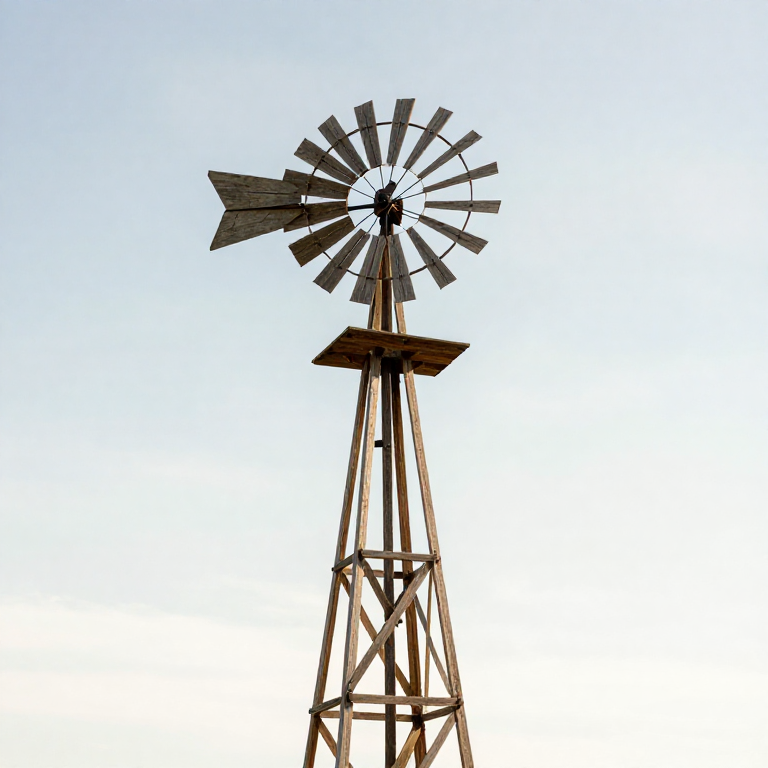


Halladay Windmill Governor
A windmill on a farm has no miller standing by it. Wind rises without warning, and a mill that runs faster in a gale runs faster until it tears itself apart. European mills solved this with a person who reefed the sails; a mill in the middle of a prairie has nobody.
Halladay's mill governs itself using the wind that threatens it. The sails are hinged and held at working angle by a counterweight. As wind speed rises, the force on the sails overcomes the weight and swings them edge-on, spilling the excess; as it falls, the weight pulls them back. The disturbance provides the correcting signal, so the mill needs no attendant at all.
US Patent 11,629, "Improved Governor for Windmills", granted to Daniel Halladay of Ellington, Connecticut on 29 August 1854. It is a mechanical feedback loop, and it is the machine that made unattended wind power practical.
Mga Tagubilin
Build at model scale and test on a line
Build at model scale and test on a line
A full-size mill head is heavy and turns fast. Build a bench model, test it in front of a fan, and never stand in the plane of the rotor.
Read US 11,629 and identify the feedback path
Read US 11,629 and identify the feedback path
Halladay claims sails that change their own obliquity to hold uniform velocity. Trace the loop: speed rises → sails turn → less force → speed falls.
Build a fixed-sail rotor first and watch it fail
Build a fixed-sail rotor first and watch it fail
Make a rotor with rigid blades and put it in a rising airflow. Speed climbs without limit until something gives. That is the failure a governor exists to prevent.
Mga materyales para sa hakbang na ito:
 Playwud na Baltic Birch1 pilyego
Mga kailangang kasangkapan:
 Lagaring Pangkamay
Cut many small sails instead of four big ones
Cut many small sails instead of four big ones
Make a ring of numerous narrow slats. Halladay's design uses many light sails rather than four heavy arms, which is why it starts in light wind and can be governed individually.
Hinge every sail on a radial pivot
Hinge every sail on a radial pivot
Pivot each slat so it can rotate from face-on to edge-on. All of them must move together — a linkage ring around the hub couples them.
Mga materyales para sa hakbang na ito:
 Bilog na Bara ng Malambot na Asero1 piraso
Hang a counterweight that sets the working angle
Hang a counterweight that sets the working angle
Weight the linkage so the sails sit face-on in light wind. The counterweight is the SETPOINT — change it and you change the regulated speed.
Confirm wind force acts against the weight
Confirm wind force acts against the weight
Push a sail by hand and feel the weight resist. The two are in opposition, and where they balance is where the mill settles.
Run it in rising airflow and watch the sails feather
Run it in rising airflow and watch the sails feather
Increase the fan speed. The sails should swing progressively edge-on and the rotor speed should stop climbing. That plateau is regulation.
Measure speed against wind speed and plot it
Measure speed against wind speed and plot it
Record rotor RPM at several airflow settings. A governed mill gives a flat line where an ungoverned one gives a rising one — plot both.
Mga kailangang kasangkapan:
 Ruler
RulerAdd a tail vane to keep it facing the wind
Add a tail vane to keep it facing the wind
Fit a vane behind the rotor on a vertical pivot. It yaws the head into wind automatically — a second feedback loop, on direction rather than speed.
Fit a furling mechanism for storms
Fit a furling mechanism for storms
Add a way to turn the whole rotor edge-on to the wind. Governing handles ordinary gusts; a storm needs the mill taken out of the wind entirely.
Deliberately over-weight the linkage and watch it hunt
Deliberately over-weight the linkage and watch it hunt
Add too much counterweight and the sails overshoot, spill, close, and overshoot again. Oscillation is the classic failure of a feedback loop with too much gain and no damping.
Damp the linkage and stop the hunting
Damp the linkage and stop the hunting
Add friction or a dashpot to the linkage. The mill settles rather than swinging — the same fix a modern control engineer would reach for.
Couple it to a pump and load it
Couple it to a pump and load it
Connect a reciprocating pump rod. Under load the regulation behaves differently — a governor tuned unloaded is not tuned for work.
Compendium — a machine that watches itself
Compendium — a machine that watches itself
The patent. US 11,629, "Improved Governor for Windmills", granted 29 August 1854 to Daniel Halladay of Ellington, Connecticut. The claim is a mill whose sails automatically alter their obliquity to hold a roughly uniform velocity regardless of wind speed, together with a vane keeping the rotor into wind. Halladay reportedly took the job on reluctantly, doubting anyone would buy a self-regulating mill; the design went on to become the standard American farm windmill and was built in the millions.
Why the American plains needed it and Europe did not. A European tower mill sat beside its miller, who reefed the canvas as the wind got up. A mill pumping water for cattle or a railway water stop on the Great Plains had no one within miles, might run for weeks unattended, and had to survive whatever weather arrived. Self-regulation was not a refinement — it was the precondition for the machine existing at all in that setting. The railroads were major customers, because steam locomotives need water every few tens of miles across country with no towns.
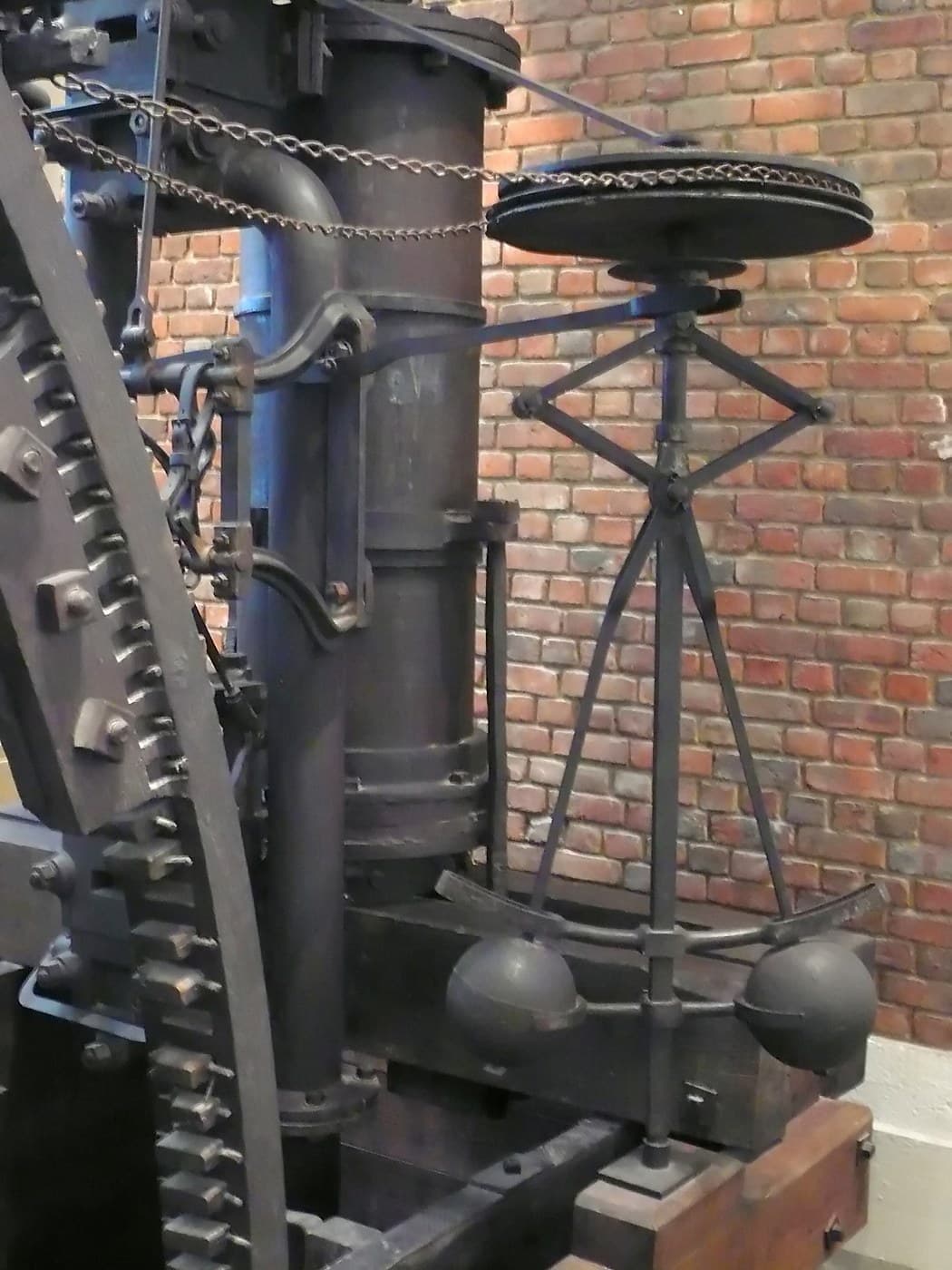
It is a proportional feedback controller made of wood and iron. Wind force on a sail rises roughly with the square of wind speed, and that force acts against a fixed counterweight. Where the two balance sets the sail angle, which sets how much of the wind is captured, which sets the speed. The controlled variable feeds back into the actuator with no sensor, no linkage to a separate governor and no external power — the disturbance itself does the correcting. Watt's centrifugal governor of 1788 does the same job for a steam engine by sensing OUTPUT speed; Halladay's senses the INPUT and is in that sense a feedforward-flavoured design. Both are studied as founding examples in control theory, and both exhibit hunting if the loop gain is too high and damping too low — which step 12 lets you produce deliberately.
What replaced it, and what did not. Aermotor's steel mills from 1888 used stamped curved blades and enclosed gearing running in an oil bath, roughly doubling efficiency, and displaced Halladay's wooden design commercially. But the principle survived: modern utility wind turbines govern by pitching their blades to spill excess wind, and furl or feather completely in storm conditions. The actuators are now hydraulic and the setpoint is computed rather than hung on a weight — the loop is the same one Halladay drew in 1854.
Mga Materyales
2- 1 pilyegoPlaceholder
- Placeholder
Kaugnay na Blueprint
Ang mga blueprint na ito ay nagbabahagi ng kaalaman — mga teknik, materyales, o prinsipyo

CC0 Pampublikong Domain
Ang blueprint na ito ay inilabas sa ilalim ng CC0. Malaya kang kumopya, magbago, mamahagi, at gumamit nang walang pahintulot.
Suportahan ang Maker sa pamamagitan ng pagbili ng mga produkto sa kanilang Blueprint Komisyon ng Maker itinakda ng mga Vendor, o lumikha ng bagong bersyon ng Blueprint na ito at isama bilang koneksyon sa iyong Blueprint upang ibahagi ang kita.