

Drill Chuck
A drill is useless unless something holds it exactly on the axis of rotation and does not let go. Before 1902 that usually meant a two-jaw chuck, a set of collets for each size, or a hand on the spindle while the other hand worked a key.
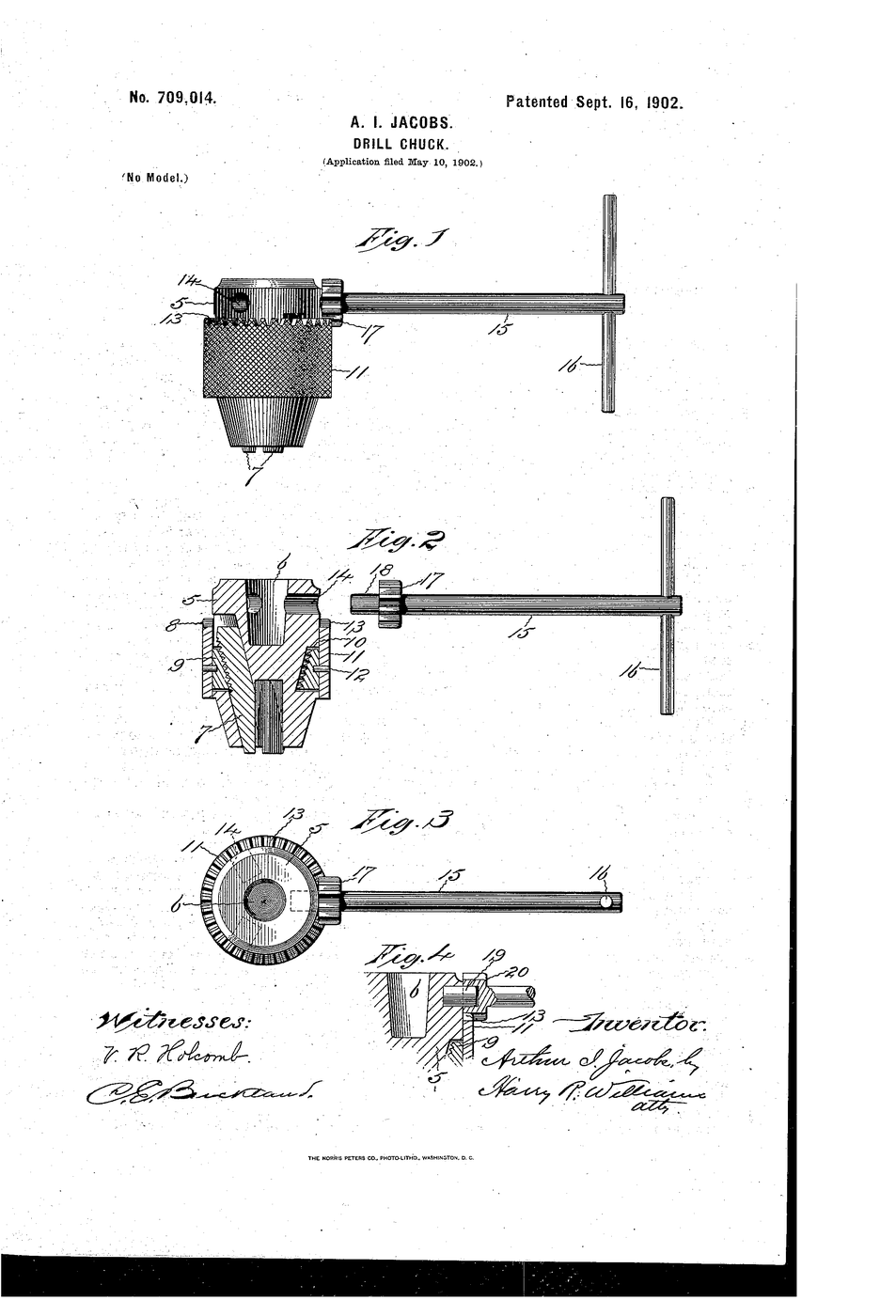
US 709,014, “Drill-Chuck”, Arthur I. Jacobs of Hartford, Connecticut. Filed 10 May 1902, granted 16 September 1902. Three jaws slide in recesses inclined to the chuck's axis and are driven by a threaded nut; a toothed key engages rack-teeth on a sleeve to turn that nut. Because the three jaws move together on inclined ways, the tool is automatically centred as it is gripped, at any diameter in the range — and the key means the operator no longer has to hold the spindle still.
Jacobs founded his chuck company the following year. The pattern is on virtually every drill press and hand drill made since, which is a rare thing to be able to say about a 1902 patent.
Mga Tagubilin
Name the three jobs a chuck must do
Name the three jobs a chuck must do
Write them down: grip hard, centre automatically, release quickly. Every design choice that follows is a trade between these three.
Draw three jaws at 120°
Draw three jaws at 120°
Draw a circle on graph paper and mark three radii 120° apart with the protractor. Three contacts is the smallest number that defines a centre.
Mga materyales para sa hakbang na ito:
 Papel na Grap1 pilyego
Mga kailangang kasangkapan:
 Panukat ng Anggulo
Show why two jaws cannot centre
Show why two jaws cannot centre
Draw the same circle with only two opposed jaws. A round bar can sit anywhere along the line between them — the grip is defined, the position is not.
Mga materyales para sa hakbang na ito:
Papel na Grap1 pilyegoOpen the real chuck fully
Open the real chuck fully
Open the drill press chuck to its maximum. Look inside with the loupe and find the three inclined ways and the threaded nut.
Mga kailangang kasangkapan:
 Baradong Nakatayo
 Lente ng Pampalaki
Measure the jaw travel per key turn
Measure the jaw travel per key turn
Mark the sleeve. Turn the key exactly one full revolution and measure how far the jaws close using the caliper. That ratio is the chuck's mechanical advantage.
Mga materyales para sa hakbang na ito:
Papel na Grap1 pilyegoMga kailangang kasangkapan:
 Digital na Kalibrador 6 Pulgada
Grip a drill bit and check run-out
Grip a drill bit and check run-out
Grip a 6 mm bit. Mount the dial indicator against its shank and rotate the spindle by hand. Record the total needle sweep — that is the run-out.
Mga kailangang kasangkapan:
 Hanay ng Talim ng Barena
 Dial IndicatorBaradong Nakatayo
Re-grip five times and record each
Re-grip five times and record each
Release and re-grip the same bit five times, measuring run-out each time. The spread is the chuck's repeatability, which matters more than any single reading.
Mga materyales para sa hakbang na ito:
Papel na Grap1 pilyegoMga kailangang kasangkapan:
Dial IndicatorTest shallow jaw engagement
Test shallow jaw engagement
Now grip the bit with only 5 mm of shank in the jaws and measure run-out again. Note how much worse it gets. Depth of engagement is free accuracy.
Mga materyales para sa hakbang na ito:
Papel na Grap1 pilyegoMga kailangang kasangkapan:
Dial IndicatorHanay ng Talim ng BarenaGrip the brass rod at the range extremes
Grip the brass rod at the range extremes
Measure run-out with the smallest and the largest shank the chuck accepts. Chucks are least accurate at the ends of their range.
Mga materyales para sa hakbang na ito:
 Bara ng Bronse1 piraso
Mga kailangang kasangkapan:
Dial IndicatorDigital na Kalibrador 6 PulgadaDrill a hole with a deliberately bad grip
Drill a hole with a deliberately bad grip
Grip the bit shallow and off-square, drill one hole in the steel bar, then measure the hole with the caliper. It will be oversize — run-out becomes hole error.
Mga materyales para sa hakbang na ito:
 Parisukat na baretang malambot na asero1 piraso
 Langis sa paggupit3 ml
Mga kailangang kasangkapan:
Baradong NakatayoDigital na Kalibrador 6 PulgadaDrill a hole with a good grip and compare
Drill a hole with a good grip and compare
Grip deep and true, drill again, measure again. Record both diameters against the bit's measured diameter.
Mga materyales para sa hakbang na ito:
Parisukat na baretang malambot na asero1 pirasoLangis sa paggupit3 mlMga kailangang kasangkapan:
Baradong NakatayoDigital na Kalibrador 6 Pulgada Mikrometro
Mark the centre before you drill
Mark the centre before you drill
Punch a centre mark with the punch and drill once more. A punched start defeats a small run-out; nothing defeats a large one.
Mga materyales para sa hakbang na ito:
Parisukat na baretang malambot na asero1 pirasoMga kailangang kasangkapan:
 Pantudlok sa GitnaBaradong Nakatayo
Compare with a lathe's three-jaw chuck
Compare with a lathe's three-jaw chuck
Examine the 3-jaw lathe chuck. Same 120° principle, scaled up, driven by a scroll instead of a nut — and it self-centres the same way.
Mga kailangang kasangkapan:
 Tsak ng torno na may 3 pangaLente ng Pampalaki
History & Context
History & Context
US 709,014, “Drill-Chuck”, Arthur Irving Jacobs, Hartford, Connecticut. Filed 10 May 1902, granted 16 September 1902. The printed sheet header reads “No. 709,014. Patented Sept. 16, 1902. A. I. JACOBS. DRILL CHUCK.” Jacobs founded the Jacobs Chuck Manufacturing Company in 1903.
The claim, precisely. Jaws move in recesses inclined to the axis, so advancing them along their ways closes them on the centre. A threaded nut drives all three together, and a toothed key engaging rack-teeth on a sleeve turns the nut — the specific benefit claimed being that the jaws can be worked “without requiring the operator to hold the drill spindle stationary”. A two-handed job became a one-handed one.
Why three. Two contacts grip but do not locate. Three contacts at 120° locate a round shank uniquely and are self-centring by geometry, not by adjustment. Four jaws grip square stock better but must be set individually — which is why lathes offer both, and drill chucks only ever three.
What run-out costs. A drill held even slightly off-axis cuts a hole larger than itself, because the tip orbits. Everything measured in steps 6-11 is that effect. This is also why the reamer exists: a drill sizes a hole approximately, and a following tool sizes it exactly.
Still standard. Keyless chucks arrived in the 1980s and dominate cordless tools, but they are the same three inclined jaws with a different actuator. The 1902 geometry has not been improved on.
Mga Materyales
4- 1 pilyegoPlaceholder
- 1 pirasoPlaceholder
- Placeholder
- Placeholder
Mga Kinakailangang Kasangkapan
9- Placeholder
- Placeholder
- Placeholder
- Placeholder
- Placeholder
- Placeholder
- Placeholder
- Placeholder
- Placeholder
Mga Materyales ng Nakakonektang Blueprint
Ang blueprint na ito ay gumagawa ng
Kaugnay na Blueprint
Ang mga blueprint na ito ay nagbabahagi ng kaalaman — mga teknik, materyales, o prinsipyo

CC0 Pampublikong Domain
Ang blueprint na ito ay inilabas sa ilalim ng CC0. Malaya kang kumopya, magbago, mamahagi, at gumamit nang walang pahintulot.
Suportahan ang Maker sa pamamagitan ng pagbili ng mga produkto sa kanilang Blueprint Komisyon ng Maker itinakda ng mga Vendor, o lumikha ng bagong bersyon ng Blueprint na ito at isama bilang koneksyon sa iyong Blueprint upang ibahagi ang kita.