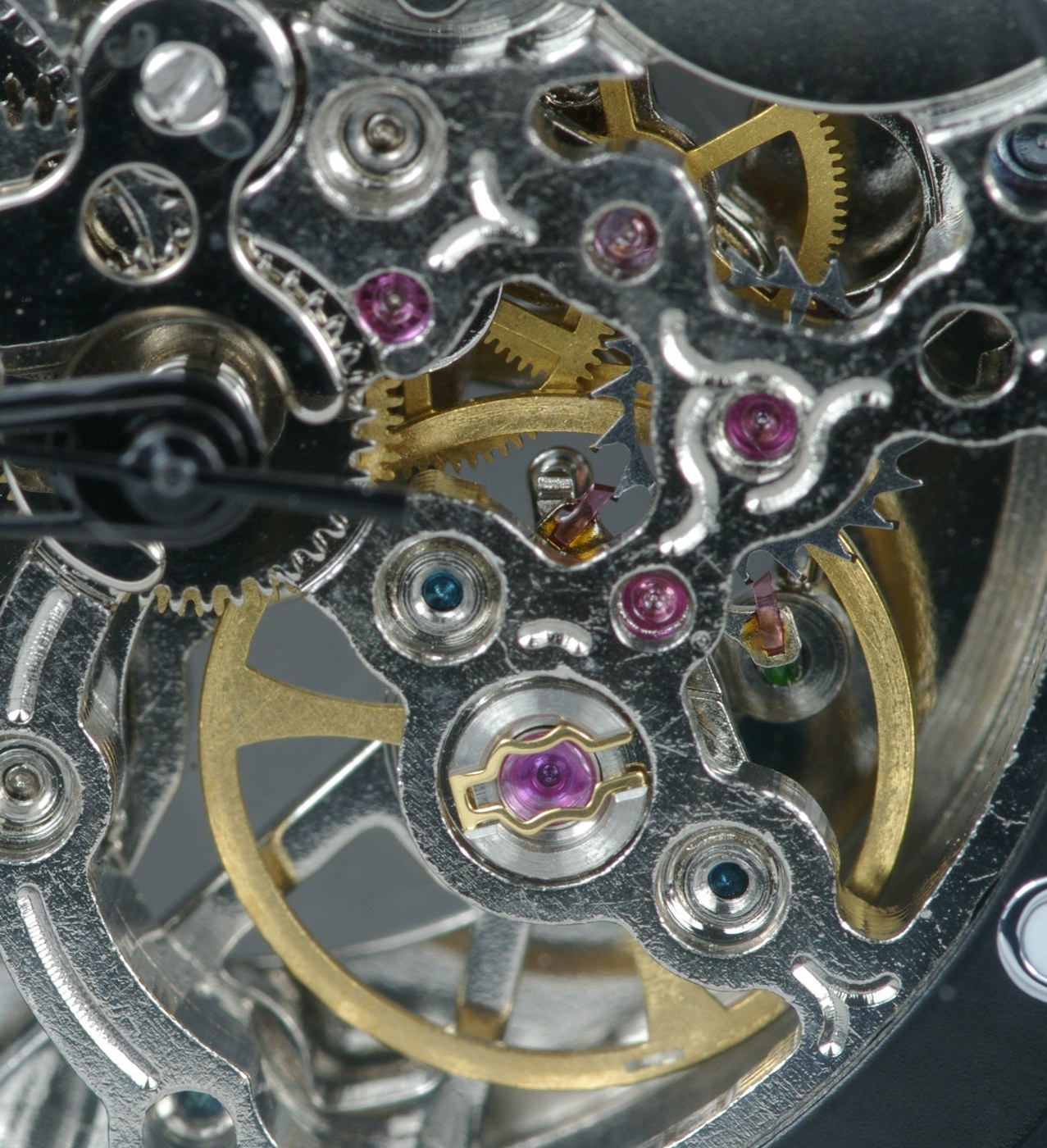


Jewelled Bearings
A watch balance swings some 400 million times a year. Its pivots are thinner than a human hair, and they run in holes. Metal running on metal at that duty cycle does not wear slowly — it wears constantly, and as the hole ovalises the balance shifts, the escapement's geometry changes and the rate walks away.
Oil postpones it and creates a second problem: oil thickens, dries, gums and creeps, so a watch's rate changes as its lubricant ages. A clock that must be cleaned to stay accurate is a clock whose accuracy has a calendar.
The jewelled bearing removes the problem by changing the material rather than the design. Drill the bearing hole in corundum — sapphire or ruby, the same mineral — and run a hardened steel pivot in it.
Corundum is roughly 9 on the Mohs scale against steel's 4 to 5, so the steel cannot abrade it. It takes a superb polish, so friction is low. It is chemically inert, so it does not corrode or react with the oil. And it holds its shape, so the hole stays round.
Not a cleverer mechanism. A harder rock, in the one place where hardness is worth more than anything else.
Mga Tagubilin
Rank your materials by who scratches whom
Rank your materials by who scratches whom
Take specimens — steel, brass, glass, quartz, corundum if you have it — and try to scratch each with each, recording the result in a grid.
Expect a strict ranking, with each material scratching everything softer and nothing harder.
That grid is the Mohs scale, rebuilt from scratch, and it carries the entire design rule: in a sliding pair, the harder material sets the wear. Steel on steel wears both. Steel on corundum wears only the steel — and the steel pivot is the cheap, replaceable half.
Mga materyales para sa hakbang na ito:
 Blokeng grapayt1 piraso
Wear out a soft bearing on purpose
Wear out a soft bearing on purpose
Run a steel wire pivot in a brass plate hole under load, spinning it for as long as you can stand, then measure the hole in two directions.
Expect it to have gone oval, elongated along the direction of load.
Now think about what an oval hole does in a watch. The balance sits slightly off its intended position, so the escapement's engagement changes, so the rate changes.
The failure is not that the clock stops. It is that it keeps running and lies to you, gradually — the worst failure mode an instrument can have.
Find out how little of the pivot should touch
Find out how little of the pivot should touch
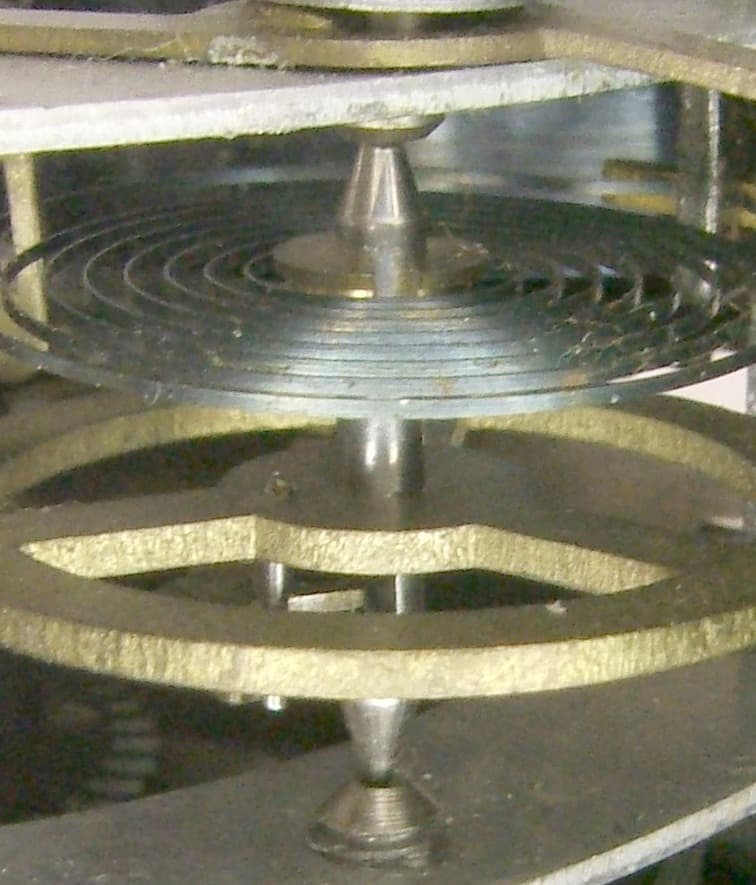
Compare a pivot running in a plain cylindrical hole with one running in a hole that has been olived — belled out so that contact is a narrow band rather than the full depth.
Measure the force needed to keep each turning.
Expect the olived hole to run noticeably freer.
A long contact traps oil and adds drag; a short one holds the pivot just as well. And note the second job it does: the curved mouth retains a drop of oil by surface tension instead of letting it creep away, which is why a jewel hole is shaped rather than merely drilled.
Cap the end and control the endshake
Cap the end and control the endshake
Add a flat cap jewel above the hole jewel so the pivot's rounded end runs against a flat rather than against a shoulder.
Measure the free axial movement — the endshake — and try it very tight, then generously loose.
Expect tight to bind and loose to let the balance wander, with a narrow band that is right.
Note what the cap changes: the pivot's end is a tiny hemisphere, so it touches the flat at nearly a point. The lowest-friction contact available is the smallest one that will carry the load, which is the same reasoning as a knife-edge on a balance beam.
Test whether the bearing still needs oil
Test whether the bearing still needs oil
Run a hard, well-polished bearing dry and lightly oiled, and compare the drag and the wear over a long run.
Expect a good hard pair to run acceptably dry where a soft pair seizes.
Then leave both for a long period and look for gumming.
This is the deeper prize and it is easy to miss: a jewelled bearing does not merely last longer, it reduces the watch's dependence on a substance that ages. Removing a consumable from a mechanism removes a whole class of drift — the same argument as a self-lubricating bushing or a sealed bearing today.
History & Context
History & Context
It was patented in London in 1704 by a Swiss and two Frenchmen. Nicolas Fatio de Duillier — a mathematician better known as Newton's friend and later his defender in the calculus dispute — worked out how to pierce and shape hard stones for pivot holes, with the brothers Peter and Jacob Debaufre. The English patent gave them a monopoly, and English watchmaking held a real technical lead for decades because of it.
The secret leaked slowly, which is unusual and instructive. Drilling a hole a few tenths of a millimetre across in sapphire, then belling and polishing it, was genuinely difficult, so the advantage lasted far longer than the patent's legal force. A monopoly protected by skill outlives one protected by law — which is why the Swiss industry's later dominance came from learning to make jewels in quantity, not from any new principle.
Then synthesis made them nearly free. Auguste Verneuil's flame-fusion process, published around 1902, grew synthetic corundum boules from alumina powder, and the price of a jewel collapsed. What had been a luxury became standard in every watch — which is why movements advertise a jewel count at all, and why that count became a marketing number long after it stopped being a meaningful one. Watch out for a specification that survives as advertising after it stops discriminating.
The idea generalises far beyond watches. Hard, inert, polished pivot bearings appear in every sensitive mechanical instrument: galvanometers, compasses, gyroscopes, analogue meters and precision balances. Anywhere a small deflection must be read repeatably, the bearing's friction sets the resolution, and corundum on steel is still a good answer.
Honest limits. It solves wear and friction and does nothing whatever for the errors that actually dominate a watch — temperature, position and escapement disturbance. Jewels are brittle: a shock that a brass hole would shrug off can crack one, which is why shock-absorbing settings were later invented. They must be fitted with real precision, since a jewel in the wrong place is worse than a bad hole. And a high jewel count guarantees nothing about accuracy, however loudly a dial says otherwise.
Mga Materyales
5- 1 pirasoPlaceholder
- 1 pilyegoPlaceholder
- Placeholder
- Placeholder
- 1 botePlaceholder
Mga Kinakailangang Kasangkapan
3- Placeholder
- Placeholder
- Placeholder
Mga Materyales ng Nakakonektang Blueprint

Kaugnay na Blueprint
Ang mga blueprint na ito ay nagbabahagi ng kaalaman — mga teknik, materyales, o prinsipyo

CC0 Pampublikong Domain
Ang blueprint na ito ay inilabas sa ilalim ng CC0. Malaya kang kumopya, magbago, mamahagi, at gumamit nang walang pahintulot.
Suportahan ang Maker sa pamamagitan ng pagbili ng mga produkto sa kanilang Blueprint Komisyon ng Maker itinakda ng mga Vendor, o lumikha ng bagong bersyon ng Blueprint na ito at isama bilang koneksyon sa iyong Blueprint upang ibahagi ang kita.