
SINING
BEAUTY AT WELLNESS
CRAFTS
KULTURA AT KASAYSAYAN
LIBANGAN
KAPALIGIRAN
PAGKAIN AT INUMIN
REVERSE ENGINEERING
AGHAM
ISPORTS
TEKNOLOHIYA
MGA WEARABLE
Woven-Reed Footstool: Nailed Dowel Frame, Wound Posts, Woven Top and Pairing-Weave Apron (Boy Mechanic, 1919)
Tex

Nilikha ni

Tex

14. Nobyembre 2026FO
17
0
0
0
0

Woven-Reed Footstool: Nailed Dowel Frame, Wound Posts, Woven Top and Pairing-Weave Apron (Boy Mechanic, 1919)

Charles M. Miller's reed footstool from The Boy Mechanic, Book 3 (1919): a frame of 3/4 in dowel rails and posts with crossed 5/8 in braces, nailed through drilled holes, the posts and rails wound with flat reed, the top woven over No. 4 spokes and the apron in pairing weave, finished with a broken-down roll.
Katamtaman
About 2 days

Mga Tagubilin

1

Cut list

Naglo-load ng Jupyter notebook…
2

Read The Boy Mechanic, Book 3

"Each piece of reed furniture has a framework, usually of dowels." The reed sizes are those of his reed basket (Boy Mechanic, Book 2).
3

Cut and drill the frame

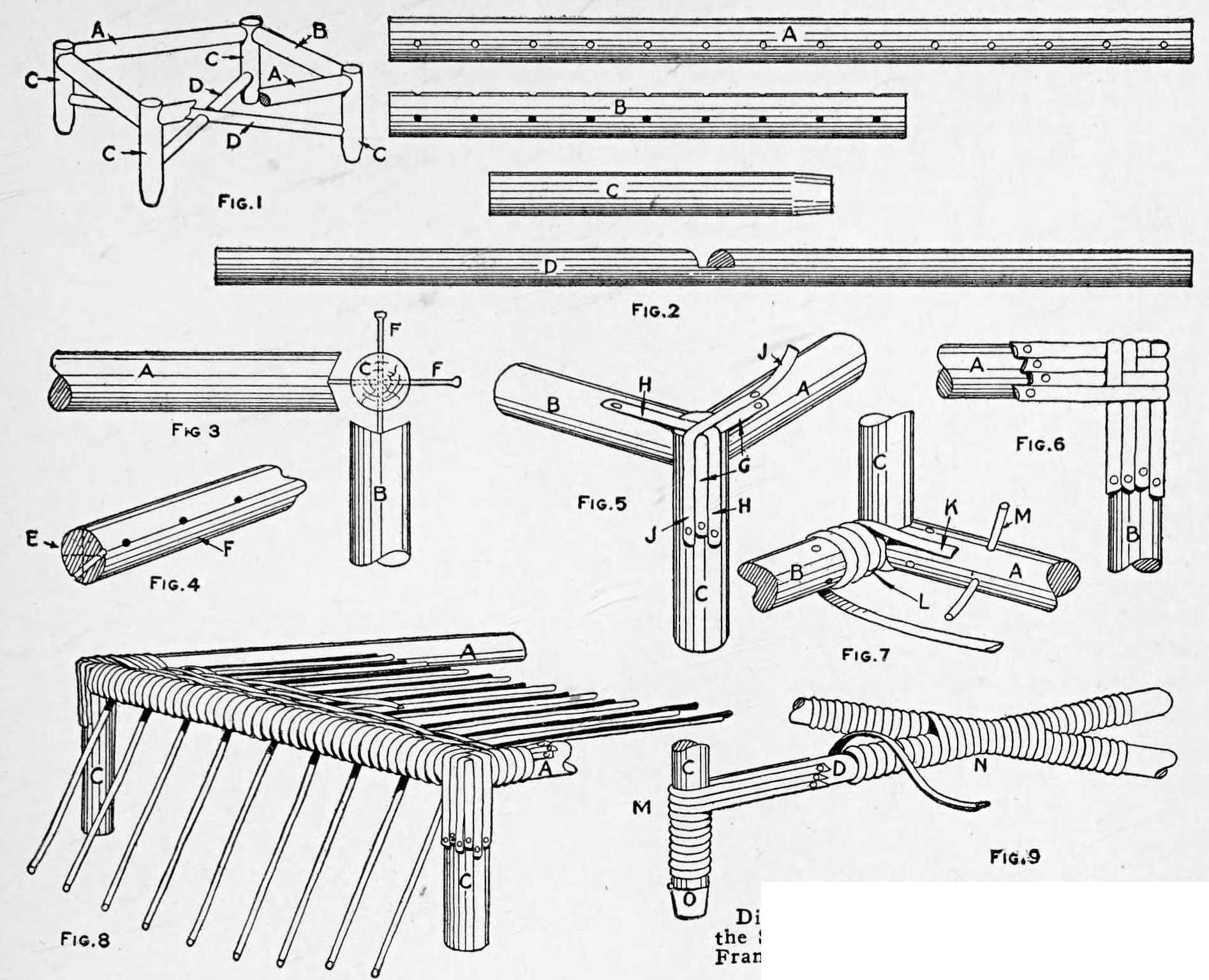
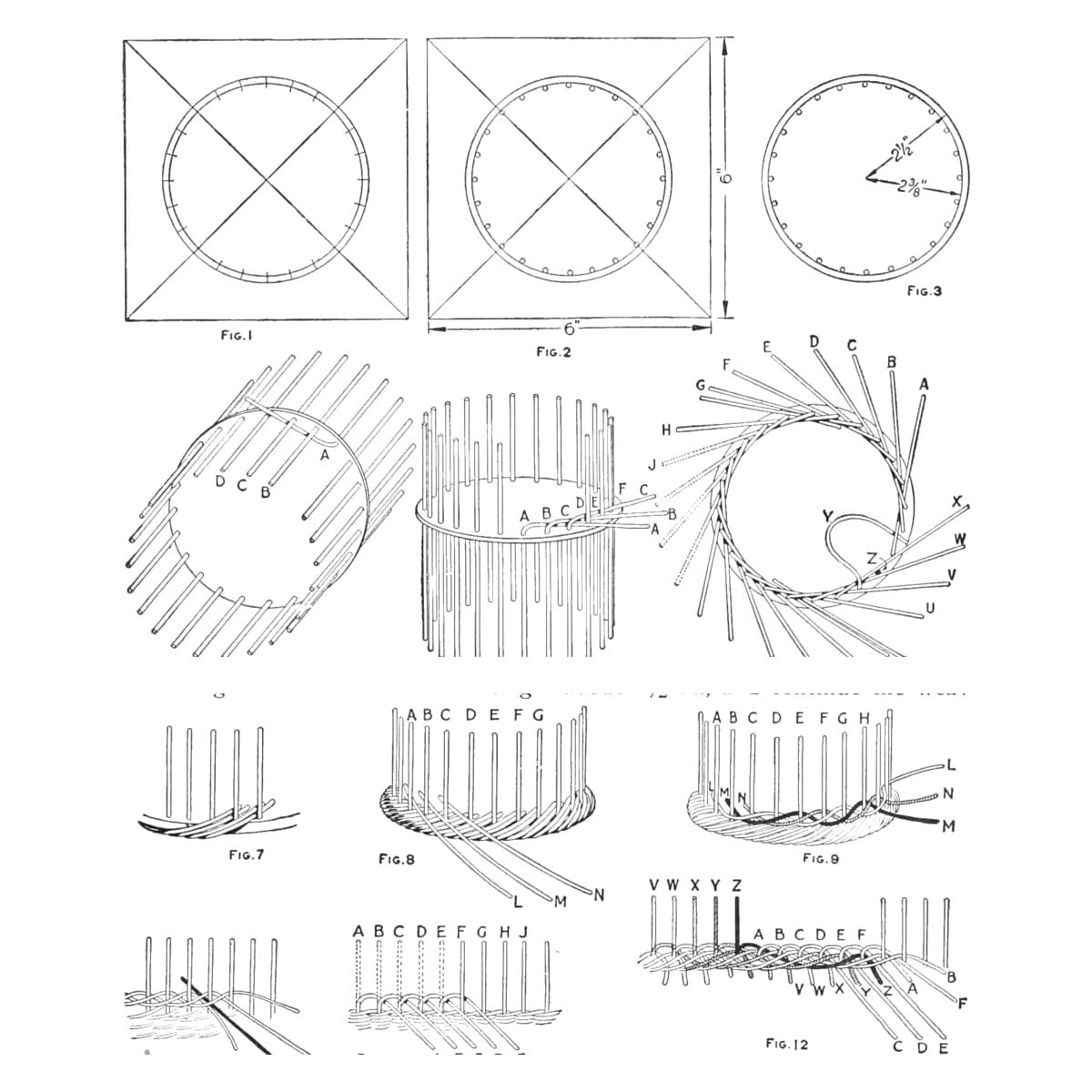
Cut two side rails 3/4 by 14 in, two end rails 3/4 by 9 in, four posts 3/4 by 7 in and two braces 5/8 by 17 in (trimmed to fit later). Notch the rail and brace ends with a coping saw to seat on the posts. Before assembly drill the spoke holes, 1/8 in for No. 4 reed, combining the top and end-side spoke holes as in Fig. 4 and drilling the side-rail holes straight (Fig. 2).

Mga materyales para sa hakbang na ito:
Kahoy na TarugoKahoy na Tarugo4 piraso

Mga kailangang kasangkapan:

Lagaring PangkurbaLagaring Pangkurba
Barenang de-kamayBarenang de-kamay
LapisLapis
Panukat na TapePanukat na Tape
4

Nail the frame

Run the posts to the top of the frame and nail through them into the rail ends with ordinary 4-penny nails, drilling 1/16 in holes first. Set the side rails about 1/16 in below the post tops. Halve the braces at the centre on a slant so their tops lie level, try them, and nail them without pulling the frame out of square (Fig. 1).

Mga materyales para sa hakbang na ito:
Mga pakoMga pako1 piraso

Mga kailangang kasangkapan:

Barenang de-kamayBarenang de-kamay

MartilyoMartilyo
Lagaring PangkurbaLagaring Pangkurba
5

Wind the posts and end rails

Cover the post tops with short pieces of winding reed tacked on with shoemaker's tacks, crossing in turn (Figs. 5, 6). Wind the end rails, marking each hole with pencil as the winding passes it; then open each hole through the winding with a bodkin (Fig. 7).

Mga materyales para sa hakbang na ito:

Hinating kawayanHinating kawayan1 piraso
Pakong panghawak sa hulmahanPakong panghawak sa hulmahan1 piraso

Mga kailangang kasangkapan:

MartilyoMartilyo

PanundotPanundot
LapisLapis
6

Weave the top

Put the 32 in No. 4 spokes through one end rail, down and out at the ends. Weave with a single No. 3 weaver, and after 3/4 in add a short extra spoke beside each spoke, weaving the pair as one; wind the weaver twice round the side rail each time. Insert the spokes in the other end rail before the weaving is within 2 or 3 in of it (Fig. 8).

Mga materyales para sa hakbang na ito:
YantokYantok1 piraso

Mga kailangang kasangkapan:

GuntingGunting
Balde na 20 LitroBalde na 20 Litro
EsponghaEspongha
7

Wind braces and posts, weave the apron

Wind the braces and posts, three strips round the post and tacked where each brace meets it, and both braces together where they cross (Fig. 9); finish the posts with brass caps or wind to within 1/8 in of the bottom. With the stool upside down, insert short spokes in the under side of the side rails and weave the apron in pairing weave, always passing one weaver twice round each post (Figs. 10-12). Cut the extra spokes even and break down the spokes into a roll, tucking the ends inside (Figs. 13-15). Singe off stray fibres carefully with a gas flame or blowtorch.

Mga materyales para sa hakbang na ito:

Hinating kawayanHinating kawayan1 piraso
YantokYantok1 piraso
Pakong panghawak sa hulmahanPakong panghawak sa hulmahan1 piraso

Mga kailangang kasangkapan:

GuntingGunting
Sulô ng PropanoSulô ng Propano
EsponghaEspongha
Balde na 20 LitroBalde na 20 Litro
8

Troubleshooting

Reed weaving troubleshooting.

Flow

Loading...
9

History and honest limits

From "A Woven-Reed Footstool" by Charles M. Miller, in **The Boy Mechanic, Book 3**, Popular Mechanics, 1919 (Project Gutenberg 71856; checked on the archive.org scan boymechanic0003unse, pp. 255-258). Fig. 2 shows the hole positions without figures, and he mentions an optional chloride-of-lime bleach that we leave out. The tools and metric figures are ours.

Mga Materyales

5

Mga Kinakailangang Kasangkapan

10

Ang blueprint na ito ay gumagawa ng

Kaugnay na Blueprint

Ang mga blueprint na ito ay nagbabahagi ng kaalaman — mga teknik, materyales, o prinsipyo
CC0 Pampublikong Domain

Ang blueprint na ito ay inilabas sa ilalim ng CC0. Malaya kang kumopya, magbago, mamahagi, at gumamit nang walang pahintulot.

Suportahan ang Maker sa pamamagitan ng pagbili ng mga produkto sa kanilang Blueprint Komisyon ng Maker itinakda ng mga Vendor, o lumikha ng bagong bersyon ng Blueprint na ito at isama bilang koneksyon sa iyong Blueprint upang ibahagi ang kita.

Talakayan

(0)

Mag-login upang sumali sa talakayan

Naglo-load ng mga komento...