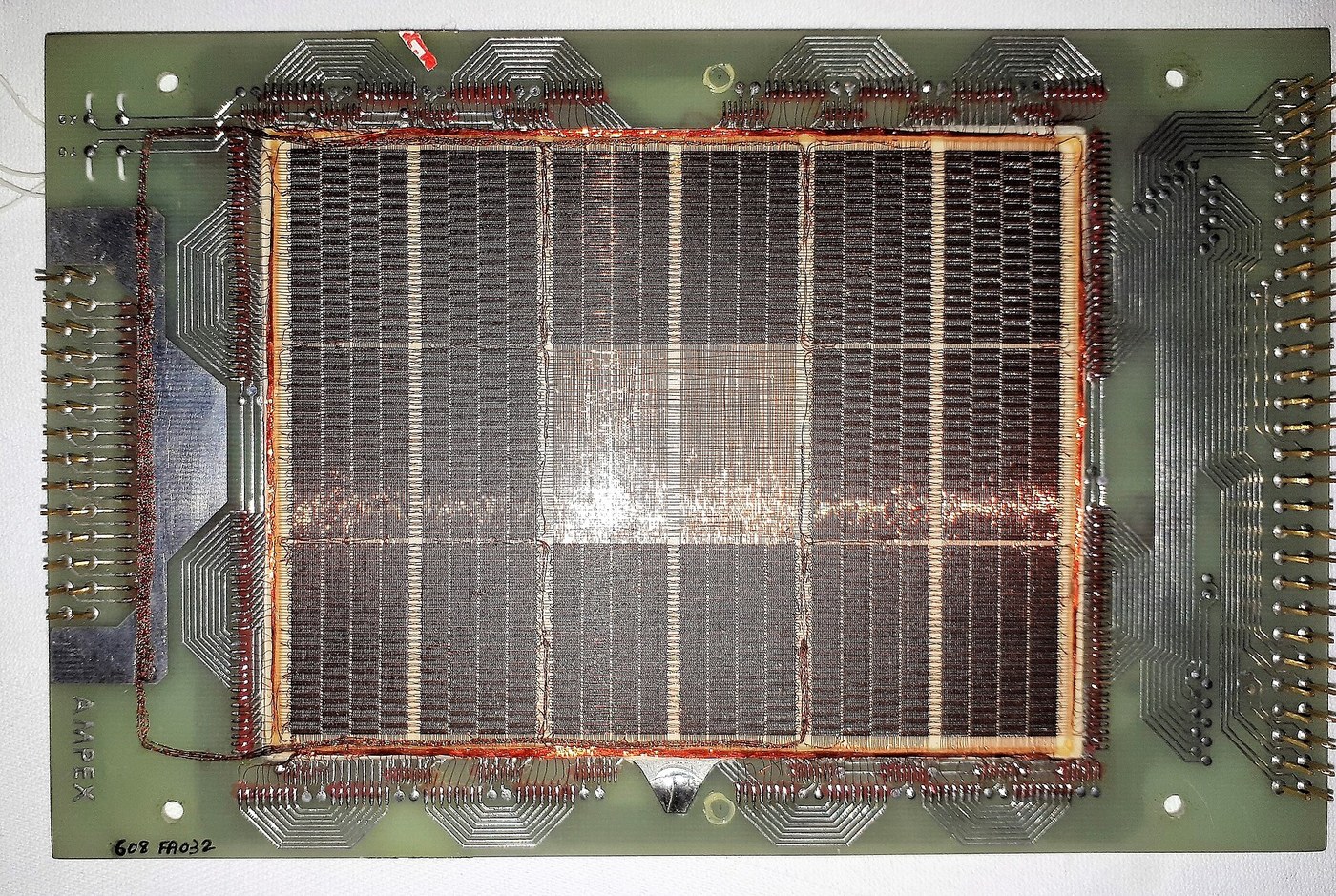

Magnetic Core Memory
Mga Tagubilin
Find the square hysteresis loop
Find the square hysteresis loop
Core memory works because of one unusual material property. Measure it before relying on it.
- Wind a few turns of wire through a ferrite toroid as a drive winding, and a few more as a sense winding.
- Drive it with a slow triangular current and plot drive current against the integrated sense voltage on the oscilloscope in X-Y mode.
- You are drawing the hysteresis loop of the material.
- Compare a ferrite intended for memory with an ordinary transformer core.
The memory ferrite gives a nearly RECTANGULAR loop: below a threshold current almost nothing happens, and above it the core flips fully. An ordinary core gives a lazy S-shape.
That squareness is what makes half-current selection possible. Half the switching current must do essentially nothing, or every core on the driven row would flip. A material with a rounded loop would half-flip hundreds of cores and destroy the data.
This is a case where the whole architecture depends on a materials property, not on circuit cleverness. Core memory was not invented until ferrites with square loops could be made reliably, and the manufacturing of those ferrites was as much of the achievement as the wiring scheme.Mga materyales para sa hakbang na ito:
 Bilog na ubod na ferrite6 piraso
 Kawad na Tanso na May Enamel5 m
 Kit ng Risistor1 kit
Mga kailangang kasangkapan:
 Osiloskopyo
 Bumubuo ng Alon
 Digital na Multimetro na Pang-laboratoryo
 Estasyon ng Panghinang
Thread a 4x4 plane and address one core
Thread a 4x4 plane and address one core
Build the smallest plane that demonstrates coincident selection. It is fiddly and it is the whole point.
- Mount sixteen cores in a 4 by 4 grid, each tilted 45° so the wires can pass cleanly.
- Thread an X wire through every core in each row, and a Y wire through every core in each column.
- Thread a single SENSE wire diagonally through all sixteen.
- Drive one X and one Y line with half the switching current each and observe the sense wire.
Only the core where the two driven wires cross receives full current and flips; every other core on those lines sees half and stays put. The sense wire picks up a voltage pulse from the one core that switched.
Reverse-engineering note: the cores are tilted alternately because a wire threading straight through would couple differently to each. Early planes were threaded BY HAND under a microscope, largely by women employed for the work, and Apollo's rope memory was woven the same way — the software was literally sewn. A 32-kilobit plane is 32,768 cores, each with three or four wires through a hole under a millimetre across.Mga materyales para sa hakbang na ito:
Bilog na ubod na ferrite16 pirasoKawad na Tanso na May Enamel10 m Perfboard / Protoboard1 piraso
 Sari-saring transistor1 kit
Mga kailangang kasangkapan:
Estasyon ng PanghinangOsiloskopyoDigital na Multimetro na Pang-laboratoryo Malinaw na Salaming Pangkaligtasan
Destructive read, and why every read is a rewrite
Destructive read, and why every read is a rewrite
Trace it carefully, because this is genuinely strange to modern eyes. You cannot ask a core what it holds — you can only try to set it to zero and see whether it objected.
A core that was storing 1 flips and announces itself with a pulse; a core already at 0 does nothing. Either way the core ends at 0, so the act of reading destroys the data, and the memory controller must immediately write it back.
That write-back is not optional and it is not free — it doubles the cycle time, which is why core memory quotes a read time and a longer full cycle time.
The surviving fossil: we still say a program's memory image is a core dump, and DEC's PDP manuals still spoke of core long after ferrite was gone. Destructive read also explains a habit of the era — reading a location and relying on the write-back was a normal way to refresh, and a program that crashed mid-cycle could leave memory genuinely corrupted rather than merely stale.Flow
Mga kailangang kasangkapan:
 Desktop na Kompyuter
Price it against the alternatives
Price it against the alternatives
Mga kailangang kasangkapan:
Desktop na KompyuterRadiation hardness, and where core outlived everything
Radiation hardness, and where core outlived everything
Core has one property that nothing has beaten, and it kept it flying for decades.
- Consider what physically stores the bit: the direction of magnetisation of a ferrite ring.
- Now consider what a passing charged particle does to that.
- Compare with a semiconductor cell, where the bit is a small packet of charge on a capacitor or a node.
A cosmic ray can dump enough charge into a semiconductor cell to flip it; it cannot realign a magnetised ferrite ring. Core memory is essentially immune to single-event upsets, and it is non-volatile, so a power transient loses nothing.
That is why Apollo used core, why the Space Shuttle's early computers used it, and why some spacecraft carried it long after it was commercially extinct. The Apollo Guidance Computer's programs were in core ROPE memory — wires woven through or around cores by hand, unalterable once woven, and utterly reliable.
The pattern is worth naming, because this batch keeps producing it: a superseded technology survives wherever its ONE surviving advantage is the thing that matters most. The delay line survived as a filter; core survived as radiation-hard non-volatile storage. Obsolete in general is not obsolete everywhere.Mga materyales para sa hakbang na ito:
Bilog na ubod na ferrite4 pirasoMga kailangang kasangkapan:
Desktop na KompyuterDigital na Multimetro na Pang-laboratoryoMga Materyales
5- 26 pirasoPlaceholder
- Placeholder
- Placeholder
- 1 pirasoPlaceholder
- Placeholder
Mga Kinakailangang Kasangkapan
6- Placeholder
- Placeholder
- Placeholder
- Placeholder
- Placeholder
- Placeholder
Kaugnay na Blueprint
Ang mga blueprint na ito ay nagbabahagi ng kaalaman — mga teknik, materyales, o prinsipyo


CC0 Pampublikong Domain
Ang blueprint na ito ay inilabas sa ilalim ng CC0. Malaya kang kumopya, magbago, mamahagi, at gumamit nang walang pahintulot.
Suportahan ang Maker sa pamamagitan ng pagbili ng mga produkto sa kanilang Blueprint Komisyon ng Maker itinakda ng mga Vendor, o lumikha ng bagong bersyon ng Blueprint na ito at isama bilang koneksyon sa iyong Blueprint upang ibahagi ang kita.