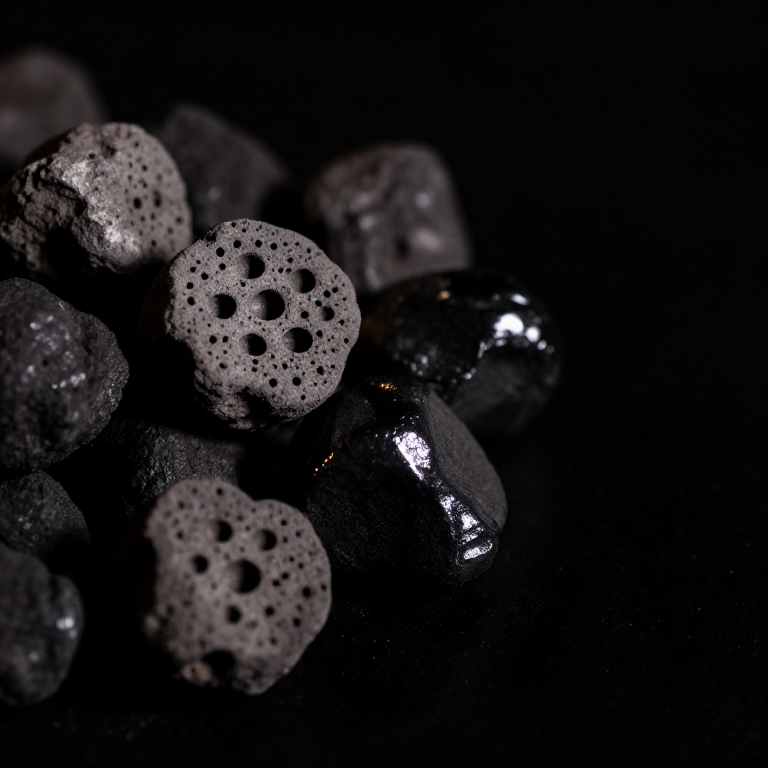


Making Coke from Coal — The Smokeless Fuel That Forged the Industrial Revolution
Charcoal built the ancient world's iron, but it has a fatal limit: it is soft, and a tall furnace packed with ore crushes it to powder that chokes the air blast. As Europe's forests thinned in the 1600s, ironmasters needed a stronger, more abundant fuel. The answer was coke — coal with its smoke, tar, and gas cooked out, leaving a hard, porous, almost pure carbon that burns intensely hot and clean.
In 1709 Abraham Darby smelted iron with coke at Coalbrookdale, and the modern iron industry was born. Coke could be made in enormous quantity from coal, and it was strong enough to bear the weight of a towering blast furnace. Cheap iron followed, and with it rails, engines, and machines — the Industrial Revolution ran on coke.
Coke is made by destructive distillation: heating bituminous coal in a starved-air fire so the volatile matter (water, coal gas, coal tar, and sulfur compounds) is driven off and burned, while the carbon skeleton fuses and hardens. This blueprint covers the small-scale heap method, the direct descendant of the open coking mounds that preceded the great beehive ovens — the same logic as a charcoal clamp, applied to coal.
Mga Tagubilin
Choose coking coal
Choose coking coal
Mga materyales para sa hakbang na ito:
 Bituminous na uling-bato25 kg
Break the coal to size
Break the coal to size
Mga kailangang kasangkapan:
 Martilyo
Prepare the coking base
Prepare the coking base
Mga kailangang kasangkapan:
 Pala
PalaBuild a central flue
Build a central flue
Mga materyales para sa hakbang na ito:
 Tuyong dahon at pang-gatong2 kg
Stack the coal into a dome
Stack the coal into a dome
Mga materyales para sa hakbang na ito:
Bituminous na uling-bato25 kgCover the heap
Cover the heap
Mga materyales para sa hakbang na ito:
 Luwad10 kg
Light the core
Light the core
Mga kailangang kasangkapan:
 Posporo
Read the smoke
Read the smoke
Mga kailangang kasangkapan:
 Panungkit sa apoy
Control the air
Control the air
Mga kailangang kasangkapan:
PalaCoke until the smoke clears
Coke until the smoke clears
Quench or seal
Quench or seal
Mga materyales para sa hakbang na ito:
 Tubig40 litro
Open and rake out the coke
Open and rake out the coke
Mga kailangang kasangkapan:
 Kalaykay na bakal
Test the coke
Test the coke
Mga kailangang kasangkapan:
Panungkit sa apoyStore the coke dry
Store the coke dry
Mga Materyales
4- Placeholder
- Placeholder
- 10 kgPlaceholder
- 40 litroPlaceholder
Kaugnay na Blueprint
Ang mga blueprint na ito ay nagbabahagi ng kaalaman — mga teknik, materyales, o prinsipyo
Making Charcoal from Hardwood — Pyrolysis in a Pit Kiln
ni Charlie
Kemistri
Smelting Bog Iron in a Bloomery Furnace — From Ore to Wrought Iron
ni Forge
Paggawa ng Metal
Perkin's Mauveine — The First Synthetic Aniline Dye from Coal Tar
ni Tex
Tela at Katad
Making Synthetic Alizarin Crimson — The Coal Tar Pigment That Destroyed the Madder Industry
ni Charlie
SINING
CC0 Pampublikong Domain
Ang blueprint na ito ay inilabas sa ilalim ng CC0. Malaya kang kumopya, magbago, mamahagi, at gumamit nang walang pahintulot.
Suportahan ang Maker sa pamamagitan ng pagbili ng mga produkto sa kanilang Blueprint Komisyon ng Maker itinakda ng mga Vendor, o lumikha ng bagong bersyon ng Blueprint na ito at isama bilang koneksyon sa iyong Blueprint upang ibahagi ang kita.