
SINING
BEAUTY AT WELLNESS
CRAFTS
KULTURA AT KASAYSAYAN
LIBANGAN
KAPALIGIRAN
PAGKAIN AT INUMIN
REVERSE ENGINEERING
AGHAM
ISPORTS
TEKNOLOHIYA
MGA WEARABLE
Shoe Horn With a Rolled Tubular Tang, Cut From One Sheet (Williams, 1901)
Forge

Nilikha ni

Forge

13. Nobyembre 2026NO
25
0
0
0
0

Shoe Horn With a Rolled Tubular Tang, Cut From One Sheet (Williams, 1901)

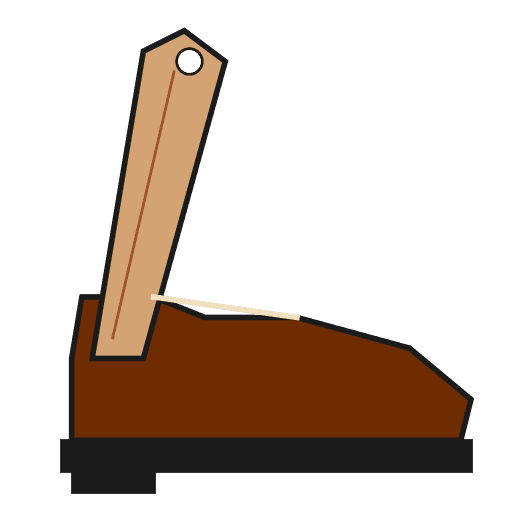
Alfred G. Williams of Newark received US 685,548, dated 29 October 1901, for a sheet-metal shoe horn whose handle tang is part of the same blank. A tongue at the narrow end is rolled into a close tube, and two wings beside it are folded over the edges of the horn, so the weak neck is stiffened where it meets the tang. A handle fits on the tang. We cut it from brass sheet with a 1:1 template and fit a hardwood handle. All sizes are ours.
Baguhan
About 3 hours

Mga Tagubilin

1

How wide to cut the tongue

Naglo-load ng Jupyter notebook…
2

Read US 685,548

"I construct the tang by extending the sheet metal from the upper or smaller end of the horn in a tongue of suitable width to roll into a tubular tang and form integral with such tongue lateral wings or flanges upon the upper end of the horn, which can be folded or curved upon the edges of the horn to stiffen the same at its junction with the tang."
3

Print the template

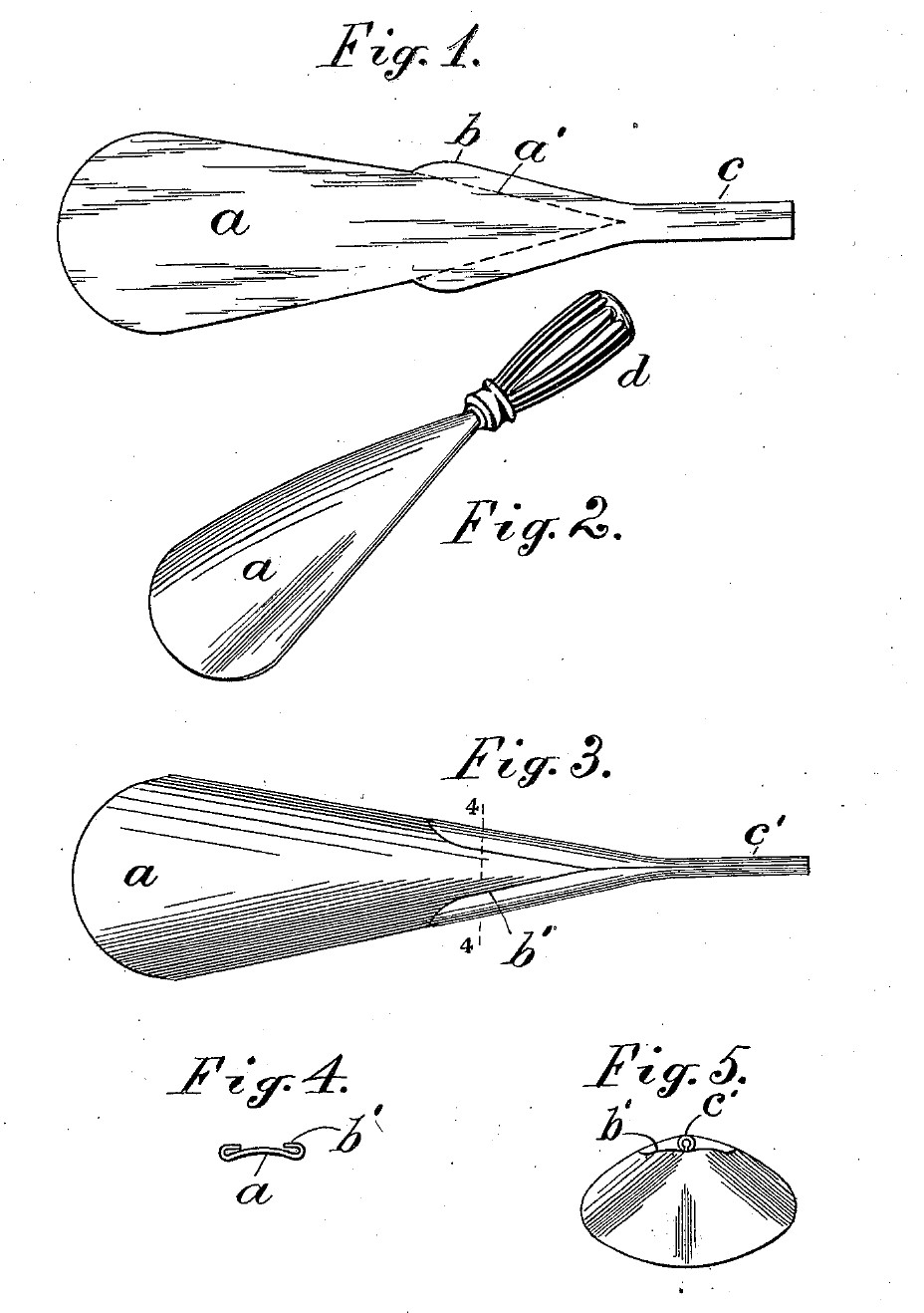
The blank at 1:1 as his Fig. 1: body a, wings b, tongue c, with the fold lines a' dashed: they run from where each wing starts in to the root of the tongue. print at 100 % (check the 50 mm bar).
File ng DisenyoPDFCC0 - Free
4

Cut the blank

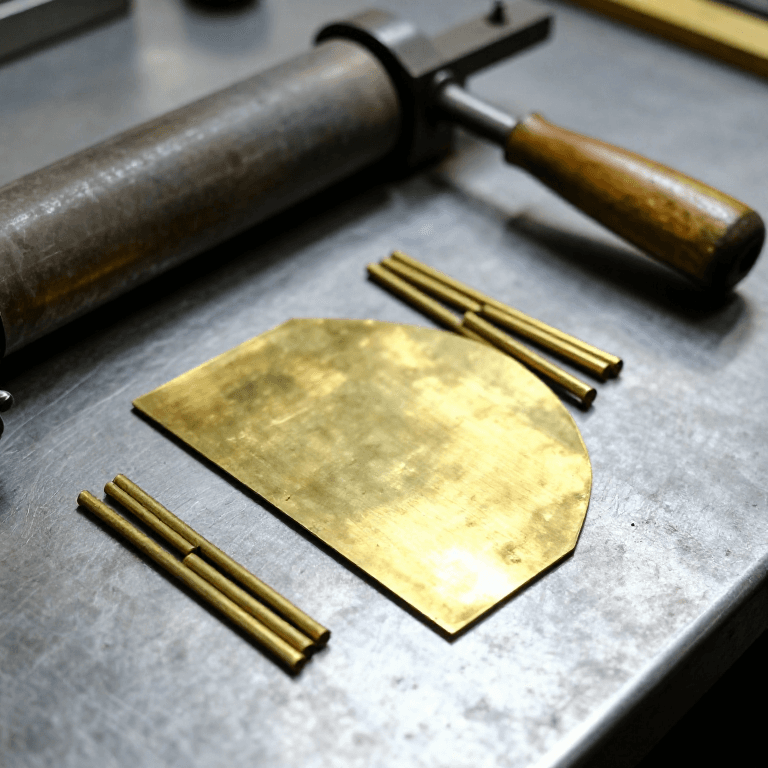
Cut the paper blank out and lay it on 0.8 mm brass sheet. Scribe round it. Cut just outside the line with tin snips, then file to the line. Keep the tongue an even 15 mm wide.

Mga materyales para sa hakbang na ito:

Lapad na BronseLapad na Bronse1 piraso

Mga kailangang kasangkapan:

PanggurlisPanggurlis
Gunting na pangyeroGunting na pangyero
Hanay ng KikilHanay ng Kikil
Bais sa Mesang PanggawaBais sa Mesang Panggawa
5

Smooth the edges

Round every edge of the body with a file and sandpaper. The mouth slides against the heel and the sock, so it must be smooth all round.

Mga kailangang kasangkapan:

Hanay ng KikilHanay ng Kikil

Papel de LihaPapel de Liha
6

Roll the tang

Lay a 4 mm rod along the middle of the tongue. With round-nose pliers, curl one edge of the tongue up round the rod, then the other, a little at a time along its length, until the edges meet: his "close-rolled cylindrical" tang c'. Slide the rod out.

Mga kailangang kasangkapan:

Plais na bilog ang duloPlais na bilog ang dulo
Plais na Patag ang NgusoPlais na Patag ang Nguso
Bilog na Bara ng Malambot na AseroBilog na Bara ng Malambot na Asero
7

Fold the wings

Fold each wing b along its dashed line a' over the edge of the horn, onto the underside, with the flat-nose pliers and then light taps of the rubber mallet, until it lies close. His Figs. 3 and 4 show the horn turned over, with the wings b' lying on the edges and running into the tang.

Mga kailangang kasangkapan:

Plais na Patag ang NgusoPlais na Patag ang Nguso
Malyong gomaMalyong goma
8

Dish the body

His body is "slightly concave transversely". Lay it, inside up, across a rod held in the vice and tap the edges down with the rubber mallet, working from the neck to the mouth, until it is evenly hollow across its width. Keep the curve slight; it should still lie nearly flat on the bench along its length.

Mga kailangang kasangkapan:

Malyong gomaMalyong goma
Bilog na barang asero na malambotBilog na barang asero na malambot
Bais sa Mesang PanggawaBais sa Mesang Panggawa
9

Make the handle

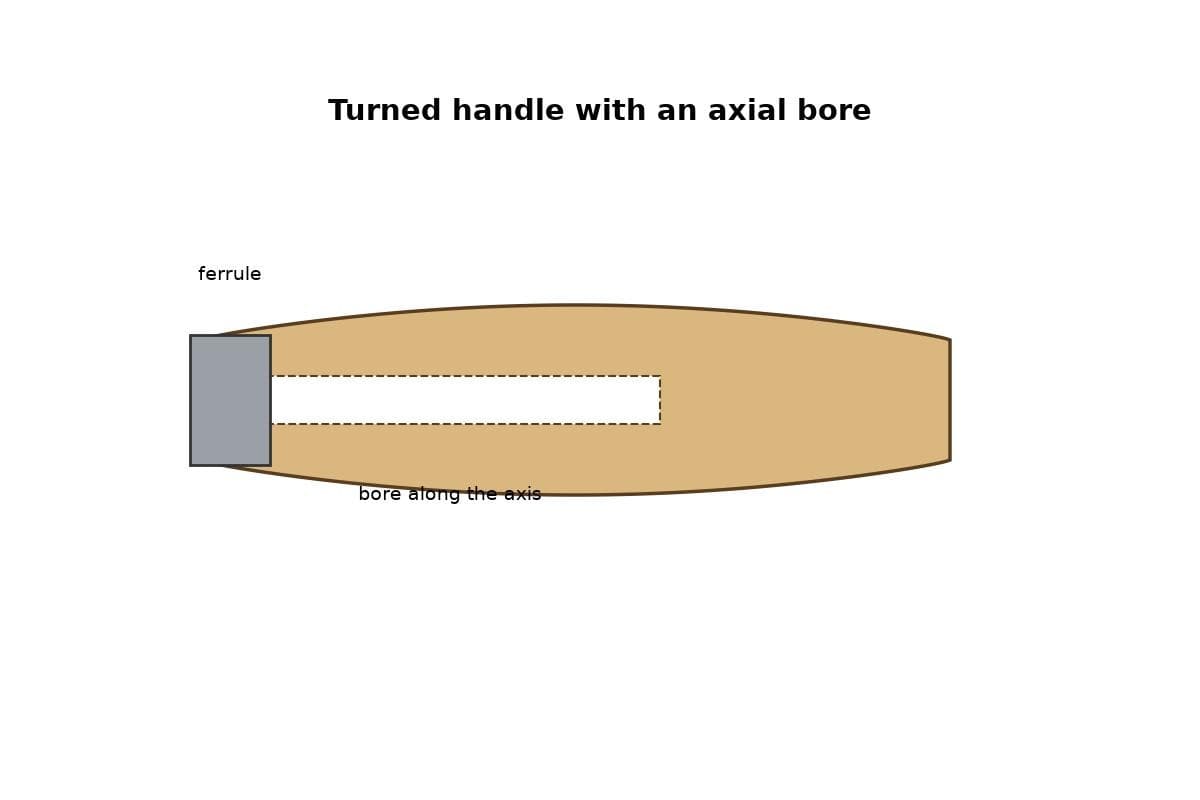
Saw 75 mm of hardwood handle stock (ours) and shape it with a rasp and sandpaper. Drill a 6 mm hole 40 mm deep in one end, straight down the middle, to take the tang. His handle is "more for ornament than for support", so any shape you like will do.

Mga materyales para sa hakbang na ito:

Kahoy na Matigas Pang-hawakanKahoy na Matigas Pang-hawakan1 piraso

Mga kailangang kasangkapan:

Lagaring Pang-metalLagaring Pang-metal
Kikil na pangkahoy (rasp)Kikil na pangkahoy (rasp)
Papel de LihaPapel de Liha
Barenang de-kamayBarenang de-kamay
Bais sa Mesang PanggawaBais sa Mesang Panggawa
10

Fit the handle

Roughen the tang with sandpaper, mix the epoxy, fill the hole and push the handle onto the tang until it meets the wings. Line the handle up with the horn and leave it to set as the epoxy's label says.

Mga materyales para sa hakbang na ito:
Epoksing dalawang bahagiEpoksing dalawang bahagi1 piraso

Mga kailangang kasangkapan:

Papel de LihaPapel de Liha
11

Polish

Polish the horn with polishing compound on a soft cloth.

Mga kailangang kasangkapan:

Pampakintab na pastaPampakintab na pasta
12

Troubleshooting

Tubular-tang shoe horn troubleshooting.

Flow

Loading...
13

History and honest limits

**Alfred G. Williams** of Newark, New Jersey, assignor to Havell Manufacturing Company, US 685,548, dated 29 October 1901, filed 26 June 1901. He claimed "the shoe-horn having integral tang c', of close-rolled cylindrical form, with integral wings b' extended from such tang and folded over upon the edges of the horn". He meant it for "ornamented handles" in "mounted toilet sets". He gives no sizes, no metal and no way of fixing the handle: the brass, all sizes, the hardwood handle, the epoxy and the order of work are ours.

Mga Materyales

3

Mga Kinakailangang Kasangkapan

14

Mga design file

1

Ang blueprint na ito ay gumagawa ng

CC0 Pampublikong Domain

Ang blueprint na ito ay inilabas sa ilalim ng CC0. Malaya kang kumopya, magbago, mamahagi, at gumamit nang walang pahintulot.

Suportahan ang Maker sa pamamagitan ng pagbili ng mga produkto sa kanilang Blueprint Komisyon ng Maker itinakda ng mga Vendor, o lumikha ng bagong bersyon ng Blueprint na ito at isama bilang koneksyon sa iyong Blueprint upang ibahagi ang kita.

Talakayan

(0)

Mag-login upang sumali sa talakayan

Naglo-load ng mga komento...