

Plimsoll Line
Mga Tagubilin
Load a hull and watch freeboard vanish
Load a hull and watch freeboard vanish
Freeboard is the height from the waterline to the deck. It is what keeps the sea out.
- Float a model hull and mark the waterline.
- Add cargo in measured steps, marking the waterline each time.
- Record freeboard against load.
Mga materyales para sa hakbang na ito:
 Sari-saring plantsa ng balsa1 pakete
 Digital na Timbangang Pangkusina1 piraso
Add waves
Add waves
Static flotation is not the test that matters.
- At high freeboard, make waves in the tank and observe.
- Load the hull heavily and repeat.
- Note when water first comes over the side.
Discover why one line is not enough
Discover why one line is not enough
The same ship floats at different depths in different water.
- Float your loaded hull in fresh water and mark the line.
- Dissolve a lot of salt to make dense water and float it again.
- Compare.
Mga materyales para sa hakbang na ito:
 Sodium chloride (asin)200 g
Read the real marking
Read the real marking
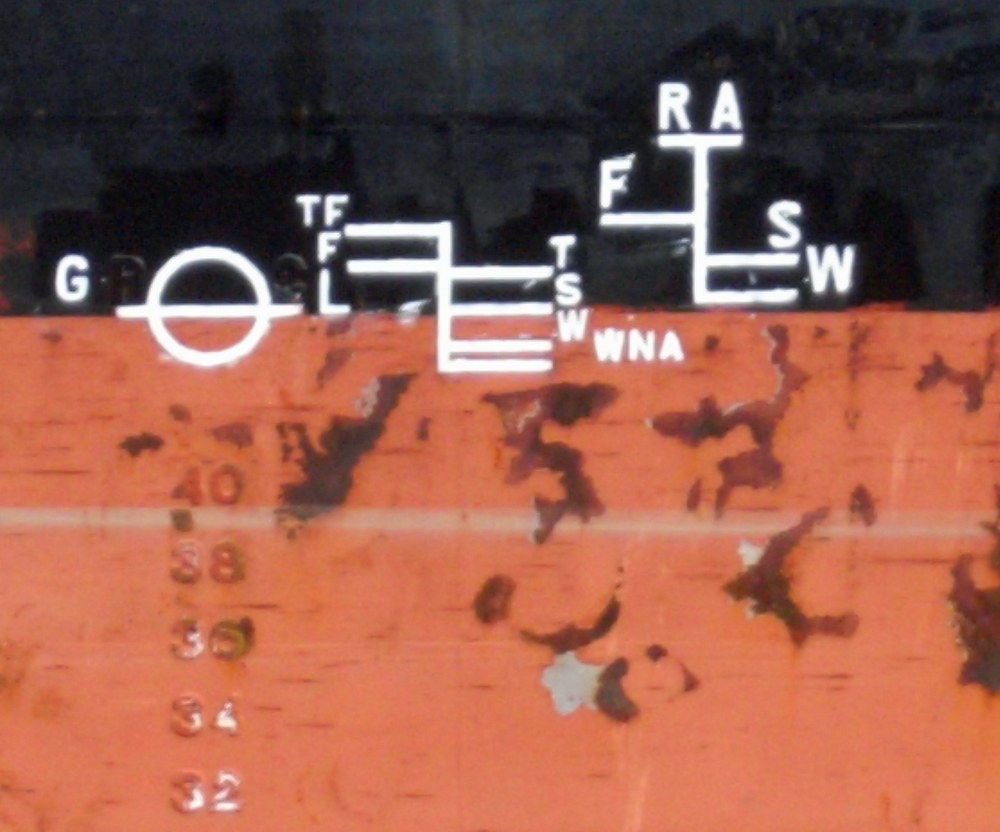
Learn the letters, which encode water density and season.
- TF Tropical Fresh · F Fresh · T Tropical · S Summer · W Winter · WNA Winter North Atlantic.
- Note that WNA is the LOWEST — the least cargo permitted.
- The circle and bar itself marks the summer load line.
History and context
History and context
Samuel Plimsoll (1824-1898) entered Parliament in 1868 and made overloading his cause, publishing Our Seamen in 1873. The practice he attacked was straightforward: a ship insured for more than her worth, loaded past safety, was a profitable loss if she sank. Crews who refused to sail in a vessel they judged unseaworthy could be — and were — imprisoned for it. In 1873 Plimsoll lost his temper in the Commons, called members villains and shook his fist at the Speaker, and was suspended. The publicity helped.
The Merchant Shipping Act of 1876 made a load line compulsory on British ships. Its serious weakness, which is worth stating, is that it let the SHIPOWNER decide where to paint the line. Owners could and did mark it too high. Government-set positions did not arrive until 1890, and international agreement came with the Load Line Convention of 1930, now maintained by the International Maritime Organization.
The mark carries the assigning authority's initials beside the disc — LR for Lloyd's Register and so on — because a line is only as trustworthy as the body that surveyed it. That is a lesson about standards generally: the number matters less than who is accountable for it.
The name went to a shoe. Plimsoll shoes are said to be named for the band of rubber around the sole, which resembles the ship marking and, like it, indicates the depth at which water gets in.
Mga Materyales
3- 1 paketePlaceholder
- 1 pirasoPlaceholder
- Placeholder
Kaugnay na Blueprint
Ang mga blueprint na ito ay nagbabahagi ng kaalaman — mga teknik, materyales, o prinsipyo
CC0 Pampublikong Domain
Ang blueprint na ito ay inilabas sa ilalim ng CC0. Malaya kang kumopya, magbago, mamahagi, at gumamit nang walang pahintulot.
Suportahan ang Maker sa pamamagitan ng pagbili ng mga produkto sa kanilang Blueprint Komisyon ng Maker itinakda ng mga Vendor, o lumikha ng bagong bersyon ng Blueprint na ito at isama bilang koneksyon sa iyong Blueprint upang ibahagi ang kita.