SINING
BEAUTY AT WELLNESS
CRAFTS
KULTURA AT KASAYSAYAN
LIBANGAN
KAPALIGIRAN
PAGKAIN AT INUMIN
REVERSE ENGINEERING
AGHAM
ISPORTS
TEKNOLOHIYA
MGA WEARABLE
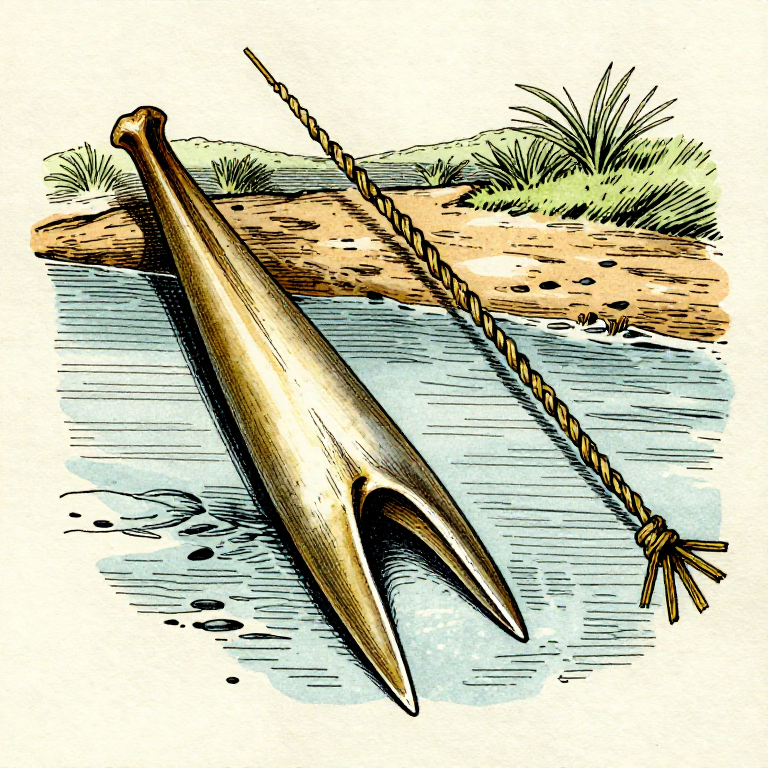


Making a Bone Fish Gorge — The Oldest Fishing Device
The fish gorge is the oldest known hook-type fishing device, predating the curved fishhook by thousands of years. Unlike a hook, which is curved to catch in the fish's jaw, a gorge is a straight, double-pointed bone spike 3 to 5 cm long with a line tied to its centre. The gorge is embedded inside bait and swallowed by the fish. When the angler pulls the line taut, the gorge turns sideways in the fish's throat or stomach, lodging firmly and preventing escape. Archaeological gorges have been found at sites dating to at least 20,000 years ago in Europe, and the device appears independently in cultures across every inhabited continent. The gorge is remarkably effective: it requires no metalworking, no complex carving of barbs, and works on fish of all sizes from small perch to large catfish. This blueprint teaches the selection of suitable bone, the shaping and pointing process, and the rigging technique for line attachment and baiting.
Baguhan
30-60 minutes
Mga Tagubilin
1
1
Select a Dense Bone Splinter
Select a Dense Bone Splinter
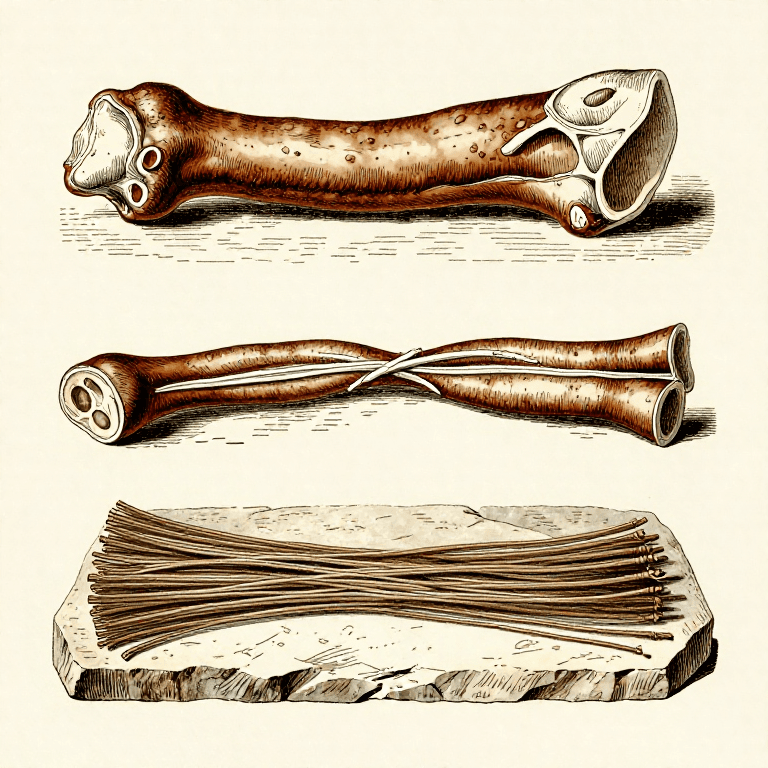
Choose a long bone from a medium-sized animal — deer, goat, or sheep leg bones (tibia or metatarsal) are ideal because they have thick, dense cortical walls. You need a section of compact bone at least 5 cm long and 5 to 8 mm wide. Avoid spongy bone from joint ends or thin-walled rib bones, which lack the strength to resist the forces of a struggling fish.
Mga materyales para sa hakbang na ito:
 Mahahabang buto ng hayop1 piraso
2
2
Split the Bone into a Rough Blank
Split the Bone into a Rough Blank
Place the bone on a flat stone anvil and strike it sharply with a hammerstone to split it lengthwise. Select a splinter that is roughly 5 to 6 cm long and 5 to 8 mm wide. The splinter should be relatively straight and free of cracks that run across its width. If the initial split produces pieces that are too wide, place a flint flake on the edge and tap it to split further.
Mga kailangang kasangkapan:
 Batong Pamukpok
3
3
Grind the Blank to a Uniform Bar
Grind the Blank to a Uniform Bar
Grind the bone splinter against a flat sandstone slab, working all four sides to create a straight, rectangular bar approximately 3 to 5 cm long (depending on target fish size: 3 cm for panfish, 5 cm for larger species) and 4 to 5 mm in cross-section. Keep the bar as straight as possible — any curve reduces the gorge's ability to turn and lock inside the fish.
Mga kailangang kasangkapan:
 Losang Batong Buhangin
4
4
Sharpen Both Ends to Points
Sharpen Both Ends to Points
Grind each end of the bar to a sharp point on the sandstone, tapering the last 8 to 10 mm on all sides to form a needle-like tip. Both points must be sharp enough to penetrate fish flesh when the gorge turns sideways under tension. The points should be symmetrical — one blunt end and one sharp end would prevent the gorge from lodging properly.
Mga kailangang kasangkapan:
Losang Batong Buhangin5
5
Carve a Centre Groove for the Line
Carve a Centre Groove for the Line
Using the edge of a sharp flint flake, score a shallow groove around the circumference of the gorge at its exact centre point. The groove should be about 1 mm deep — enough to seat the line and prevent it from sliding toward either end, but not so deep that it weakens the bone. A gorge without a centre groove will have the line slip to one end, causing it to enter the fish at an angle instead of straight.
Mga kailangang kasangkapan:
 Kutsilyong Batong Silisyo
6
6
Final Polish of the Gorge Surface
Final Polish of the Gorge Surface
Polish the entire gorge surface by rubbing it against a piece of wet leather or a smooth river pebble. A smooth surface is essential — rough bone catches on bait during insertion and creates drag as the fish swallows, potentially causing the fish to reject the bait. The finished gorge should be uniformly smooth with cleanly defined points and a visible centre groove.
7
7
Attach the Fishing Line
Attach the Fishing Line
Take a length of sinew thread (1.5 to 2 metres for hand-line fishing). Tie the line to the centre groove using a clove hitch followed by two half hitches to lock it in place. The knot must seat firmly in the groove and must not slip under load. Pull hard on the line in both directions to test — the gorge should hang perfectly level, balanced at its centre point. If it tilts, the groove is off-centre and must be recut.
Mga materyales para sa hakbang na ito:
 Sinulid na Litid1 piraso
8
8
Prepare the Bait
Prepare the Bait
The gorge must be completely hidden inside the bait. Use a piece of fish flesh, earthworm, grub, or small frog — the bait must be large enough to conceal the entire gorge and soft enough for the fish to swallow whole. Push one pointed end of the gorge into the centre of the bait, threading it lengthwise so the gorge lies hidden along the bait's long axis. The line exits from the centre of the bait.
9
9
Set the Line in the Water
Set the Line in the Water
Lower the baited gorge into the water near structure where fish congregate — submerged logs, undercut banks, weed beds, or eddies behind rocks. Let the bait sink to the depth where fish are feeding (bottom for catfish and carp, mid-water for perch and trout). Keep light tension on the line — enough to feel a bite, but not so much that it pulls the bait unnaturally.
10
10
Wait for the Fish to Swallow the Bait
Wait for the Fish to Swallow the Bait
When a fish takes the bait, you will feel a sharp tug followed by a steady pull. Do NOT pull immediately — the fish needs time to swallow the gorge completely. Wait 5 to 10 seconds after the initial strike, allowing the fish to turn and swim away with the bait in its throat. Pulling too early yanks the gorge out before it has passed beyond the mouth, losing the fish.
11
11
Set the Gorge with a Firm Pull
Set the Gorge with a Firm Pull
After the pause, pull the line firmly and steadily — not a sharp jerk, but a sustained pull that draws the line taut. As tension builds, the gorge turns sideways inside the fish's throat or stomach. The two sharp points dig into the soft tissue on opposite sides, creating a T-shaped anchor that cannot be pulled back out through the narrow oesophagus. Maintain steady tension as you bring the fish to shore.
12
12
Retrieve and Re-Bait the Gorge
Retrieve and Re-Bait the Gorge
Once the fish is landed, carefully open the mouth or gill cover and follow the line to locate the gorge. Gently work the points free by reversing the gorge back to its lengthwise orientation. Rinse the gorge in clean water and inspect for cracks or dulled points — resharpen on sandstone if needed. Re-bait and repeat. A well-made bone gorge lasts for dozens of fishing sessions before the points wear down enough to require replacement.
Mga Materyales
2- 1 pirasoPlaceholder
- 1 pirasoPlaceholder
Mga Kinakailangang Kasangkapan
3- Placeholder
- Placeholder
- Placeholder
Mga Materyales ng Nakakonektang Blueprint
Ang blueprint na ito ay gumagawa ng

Kaugnay na Blueprint
Ang mga blueprint na ito ay nagbabahagi ng kaalaman — mga teknik, materyales, o prinsipyo



CC0 Pampublikong Domain
Ang blueprint na ito ay inilabas sa ilalim ng CC0. Malaya kang kumopya, magbago, mamahagi, at gumamit nang walang pahintulot.
Suportahan ang Maker sa pamamagitan ng pagbili ng mga produkto sa kanilang Blueprint Komisyon ng Maker itinakda ng mga Vendor, o lumikha ng bagong bersyon ng Blueprint na ito at isama bilang koneksyon sa iyong Blueprint upang ibahagi ang kita.