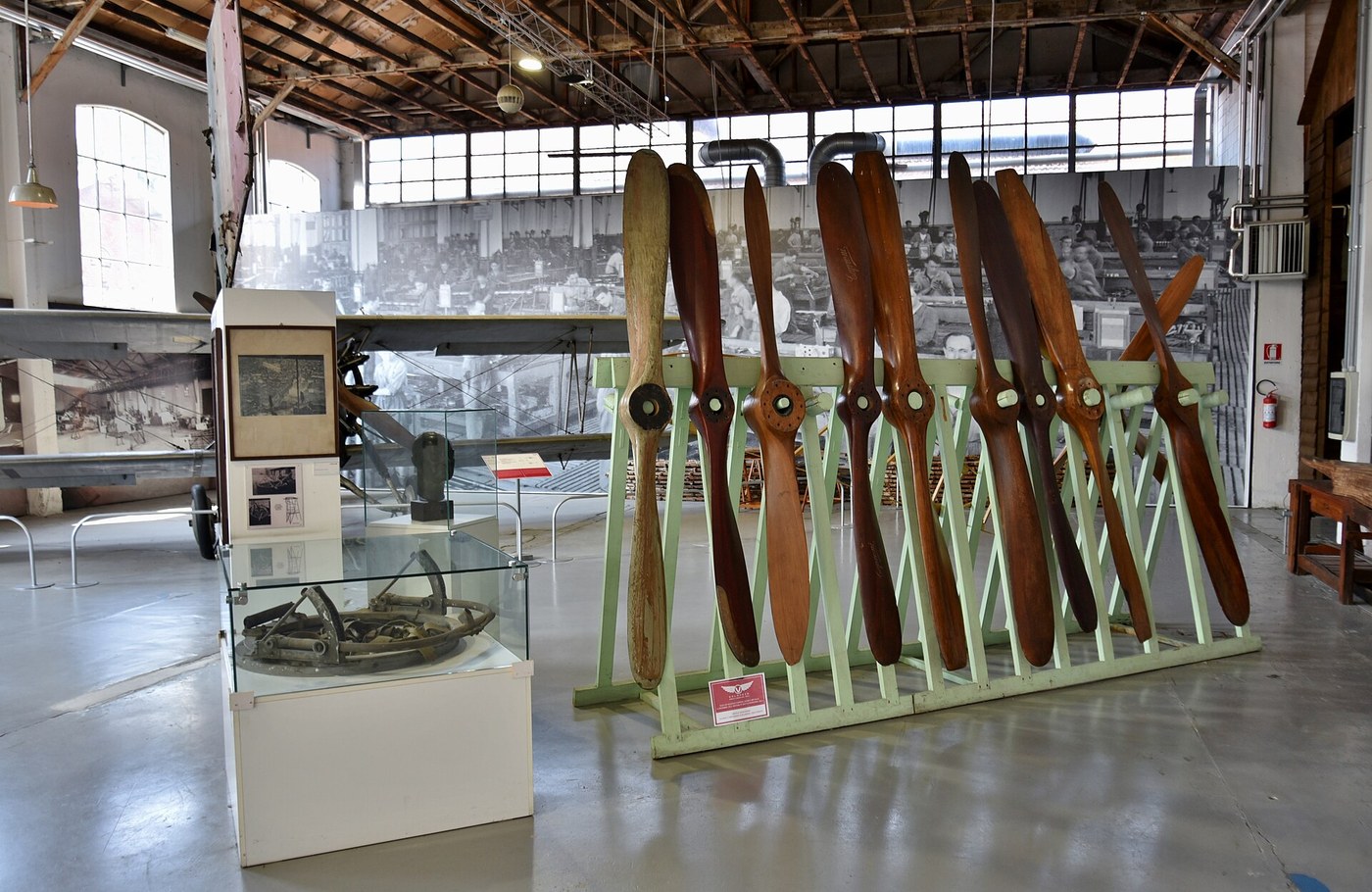


The Propeller as a Rotating Wing
Mga Tagubilin
Show that a blade section is just a wing
Show that a blade section is just a wing
Prove the analogy before relying on it.
- Cut a short section of aerofoil identical to your best wind-tunnel result.
- Mount it in the tunnel and record lift and drag at a few angles, as before.
- Now reason about what that same section experiences when it is instead sweeping a circle at radius r and turning at n revolutions per second.
- Work out the speed it meets the air: the vector sum of the aircraft’s forward speed and the rotational speed 2πrn.
The section does not know or care whether it is flying straight or going round in a circle — it only experiences a relative wind and an angle to it. That is the whole insight. Lift becomes thrust because the section is oriented so its lift points forward; drag becomes the torque the engine must overcome.
The vector sum is why a propeller behaves so differently standing still and at speed. On the ground the forward component is zero and the blade meets the air at a very coarse angle — often past the stall. This is exactly why a fixed-pitch propeller optimised for cruise gives poor static thrust, and it is the problem the variable-pitch blueprint later solves.Mga materyales para sa hakbang na ito:
 Plantsang Kahoy na Basswood1 pilyego
 Papel na Grap1 pad
Mga kailangang kasangkapan:
 Band saw (pang-mesa)
 Panlihang panlampas
 Digital na Kalibrador 6 Pulgada
 Panukat ng Anggulo
 Timbangang Bukal
 Malinaw na Salaming Pangkaligtasan
Calculate the twist the blade must have
Calculate the twist the blade must have
Do the arithmetic that produces the shape, so the shape stops being mysterious.
- Choose a design forward speed V and a rotational speed n.
- Divide the blade into stations at, say, 25, 50, 75 and 100 percent of the radius.
- At each station compute the rotational speed 2πrn and the resulting helix angle, whose tangent is V divided by that rotational speed.
- Add your aerofoil’s best angle of attack to the helix angle at each station. That sum is the blade angle there.
- Tabulate the four blade angles.
The angles fall steeply from root to tip — often from around 40° near the hub to under 15° at the tip. The blade is not bent for strength or elegance; each station is individually aimed so it meets the air at the angle the tunnel said was best.
Notice what happens at the very centre: the helix angle tends toward 90° and the blade would have to stand almost edge-on to the disc. That region produces almost no useful thrust, which is why propeller roots are usually blended into a spinner or simply thickened for strength — the aerodynamics there are a lost cause and the structure needs the material.Mga materyales para sa hakbang na ito:
Papel na Grap1 padMga kailangang kasangkapan:
Panukat ng AngguloDigital na Kalibrador 6 Pulgada Panuka na Pinagsama
Carve the blade to the calculated angles
Carve the blade to the calculated angles
Cut the numbers into wood, one station at a time.
- Start from a rectangular hardwood blank of the right length and thickness, with the centreline marked on all four faces.
- Mark the four stations across the blank.
- At each station, cut a gauge from card at the calculated blade angle.
- Carve down to each gauge in turn, working from tip to root, then fair the surface smoothly between stations.
- Shape the aerofoil section on each blade face, thicker at the root and thinner toward the tip.
Fairing between the stations is where a propeller is made or ruined. The four gauges only fix four sections; the surface between them must run smoothly, because any local bump or hollow produces flow separation and both loses thrust and makes noise.
The Wrights carved theirs from laminated spruce with a hatchet and a drawknife, and achieved around 66 percent efficiency at a time when the best marine screws managed roughly 50. Their advantage was not their carving, it was that they had a tunnel and could aim each station at a number.Mga materyales para sa hakbang na ito:
 Bloke ng abetong pinatong-patong1 piraso
 Pandikit sa Kahoy1 bote
 Papel de Liha1 paketePapel de Liha1 pakete
Mga kailangang kasangkapan:
Band saw (pang-mesa)Panlihang panlampas Hanay ng KikilDigital na Kalibrador 6 PulgadaPanukat ng Anggulo
 Klamp na hugis-C
 Bais sa Mesang PanggawaMalinaw na Salaming Pangkaligtasan
Balance it, and understand why that is not optional
Balance it, and understand why that is not optional
An unbalanced propeller is a vibration source bolted to the front of the machine.
- Mount the finished propeller on a free-running horizontal spindle with very low friction.
- Let it settle. If one blade consistently swings to the bottom, that blade is heavy.
- Remove material from the heavy blade’s FACE — never from its edges or tip profile — or add weight at the light blade’s root.
- Repeat until it shows no preferred resting position.
- Also check horizontal balance: the blades must weigh the same at the same radius, not merely weigh the same.
An out-of-balance propeller applies a rotating force at the shaft frequency, which fatigues the mounting, blurs instruments and cracks structure over time. The mass involved may be a gram; the force scales with the square of the rotational speed, so a gram at 3000 rpm is not a small thing.
Never correct balance by shortening a blade. Different radii mean different tip speeds, different thrust and a bending moment that alternates once per revolution — you would trade a vibration you can measure for a fatigue crack you cannot see.Mga materyales para sa hakbang na ito:
Papel de Liha1 paketeMga kailangang kasangkapan:
 Digital na TimbanganDigital na Kalibrador 6 PulgadaHanay ng Kikil
 Digital na Panukat ng AngguloMalinaw na Salaming Pangkaligtasan
Measure thrust and efficiency, and find the tip-speed wall
Measure thrust and efficiency, and find the tip-speed wall
Now find out whether the calculation was worth doing.
- Mount the propeller on a motor fixed to a pivoted arm, with a spring scale reading the thrust it produces.
- Measure thrust and rotational speed together across a range of speeds, along with the electrical power going in.
- Compute thrust per watt at each speed.
- Now compute the TIP speed at each: 2πRn.
Thrust per watt improves with speed and then falls away, and the fall begins as tip speed climbs toward the speed of sound. As the tip approaches roughly 0.85 to 0.9 of sonic speed, local flow over the blade goes supersonic, shock waves form, drag rises steeply and efficiency collapses — and the propeller gets very loud, because that noise is the energy you are no longer converting to thrust.
This is the hard ceiling on propeller-driven flight, and it is the reason the batch ends where it does. You cannot spin faster and you cannot usefully make the blade longer, because a longer blade has a faster tip at the same rpm. The propeller runs out of road at somewhere around 700 km/h, and the only way past is to stop using one.
That is the argument for the turbojet, and it is a genuine limit rather than a failure of imagination. Propellers remain the most efficient thing available below their ceiling, which is exactly why turboprops still dominate short regional routes today.Mga materyales para sa hakbang na ito:
Papel na Grap1 pad Motor na walang brotsa1 set
 Elektronikong pamahala ng bilis1 set
Mga kailangang kasangkapan:
Timbangang Bukal Digital na TakometroDigital na TimbanganDigital na Kalibrador 6 Pulgada
 Selpon na May Mabagal na BidyoMalinaw na Salaming Pangkaligtasan
Mga Materyales
8- 1 pilyegoPlaceholder
- 1 padPlaceholder
- 1 pirasoPlaceholder
- 1 botePlaceholder
- 1 paketePlaceholder
- 1 paketePlaceholder
- Placeholder
- Placeholder
Mga Kinakailangang Kasangkapan
14- Placeholder
- 1 vendor sell this, none ship to you yetPlaceholder
- Placeholder
- Placeholder
- Placeholder
- Placeholder
- Placeholder
- Placeholder
- Placeholder
- Placeholder
- Placeholder
- Placeholder
- Placeholder
- Placeholder
Kaugnay na Blueprint
Ang mga blueprint na ito ay nagbabahagi ng kaalaman — mga teknik, materyales, o prinsipyo


CC0 Pampublikong Domain
Ang blueprint na ito ay inilabas sa ilalim ng CC0. Malaya kang kumopya, magbago, mamahagi, at gumamit nang walang pahintulot.
Suportahan ang Maker sa pamamagitan ng pagbili ng mga produkto sa kanilang Blueprint Komisyon ng Maker itinakda ng mga Vendor, o lumikha ng bagong bersyon ng Blueprint na ito at isama bilang koneksyon sa iyong Blueprint upang ibahagi ang kita.