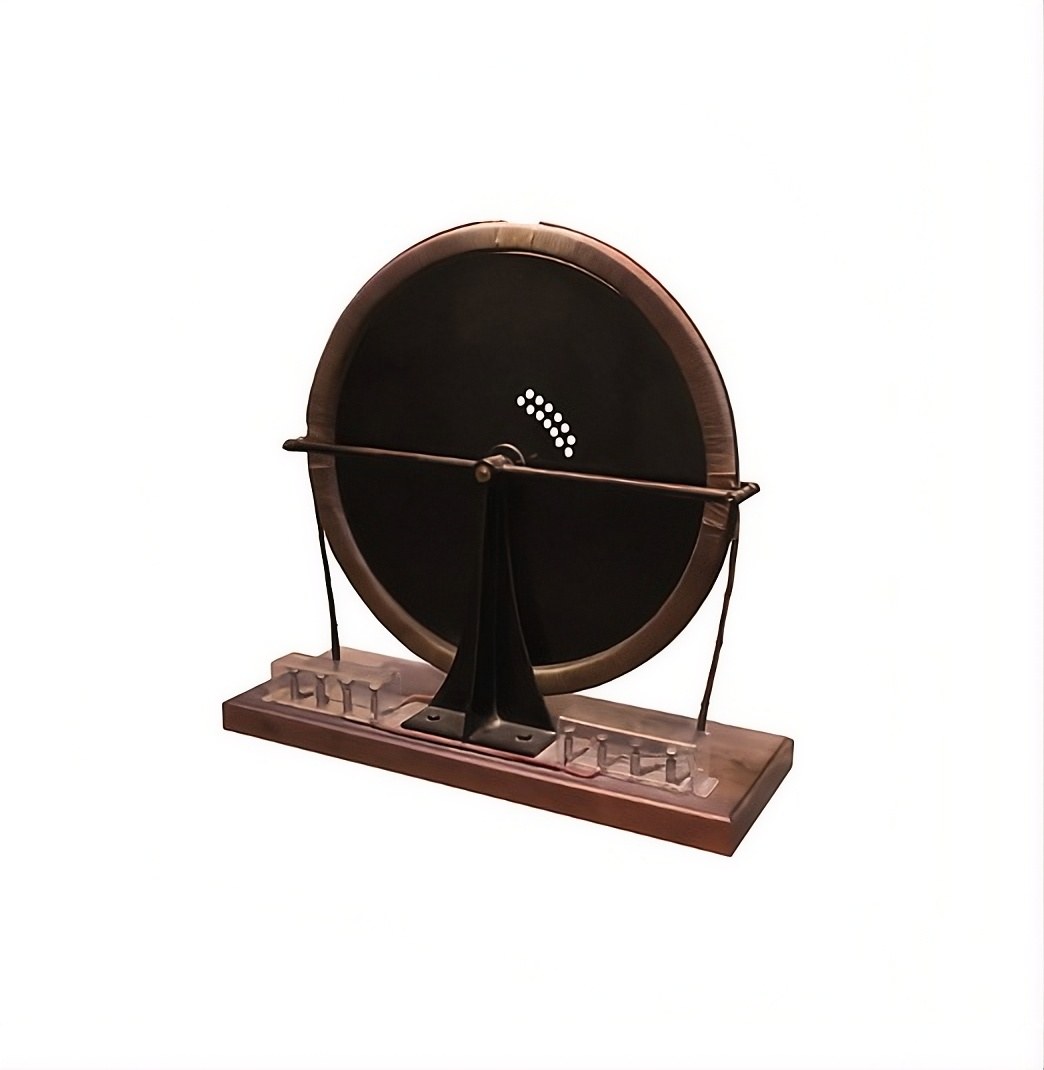
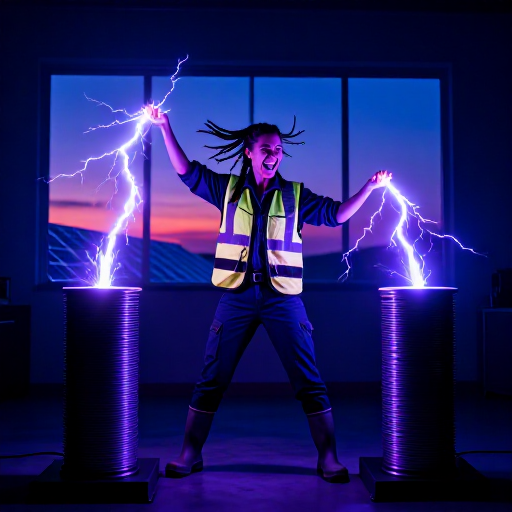

Tesla Induction Motor
Every electric motor before 1888 had a commutator: a split ring and carbon brushes that reversed the current in the rotating winding twice a revolution. Brushes spark, wear out, need replacing, and cannot be used anywhere near dust or fumes.
Tesla's motor has no electrical connection to the rotor at all. Feed two or more windings with alternating currents that are out of step with each other, and the combined magnetic field does not merely pulse — it ROTATES, smoothly, at the supply frequency. Put any conductor in that turning field and induced currents drag it round.
The rotor is a plain cage of bars. Nothing touches it, nothing sparks, nothing wears. US Patent 381,968, "Electro-magnetic motor", granted to Nikola Tesla on 1 May 1888 — and it is the reason the world settled on alternating current.
Mga Tagubilin
Work from a low-voltage bench supply
Work from a low-voltage bench supply
Build and run this on a low-voltage AC source, never on the mains. Enclose the rotor before powering up — an unbalanced rotor at speed throws parts.
Read US 381,968 and note what is absent
Read US 381,968 and note what is absent
Tesla claims two or more independent circuits carrying alternating currents producing a rotating field. There is no commutator, no brush and no connection to the rotating part.
Look at a brushed motor first
Look at a brushed motor first
Open a small DC motor and find the split commutator and brushes. Run it in the dark: it sparks. That sparking is wear, radio interference and an ignition source.
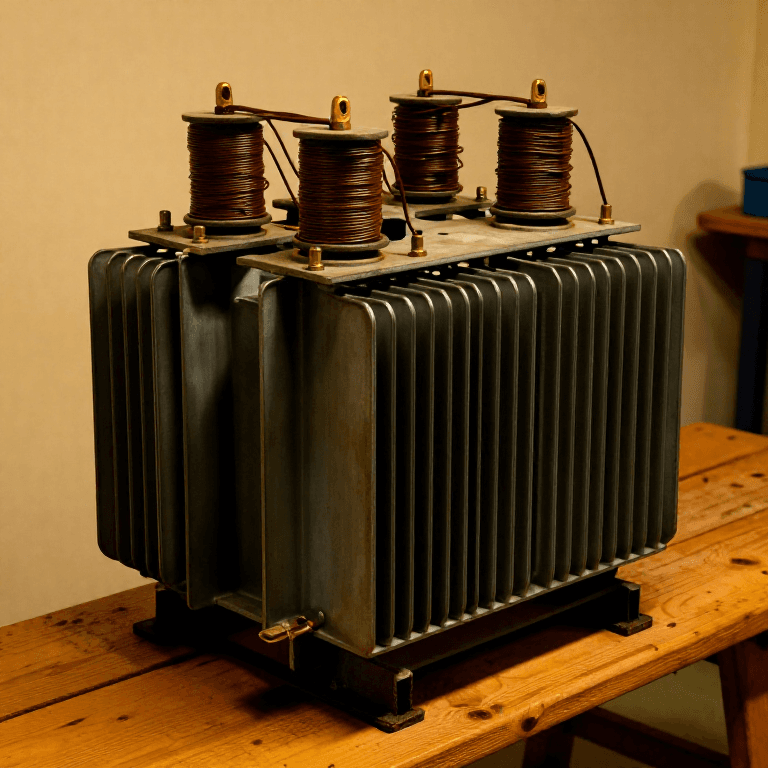
Wind four coils on a soft iron ring
Wind four coils on a soft iron ring
Wind two opposed pairs at right angles around a laminated ring. Each pair is one phase, and their axes must be exactly 90° apart.
Mga materyales para sa hakbang na ito:
 Kawad na Tanso na May Enamel80 metro
Use laminated iron, not a solid lump
Use laminated iron, not a solid lump
Build the core from insulated sheets. A solid core carries its own induced eddy currents and turns your motor into a heater.
Mga materyales para sa hakbang na ito:
 Plantsang Malambot na Asero1 pilyego
Energise one phase only and observe
Energise one phase only and observe
Drive a single pair with AC. The field pulses back and forth along one axis. A rotor placed in it will hum and sit still — pulsing is not rotating.
Shift the second phase in time
Shift the second phase in time
Feed the other pair through a capacitor so its current lags or leads. You now have two fields at right angles, out of step in TIME — that is the whole invention.
Mga materyales para sa hakbang na ito:
 Kit ng mga Kapasitor2 piraso
Map the resultant field with a compass
Map the resultant field with a compass
Put a small compass needle in the bore at low frequency. It turns steadily rather than shaking — the field vector is sweeping round the circle.
Drop in a plain metal disc and watch it turn
Drop in a plain metal disc and watch it turn
Suspend an aluminium or copper disc in the bore. It rotates, with no windings, no magnets and no connections — this is the Arago disc effect doing useful work.
Mga materyales para sa hakbang na ito:
 Plantsang aluminyo1 pilyego
Build a squirrel-cage rotor
Build a squirrel-cage rotor
Set copper bars in slots around a laminated cylinder and short them together with end rings. It is a cage, not a winding, and it has no beginning or end.
Mga materyales para sa hakbang na ito:
 Kawad na Tanso10 metro
Measure the rotor speed against the field speed
Measure the rotor speed against the field speed
The rotor always turns slightly slower than the field. That difference is called slip, and it is not a defect — without it there is no relative motion and no induced current.
Mga kailangang kasangkapan:
 Multimetro
Load the shaft and watch slip increase
Load the shaft and watch slip increase
Apply a brake. The rotor falls further behind, induced currents rise, and torque rises to meet the load. The motor self-regulates with no controller.
Swap two phase connections
Swap two phase connections
Exchange the leads of one phase. The field now rotates the other way and so does the motor. Direction is set by wiring order alone.
Run it for an hour and inspect
Run it for an hour and inspect
Let it run under load, then examine the rotor. Nothing has worn, because nothing touched it. This is why induction motors last decades in pumps and fans.
Compendium — a field that rotates
Compendium — a field that rotates
The patent. US 381,968, "Electro-magnetic motor", granted 1 May 1888 to Nikola Tesla. He described the polyphase system in a lecture to the American Institute of Electrical Engineers days later, and George Westinghouse licensed the patents that year. The Italian physicist Galileo Ferraris demonstrated a rotating magnetic field independently in 1885 and published in March 1888, two months before Tesla's grant — the two arrived at the same principle separately, and Ferraris deserves naming.
Why time-shifted currents rotate a field. Two coil pairs at right angles, carrying currents 90° out of phase, produce two sinusoidal fields in quadrature. Add them as vectors and the resultant has constant magnitude and steadily rotating direction — it sweeps the circle once per electrical cycle. Nothing mechanical rotates to make this happen; the rotation is a consequence of geometry plus timing. It is the same mathematics as circular polarisation in optics.
Slip is what makes it work. The cage rotor has no supply of its own. It gets current by induction, which requires relative motion between the field and the bars — so the rotor MUST lag the field. At exactly synchronous speed there would be no relative motion, no induced current, no torque. Loading the shaft increases slip, which increases induced current, which increases torque: the machine matches its own load automatically. That elegant self-regulation is why induction motors need no control gear to run.
Why this decided the War of the Currents. Edison's DC could not be transformed to high voltage, so it could not be transmitted far. AC could — Stanley's transformer of 1886 saw to that — but until 1888 there was no good AC MOTOR, and a power system with no motors is only a lighting system. Tesla's motor closed the gap, and with generation, transmission and motive power all working on alternating current, the argument was effectively over. Roughly half of all electricity generated today is consumed by induction motors, most of them still squirrel-cage machines built to this patent's principle.
Mga Materyales
5- 80 metroPlaceholder
- 1 pilyegoPlaceholder
- 2 pirasoPlaceholder
- 1 pilyegoPlaceholder
- 10 metroPlaceholder
Mga Kinakailangang Kasangkapan
1- Placeholder
Kaugnay na Blueprint
Ang mga blueprint na ito ay nagbabahagi ng kaalaman — mga teknik, materyales, o prinsipyo


CC0 Pampublikong Domain
Ang blueprint na ito ay inilabas sa ilalim ng CC0. Malaya kang kumopya, magbago, mamahagi, at gumamit nang walang pahintulot.
Suportahan ang Maker sa pamamagitan ng pagbili ng mga produkto sa kanilang Blueprint Komisyon ng Maker itinakda ng mga Vendor, o lumikha ng bagong bersyon ng Blueprint na ito at isama bilang koneksyon sa iyong Blueprint upang ibahagi ang kita.