SINING
BEAUTY AT WELLNESS
CRAFTS
KULTURA AT KASAYSAYAN
LIBANGAN
KAPALIGIRAN
PAGKAIN AT INUMIN
REVERSE ENGINEERING
AGHAM
ISPORTS
TEKNOLOHIYA
MGA WEARABLE
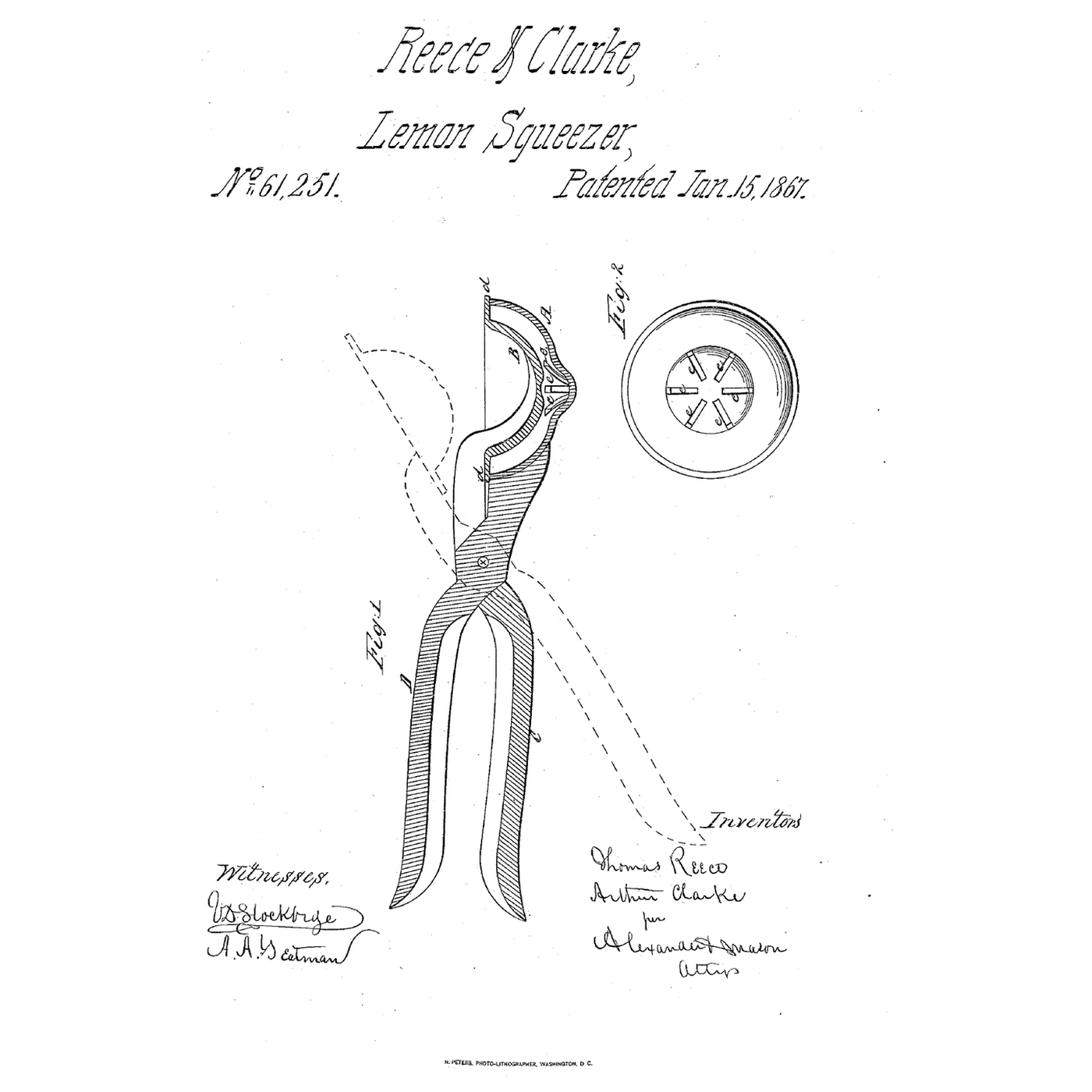


The Shears-Cup Lemon Squeezer: Two Cups on Crossed Handles, a Slotted Recess for the Juice
A lemon squeezer lets the seeds through with the juice, or crushes them into it, and its holes clog with pulp.
Thomas Reece and Arthur Clarke of Philadelphia, Pennsylvania, received US 61,251, dated 15 January 1867, for a squeezer of two cups of metal or wood on handles "pivoted together at x, so that the cups may be separated or brought together similar to the blades of a pair of shears." The larger cup has a small recess in its bottom with slots radiating from its centre, so formed "as not to allow any seed to pass through them", and the smaller cup has a flange that stops it going too far into the other.
This rung works out the squeeze through the crossed handles, with a work check, then makes the squeezer from two tins on flat-bar handles, and squeezes lemons with it.
Katamtaman
About 4 hours
Mga Tagubilin
1
1
Crossed handles
Crossed handles
Naglo-load ng Jupyter notebook…
2
2
A hinged squeezer before it
A hinged squeezer before it
The embedded blueprint pins its handles at their front ends. Reece and Clarke cross theirs like shears and slot the recess so seeds stay behind.
3
3
Read US 61,251
Read US 61,251
"The cup B is made smaller than cup A, and works within it with its bottom down. This cup B is provided around its mouth with a flange, d, which catches upon the mouth of cup A when the two cups are brought together, as shown in Figure 1. These cups are provided with the handles C and D, which said handles are pivoted together at x, so that the cups may be separated or brought together similar to the blades of a pair of shears."
"The space between the two cups allows the juice to be pressed out through the slots or openings without breaking the seed, and the slots are so formed and are of such a size as not to allow any seed to pass through them."
4
4
Make the squeezer and press lemons
Make the squeezer and press lemons
**Handles.** Cut two 25 cm lengths of 20 × 5 mm mild steel flat bar and drill each 8 cm from one end for an M6 pivot bolt, so they cross like shears.
**Cups.** Cut the bottoms from two clean tin cans, one about 8 cm across and one about 6.5 cm, each 3 cm deep. In the larger one's base, hammer a small recess over a hole in a hardwood block, and cut four narrow slots in it radiating from the centre, 2 mm wide. Rivet a ring of tinplate round the smaller one's mouth as the flange d.
**Assemble.** Rivet each cup to the short end of a handle so the smaller cup, bottom down, closes into the larger one when the handles are squeezed, and bolt the handles at the pivot.
**Test.** Halve a lemon, put one half cut side down in the larger cup over a glass, and squeeze. Count the seeds left in the cup and in the glass, and weigh the juice.
Mga materyales para sa hakbang na ito:
 Patag na Baras na Malambot na Asero0.5 metro
 Lata2 piraso
 Plantsa ng lata1 piraso
 Mga pop rivet8 piraso
 Sari-saring hex bolt1 piraso
 Tuerkang Heksagonal1 piraso
 Tipak ng Matigas na Kahoy1 piraso
 Limon2 piraso
Mga kailangang kasangkapan:
 Lagaring Pang-metal
 Walang-Kableng Barena
 Hanay ng Talim ng Barena
 Kikil (Kikil na Pangkamay)
 Hanay ng Pinong Kikil
 Bais sa Mesang Panggawa
 Gunting na pangyero
 Martilyo
 Kit ng pop rivet gun
 Llaveng ingles
 Kutsilyo sa kusina
 Digital na Timbangang Pangkusina
 Baso
Baso Guwantes na Katad Pangtrabaho
5
5
A squeezer that lets seeds through, clogs or sprays
A squeezer that lets seeds through, clogs or sprays
Shears-cup lemon squeezer troubleshooting.
Flow
Loading...
6
6
History and honest limits
History and honest limits
**Thomas Reece and Arthur Clarke** of Philadelphia, Pennsylvania, received US 61,251, dated 15 January 1867. The cups could be metal, galvanized, or wood tinned against the acid; the peculiar shape of cup A with its recess kept the squeezer from clogging or choking. Their claim is the two hinged handles with the two cups, one with a slotted recess and the other with a flange.
**Honest limits.** Tin cans and flat bar stand in for their made-up cups and handles. The notebook ignores friction; its forces and lengths are examples. Your seed count and juice are the result.
Mga Materyales
8- 0.5 metroPlaceholder
- 2 pirasoPlaceholder
- 1 pirasoPlaceholder
- 8 pirasoPlaceholder
- 1 pirasoPlaceholder
- 1 pirasoPlaceholder
- 1 pirasoPlaceholder
- 2 pirasoPlaceholder
Mga Kinakailangang Kasangkapan
14- Placeholder
- 1 vendor sell this, none ship to you yetPlaceholder
- Placeholder
- Placeholder
- Placeholder
- Placeholder
- Placeholder
- Placeholder
- Placeholder
- Placeholder
- Placeholder
- Placeholder
- Placeholder
- Placeholder
Ang blueprint na ito ay gumagawa ng

Kaugnay na Blueprint
Ang mga blueprint na ito ay nagbabahagi ng kaalaman — mga teknik, materyales, o prinsipyo




CC0 Pampublikong Domain
Ang blueprint na ito ay inilabas sa ilalim ng CC0. Malaya kang kumopya, magbago, mamahagi, at gumamit nang walang pahintulot.
Suportahan ang Maker sa pamamagitan ng pagbili ng mga produkto sa kanilang Blueprint Komisyon ng Maker itinakda ng mga Vendor, o lumikha ng bagong bersyon ng Blueprint na ito at isama bilang koneksyon sa iyong Blueprint upang ibahagi ang kita.