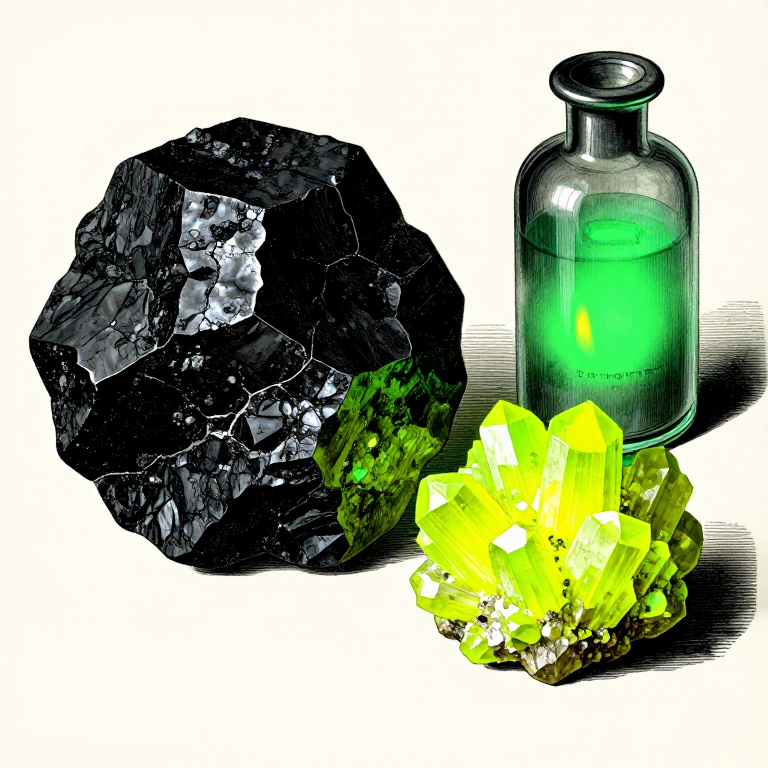

Understanding Uranium from Uraninite — The Element That Changed Everything
Uranium (U, element 92) is the heaviest naturally occurring element in significant quantities and the element that ushered in the nuclear age. Martin Heinrich Klaproth — the same chemist who named titanium — discovered uranium in 1789 by analyzing pitchblende (uraninite, UO₂) from the Joachimsthal silver mines in Bohemia. He named it after the planet Uranus, which had been discovered just eight years earlier by William Herschel.
For over a century after its discovery, uranium was a chemical curiosity with no practical use beyond coloring glass and ceramics a vivid fluorescent yellow-green. Everything changed in 1896 when Henri Becquerel discovered that uranium salts spontaneously emitted penetrating rays — the discovery of radioactivity. This led to Marie and Pierre Curie's isolation of radium and polonium from uranium ore, to Rutherford's discovery of the atomic nucleus, and ultimately to nuclear fission (Hahn and Strassmann, 1938) and the atomic bomb.
Uraninite (UO₂, uranium dioxide) is the primary uranium mineral, containing up to 88.1% uranium by mass. It occurs in hydrothermal veins, granitic pegmatites, and sedimentary deposits (sandstone-hosted uranium). Uraninite is radioactive and must be handled with appropriate precautions.
EXTREME HAZARD — RADIOACTIVE AND TOXIC: Uranium is both a chemical toxin (heavy metal, damages kidneys) and a radioactive hazard. Uraninite emits alpha particles, beta particles, and gamma rays from uranium and its decay chain (radium, radon gas, polonium). Handling uraninite requires radiation monitoring, respiratory protection (to prevent radon and uranium dust inhalation), and compliance with nuclear material regulations in your jurisdiction. This blueprint is educational only — do not attempt uranium extraction.
Mapanganib na nilalaman
Ang blueprint na ito ay naglalaman ng mga mapanganib na proseso. Mag-log in at i-enable ang mapanganib na nilalaman sa iyong account settings upang makita ang step-by-step na mga tagubilin.
Mag-sign inCC0 Pampublikong Domain
Ang blueprint na ito ay inilabas sa ilalim ng CC0. Malaya kang kumopya, magbago, mamahagi, at gumamit nang walang pahintulot.
Suportahan ang Maker sa pamamagitan ng pagbili ng mga produkto sa kanilang Blueprint Komisyon ng Maker itinakda ng mga Vendor, o lumikha ng bagong bersyon ng Blueprint na ito at isama bilang koneksyon sa iyong Blueprint upang ibahagi ang kita.