
Wedgwood Pyrometer
Mga Tagubilin
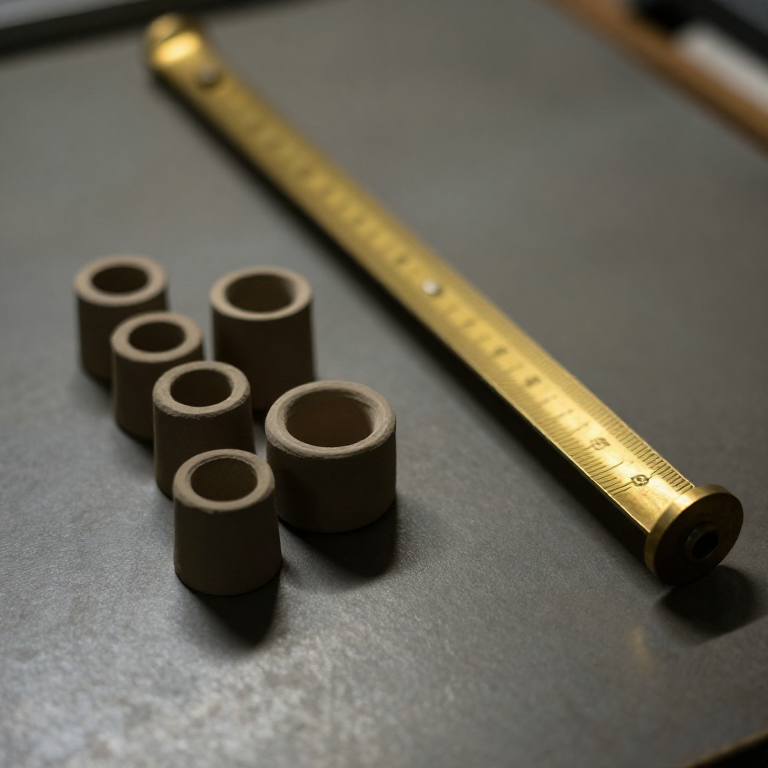
Make a batch of identical clay test pieces
Make a batch of identical clay test pieces
The instrument only works if every piece starts the same, so consistency is the entire preparation.
- Mix a batch of ball clay to an even, well-wedged consistency — the whole batch at once, never in separate lots.
- Form at least twelve cylinders in a single mould, each about 25 mm diameter and 60 mm long.
- Dry them all together, slowly, under the same conditions.
- Measure each dried piece's length and diameter with the caliper and record every reading.
- Discard any that differ noticeably from the rest.
One batch, one mould, one drying schedule. Wedgwood's instrument compares a fired piece against its unfired size, so any variation between pieces is indistinguishable from a temperature difference. He supplied his own standard clay for exactly this reason — the instrument is only meaningful if everyone uses identical material.
Record every dimension before firing. A shrinkage measurement needs a before, and there is no way to recover it afterwards.Mga materyales para sa hakbang na ito:
 Ball clay1 bag
 Pulbos na ball clay1 bag
Mga kailangang kasangkapan:
 Digital na Kalibrador 6 Pulgada
 Panuka na Pinagsama
 Set ng alambre at kutsilyo sa luad
Build the measuring gauge Wedgwood used
Build the measuring gauge Wedgwood used
A tapering slot, so a shrunken cylinder slides further in — reading small changes as a long travel.
- Take two straight brass or aluminium strips 300 mm long.
- Mount them on a base converging very slightly, so the gap narrows from 26 mm at one end to 20 mm at the other.
- Mark a scale along the length.
- Drop an unfired cylinder in at the wide end and note where it stops.
The taper is a mechanical amplifier. A shrinkage of half a millimetre in diameter moves the cylinder a long way down a shallow taper, turning a measurement too small to read into one anybody can read at a glance. This is exactly the sine bar's trick from batch 69 — spread a small change over a long travel — arriving from the opposite direction.
Make the taper shallow and consistent. A steeper gauge is easier to build and gives correspondingly less resolution, which is the whole trade.Mga materyales para sa hakbang na ito:
 Patag na Bara ng Aluminyo1 piraso
 Playwud na Baltic Birch1 pilyego
 Turnilyong May Ulong Soket4 piraso
 Tuerkang Heksagonal4 piraso
Mga kailangang kasangkapan:
 Walang-Kableng Barena
 Hanay ng Talim ng Barena
 Hanay ng KikilDigital na Kalibrador 6 PulgadaPanuka na Pinagsama
 Hanay ng Susing Heks
Fire pieces at several known temperatures
Fire pieces at several known temperatures
Build the calibration curve the instrument needs, using a kiln whose temperature you can read independently.
- Fire three cylinders to 700 °C, using a kiln controller or pyrometric cones as the reference.
- Fire three more to 900 °C, and three to 1100 °C.
- Cool each set fully before measuring.
- Measure each fired piece on the taper gauge and with the caliper.
- Plot gauge reading against the known firing temperature.
Mga materyales para sa hakbang na ito:
 Pugon1 pirasoBall clay1 bag
Mga kailangang kasangkapan:
Digital na Kalibrador 6 Pulgada Termometrong Infrared
 Panukat ng Oras
Find where the scale goes non-linear, and where it dies
Find where the scale goes non-linear, and where it dies
Every proxy measurement has a region where it stops working. Find this one's.
- Look at your plot: is equal shrinkage produced by equal temperature steps?
- Fire another set at 1200 °C and add the point.
- Keep going until the clay begins to vitrify and slump.
- Note the temperature at which shrinkage stops increasing usefully.
Mga materyales para sa hakbang na ito:
 Papel na Grap1 pad
Mga kailangang kasangkapan:
Digital na Kalibrador 6 PulgadaMeasuring the effect instead of the cause, and history
Measuring the effect instead of the cause, and history
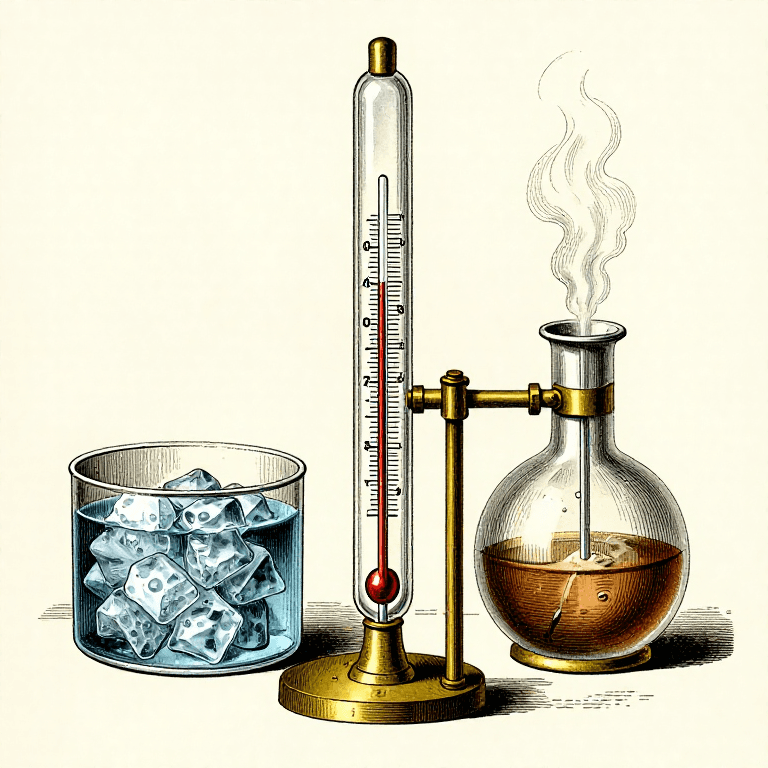
Josiah Wedgwood presented his pyrometer to the Royal Society in 1782 and was elected a Fellow the following year, largely on its strength. He was a manufacturer solving a manufacturing problem: his pottery business depended on firing consistently, and without a measurement he was relying on the judgement of experienced firemen watching the colour of the kiln.
The idea is to measure a permanent EFFECT rather than the transient cause. Temperature exists only while the kiln is hot; shrinkage persists. So the instrument records something that has already happened and can be read at leisure, at room temperature, with an ordinary gauge. That is why the same principle survives today as pyrometric cones — which measure heat WORK, the combination of time and temperature, rather than peak temperature alone.
Its honest failure is instructive. The instrument was repeatable, so Wedgwood could compare one firing to another with confidence — that alone transformed his business. But the scale was non-linear and untied to any external standard, so his numbers were precise and inaccurate. Precision without accuracy is genuinely useful for control and genuinely useless for communication, and the distinction matters in every measurement discipline.
Where the chain goes next: the thermocouple later in this batch measures temperature directly, continuously, while the process is running, and can be tied to fixed points. That is the fundamental advance — from a proxy read afterwards to a signal read live — and everything after it in instrumentation follows that direction.
Mga Materyales
8- 1 bagPlaceholder
- 1 bagPlaceholder
- 1 pirasoPlaceholder
- 1 pilyegoPlaceholder
- 4 pirasoPlaceholder
- 4 pirasoPlaceholder
- 1 pirasoPlaceholder
- 1 padPlaceholder
Mga Kinakailangang Kasangkapan
9- Placeholder
- Placeholder
- Placeholder
- 1 vendor sell this, none ship to you yetPlaceholder
- Placeholder
- Placeholder
- Placeholder
- Placeholder
- Placeholder
Ang blueprint na ito ay gumagawa ng

Kaugnay na Blueprint
Ang mga blueprint na ito ay nagbabahagi ng kaalaman — mga teknik, materyales, o prinsipyo
CC0 Pampublikong Domain
Ang blueprint na ito ay inilabas sa ilalim ng CC0. Malaya kang kumopya, magbago, mamahagi, at gumamit nang walang pahintulot.
Suportahan ang Maker sa pamamagitan ng pagbili ng mga produkto sa kanilang Blueprint Komisyon ng Maker itinakda ng mga Vendor, o lumikha ng bagong bersyon ng Blueprint na ito at isama bilang koneksyon sa iyong Blueprint upang ibahagi ang kita.