

The Float Valve
A cistern has to refill itself after every use and then stop — exactly at the right level, every time, for decades, with nobody watching it. Get it wrong in one direction and the next person has no water. Get it wrong in the other and it overflows continuously.
The problem is that the thing being controlled (the water level) and the thing doing the controlling (a valve) are different objects in different places. Almost every solution to that requires a sensor, a signal and an actuator.
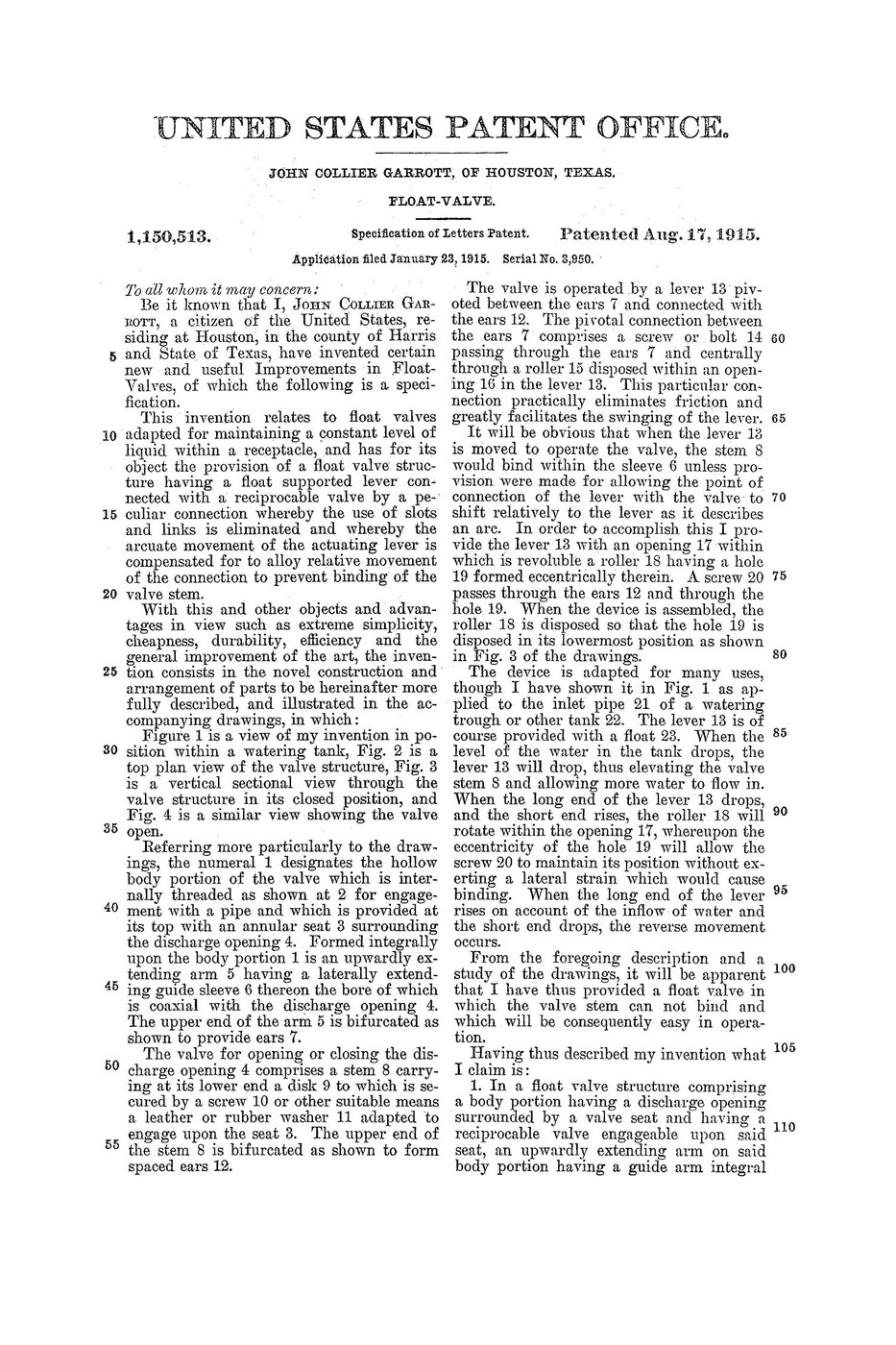
The float valve needs none of them, because it makes the water level operate its own supply. A hollow ball rides on the surface, so its height is the level — that is the measurement, taken for free. A lever carries that height to a washer seating on the inlet. As the level rises the ball rises, the lever closes the valve, and the flow that was raising the level is what shuts it off.
This is negative feedback built out of a stick and a ball: the output of the process is fed back to oppose its own cause. It settles at equilibrium by itself, needs no power, and has one moving joint.
The adjustment is equally direct — bend the arm or move the float and you have changed the set point, because the geometry is the setting.
ہدایات
Measure the force a float can actually produce
Measure the force a float can actually produce
Push a sealed empty bottle down into water and measure the force needed to hold it under, using a spring balance or by weighing.
Compute the buoyancy: it equals the weight of water displaced. A 1-litre float fully submerged gives about 10 N.
Write that number down. It is the entire power budget of the mechanism — everything the valve does must be done with that, and it is why float valves have levers.
درکار اوزار:
 ڈیجیٹل باورچی خانہ ترازو
 پانی کی بوتل
Turn a small force into a sealing force with the lever
Turn a small force into a sealing force with the lever
Look at a real float valve and measure two distances: pivot-to-float and pivot-to-washer.
Compute the ratio. Expect something like 8:1 or more.
Now multiply step 1's buoyancy by that ratio. That product is the force pressing the washer onto its seat, and it must beat the mains pressure trying to push it open.
This is why the float sits on a long arm and the valve is right at the pivot. Buoyancy is weak; the lever is what makes it strong enough to shut off a water main.
درکار اوزار:
 فیتہ پیما
Watch the feedback settle itself
Watch the feedback settle itself
Run a float valve in a clear container and watch the last few centimetres of filling closely.
Expect it to throttle gradually, not slam shut — the flow slows as the level nears the set point and eases to nothing.
That is the loop closing. Each millimetre of rise reduces the opening, which reduces the rise, which is the definition of negative feedback.
Note what is absent: nothing decides anything, nothing is measured and compared, and no state is stored. The control law is a physical shape.
Move the set point by bending the geometry
Move the set point by bending the geometry
Bend the arm slightly downward, or slide the float along it, and re-run. Measure the new shut-off level.
Expect a direct, predictable shift.
The set point is not a number in a controller. It is where the float has to be for the lever to close the valve, so changing the geometry changes the target.
Then find the overflow pipe in the cistern and note that it sits above the working level but below the rim — the admission that this mechanism can fail, and the decision to make its failure harmless rather than to pretend it cannot happen.
Make it fail the two ways it really fails
Make it fail the two ways it really fails
First, put a small hole in the float so it slowly fills. Expect the valve to never close — a sunk float cannot rise, so the cistern runs to the overflow forever. That is the classic running-toilet fault, and it is nearly always this.
Second, put grit or scale on the seat. Expect a persistent dribble — the lever is applying full force but the washer no longer seals against a damaged face.
Both are wear, not design faults, and both are why the valve is a serviceable part with a replaceable washer rather than a sealed unit.
History & Context
History & Context
Older than the plumbing it is famous for. Float-operated valves are ancient — Hero of Alexandria describes float control, and Roman and Islamic water engineers used floats to hold levels in tanks. The nineteenth century did not invent the idea; it mass-produced it in brass and put one in every house. This is the pattern the whole sanitation story follows: the mechanism was known, then forgotten as a common technique, then recollected when cities needed millions of them.
It is a governor, and it is worth seeing that. The float valve and the centrifugal governor on a steam engine are the same invention in different clothing: measure the output, feed it back to oppose the input, settle at equilibrium with no intelligence anywhere. Maxwell's 1868 paper analysing governors is the beginning of control theory as a discipline — and the humble ballcock is that theory, installed in every bathroom, decades before anyone wrote the mathematics down.
What it buys the rest of the system. Because refilling is automatic and bounded, a cistern can be a simple open tank. There is no need for pressure regulation at the fixture, no need for a user to judge anything, and a mains supply that fluctuates all day still produces the same flush. One self-regulating component removes a great deal of complexity everywhere else — which is the usual reward for solving a problem at the right place.
Where it went next. Livestock drinkers, header tanks, evaporative coolers, humidifiers, boiler feed tanks, and the carburettor float chamber that held petrol at a constant level in almost every engine for a century. Anywhere a level must hold itself, this mechanism turns up, usually unnoticed.
Modern refinements and their honest cost. Diaphragm and piston valves replaced the simple washer for quieter, faster shut-off; vertical float valves fit slimmer cisterns. Both are harder to diagnose by eye than a ball on a stick — and the older design's real virtue was that its fault was visible. Anyone can see a sunk float. Almost nobody can see a failed diaphragm.
درکار اوزار
3- پلیس ہولڈر
- پلیس ہولڈر
- 1 vendor sell this, none ship to you yetپلیس ہولڈر
منسلک بلیو پرنٹ مواد

CC0 پبلک ڈومین
یہ بلیو پرنٹ CC0 کے تحت جاری کیا گیا ہے۔ آپ اجازت لیے بغیر اس کام کو نقل، ترمیم، تقسیم اور کسی بھی مقصد کے لیے استعمال کرنے کے لیے آزاد ہیں۔
میکر کی حمایت کریں ان کے بلیو پرنٹ کے ذریعے پروڈکٹس خرید کر جہاں وہ میکر کمیشن وینڈرز کی طرف سے مقرر، کماتے ہیں، یا اس بلیو پرنٹ کی نئی تکرار بنائیں اور آمدنی شیئر کرنے کے لیے اسے اپنے بلیو پرنٹ میں کنکشن کے طور پر شامل کریں۔