

Blackwork Embroidery
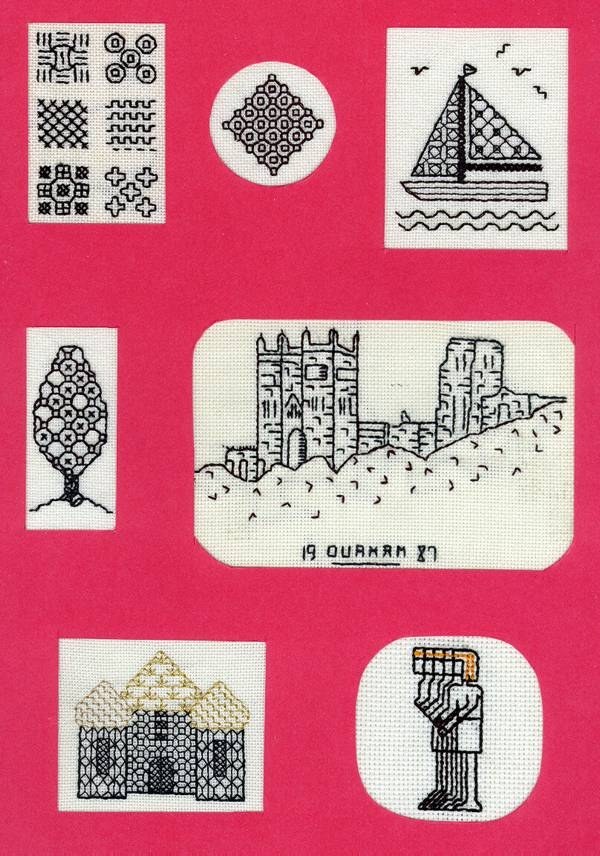
Look at a Holbein portrait and the sitter's collar and cuffs carry a fine black geometric pattern on white linen. That is blackwork, and it was everywhere in Tudor England — on shirts, smocks, coifs and sleeves — because it did something no other embroidery could: it produced a rich, dense pattern using one colour of thread and one stitch.
The technique is counted work. You do not draw a line and follow it; you count threads of the ground fabric and let the weave dictate every stitch. Get the count right and the pattern is inevitable.
The classic version is double running stitch — Holbein stitch — which produces an identical line on both faces. That mattered when the embroidery sat on a turned-back cuff and both sides showed.
ہدایات
Choose an evenweave linen
Choose an evenweave linen
Use linen with the same thread count in warp and weft, around 28-32 threads per inch. Uneven weave gives stretched patterns — squares come out as rectangles and no skill can fix it.
اس مرحلے کے لیے مواد:
 کتان کا کپڑا1 sqm
Count the threads to confirm
Count the threads to confirm
Count threads over 25 mm in both directions with a magnifier. Trust the count, not the label on the fabric.
درکار اوزار:
 عدسی
عدسیWash and press the linen first
Wash and press the linen first
Wash, dry and press before stitching. Linen shrinks, and a finished piece that shrinks afterwards distorts every stitch in it.
Mount it in a hoop or frame, drum tight
Mount it in a hoop or frame, drum tight
Tension the fabric evenly. Slack fabric lets stitches pull the weave together and the pattern closes up.
Choose silk or fine cotton thread
Choose silk or fine cotton thread
Use black silk for authenticity, or stranded cotton. Match thread weight to the weave: too heavy and the pattern turns into a blot.
اس مرحلے کے لیے مواد:
 سوتی دھاگہ20 میٹر
Use a blunt tapestry needle
Use a blunt tapestry needle
A blunt point slips between the ground threads instead of piercing them. A sharp needle splits threads and throws the count off by a fraction each time.
درکار اوزار:
 بڑے ناکے والی سوئی
Chart the pattern on squared paper
Chart the pattern on squared paper
Draw the design on graph paper where one square equals two ground threads. You stitch from the chart, never from a drawing on the cloth.
Plan the route before the first stitch
Plan the route before the first stitch
Trace the path your needle will take out and back. Double running rewards planning: a badly planned route leaves gaps you cannot reach on the return.
Work the outward journey in running stitch
Work the outward journey in running stitch
Stitch over two threads, skip two, all along the line. Keep every stitch the same length by counting, not by eye.
Return along the same line, filling the gaps
Return along the same line, filling the gaps
Come back the way you went, placing stitches in the spaces left. The result is a solid line — identical front and back, which is the whole trick.
Pierce the same holes on the return
Pierce the same holes on the return
Enter the exact holes used on the way out. Miss them and the line looks doubled and ragged instead of continuous.
Keep tension light and constant
Keep tension light and constant
Pull just enough to seat the thread. Tight stitches gather the linen and the whole panel cups.
Start and finish without knots
Start and finish without knots
Weave the tail under existing stitches instead of knotting. A knot shows as a lump through fine linen and defeats the reversible finish.
Build shaded areas by varying pattern density
Build shaded areas by varying pattern density
For fill patterns, use denser motifs where you want dark and sparser where you want light. One thread colour, and the tone comes entirely from spacing.
History & Context — one colour, counted
History & Context — one colour, counted
Where it was worn. Blackwork appears constantly in English portraits from roughly 1520 to 1620 — Holbein's sitters are the standard reference — on shirt collars, cuffs, smocks, coifs and sleeves. It is domestic and personal rather than ecclesiastical, and much of it was worked by women at home rather than in professional workshops. Surviving pieces are rarer than the paintings suggest, partly because linen underclothes were worn until they wore out.
The Catherine of Aragon story is legend, not record. It is repeated everywhere that Catherine brought blackwork from Spain to England on her marriage in 1501, and it is a good story with no documentary basis. Black-on-white counted embroidery is recorded in England before her arrival and existed across Europe and in the Islamic world well before that. Spanish work certainly influenced English taste, but the neat single-origin account should be treated as folklore.
Why the stitch is reversible. Double running — commonly called Holbein stitch — lays a broken line on the way out and completes it on the way back, so both faces carry an identical solid line. On a turned-back cuff or an unlined collar both sides are visible, so a technique with a messy reverse is unusable. The constraint produced the stitch.
And a warning written into the surviving pieces. Much period black silk was dyed with iron-based mordants, and iron slowly degrades silk. In many surviving textiles the black thread has rotted clean away, leaving only the needle holes where the pattern used to be — the design survives as an absence. Modern black thread is not dyed that way, so what you stitch today will outlast the originals it copies.
مواد
2- 1 sqmپلیس ہولڈر
- 20 میٹرپلیس ہولڈر
یہ بلوپرنٹ بناتا ہے
متعلقہ بلیو پرنٹ
یہ بلیو پرنٹ علم بانٹتے ہیں — تکنیک، مواد یا اصول

CC0 پبلک ڈومین
یہ بلیو پرنٹ CC0 کے تحت جاری کیا گیا ہے۔ آپ اجازت لیے بغیر اس کام کو نقل، ترمیم، تقسیم اور کسی بھی مقصد کے لیے استعمال کرنے کے لیے آزاد ہیں۔
میکر کی حمایت کریں ان کے بلیو پرنٹ کے ذریعے پروڈکٹس خرید کر جہاں وہ میکر کمیشن وینڈرز کی طرف سے مقرر، کماتے ہیں، یا اس بلیو پرنٹ کی نئی تکرار بنائیں اور آمدنی شیئر کرنے کے لیے اسے اپنے بلیو پرنٹ میں کنکشن کے طور پر شامل کریں۔