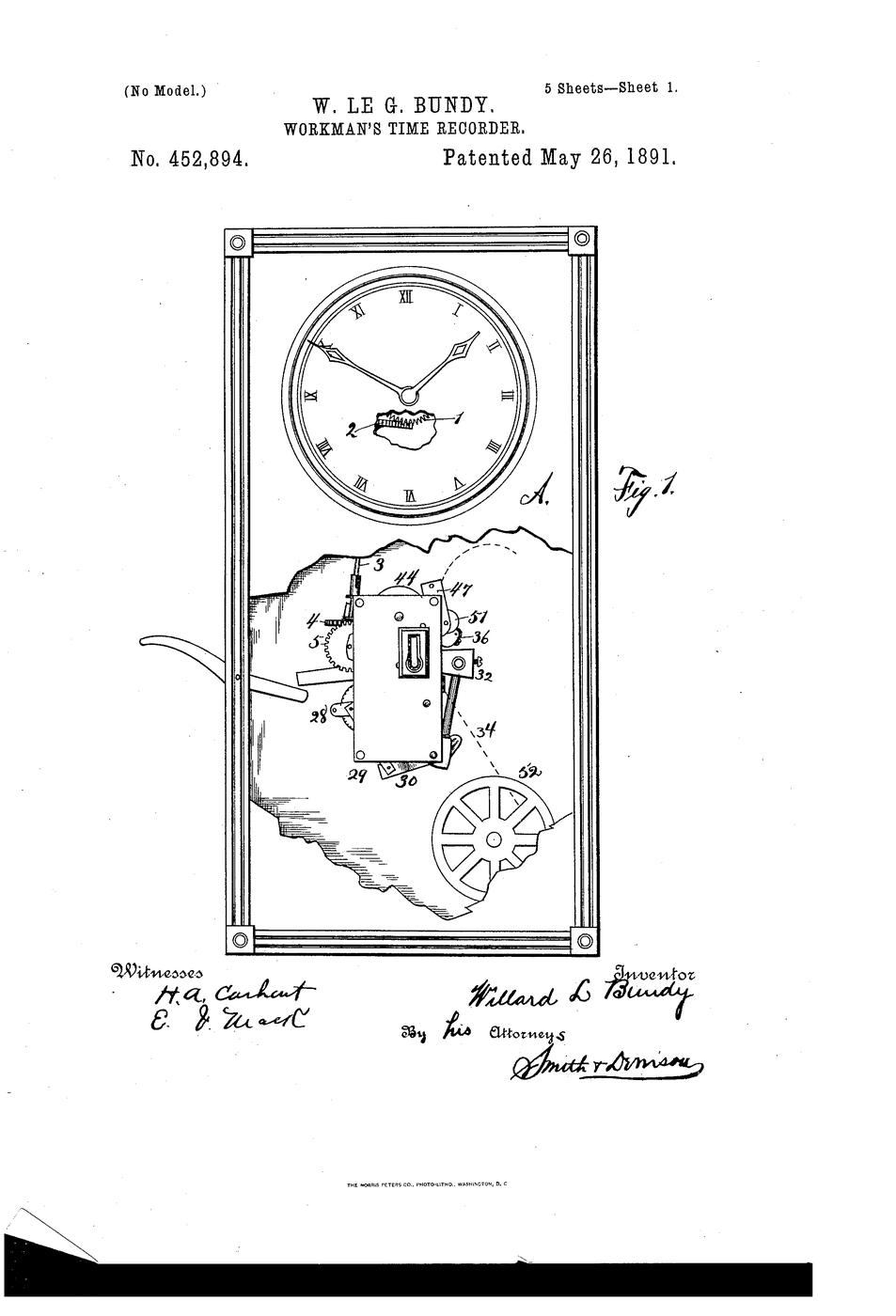


Time Recorder
Paying people by the hour requires knowing the hours. In a nineteenth-century factory that meant a timekeeper with a book, writing down names as men came through the gate — which is slow at shift change, wrong when he is busy, and permanently open to argument. The worker says he arrived at six; the book says ten past; there is no third party.
Bundy's answer is to make the worker produce the evidence himself. Each man carries a key with his own number embossed on it. He puts it in, turns it, and a hammer stamps his number and the exact time onto a paper strip in one blow. Nobody transcribes anything, so nobody can mis-transcribe it.
US Patent 452,894, "Workman's Time-Recorder", filed 18 December 1890 and granted 26 May 1891 to Willard Le Grand Bundy. His own wording: each workman "will by his own act accurately record the time of his arrival or departure."
ہدایات
Read US 452,894 and note who does the recording
Read US 452,894 and note who does the recording
Bundy's claim rests on the worker acting for himself. The machine has no operator — that is what removes the dispute, not the clock.
Run a shift change by hand first
Run a shift change by hand first
Have someone call out ten names in quick succession while you write each with a time. Count your errors and how far behind you fall.
Build the two number wheels
Build the two number wheels
Make two discs with raised digits around their rims — one for hours, one for minutes. Raised, because they will be struck through a ribbon.
اس مرحلے کے لیے مواد:
 پلائی ووڈ کی چادر1 شیٹ
Gear the wheels to a clock movement
Gear the wheels to a clock movement
Drive both from a clock so they always show the current time. The wheels turn continuously whether or not anyone uses the machine.
اس مرحلے کے لیے مواد:
 لکڑی کی چولیں1 ٹکڑا
Check the minute wheel steps cleanly
Check the minute wheel steps cleanly
Watch a minute change. If a digit can sit half-way between positions it will print an unreadable smear — the wheel must snap, not drift.
Cut three numbered keys
Cut three numbered keys
Make three keys, each carrying a different raised number. The key is both the identity and the trigger — no key, no record.
اس مرحلے کے لیے مواد:
 جست چڑھی فولادی تار1 میٹر
درکار اوزار:
 چپٹے منہ کا پلاس
Make the keyway that seats a key one way only
Make the keyway that seats a key one way only
Cut a slot that accepts a key in a single orientation, aligning its number with the printing line. Ambiguous seating prints crooked numbers.
Fit the spring hammer
Fit the spring hammer
Mount a hammer on a spring so that turning the key releases it against the printing line. One sharp blow, not a press — a slow squeeze blurs.
اس مرحلے کے لیے مواد:
 دبنے والی کمانیوں کا سیٹ1 سیٹ
Thread an inked ribbon over the paper
Thread an inked ribbon over the paper
Run a ribbon between the raised digits and the paper strip. The hammer drives paper, ribbon and type together for an instant.
اس مرحلے کے لیے مواد:
 بلاک چھپائی کی سیاہی1 ٹکڑا
Stamp a first record
Stamp a first record
Insert key 1, turn, and read the strip. Number, hour and minute should appear together in one line, printed by one blow.
Add the automatic paper feed
Add the automatic paper feed
Link the key's return stroke to a ratchet that advances the strip. Without it the next man prints on top of the last one.
Run the same ten-name shift change
Run the same ten-name shift change
Have three people clock in repeatedly as fast as they can. Compare speed and error count against step 2.
Try to clock in for someone else
Try to clock in for someone else
Use key 2 while pretending to be worker 3. It records key 2. The machine authenticates the key, not the person — note that limitation, it never went away.
Read the strip as a day's record
Read the strip as a day's record
Lay out the finished strip. It is a chronological, tamper-evident list that nobody wrote — the output is the point, not the mechanism.
History & Context — two Binghamton machines that became IBM
History & Context — two Binghamton machines that became IBM
The patent. US 452,894, "Workman's Time-Recorder", filed 18 December 1890 and granted 26 May 1891 to Willard Le Grand Bundy, a jeweller in Binghamton, New York. He had patented an earlier recorder in 1888; his brother Harlow pushed him to manufacture, and the two founded the Bundy Manufacturing Company in 1889.
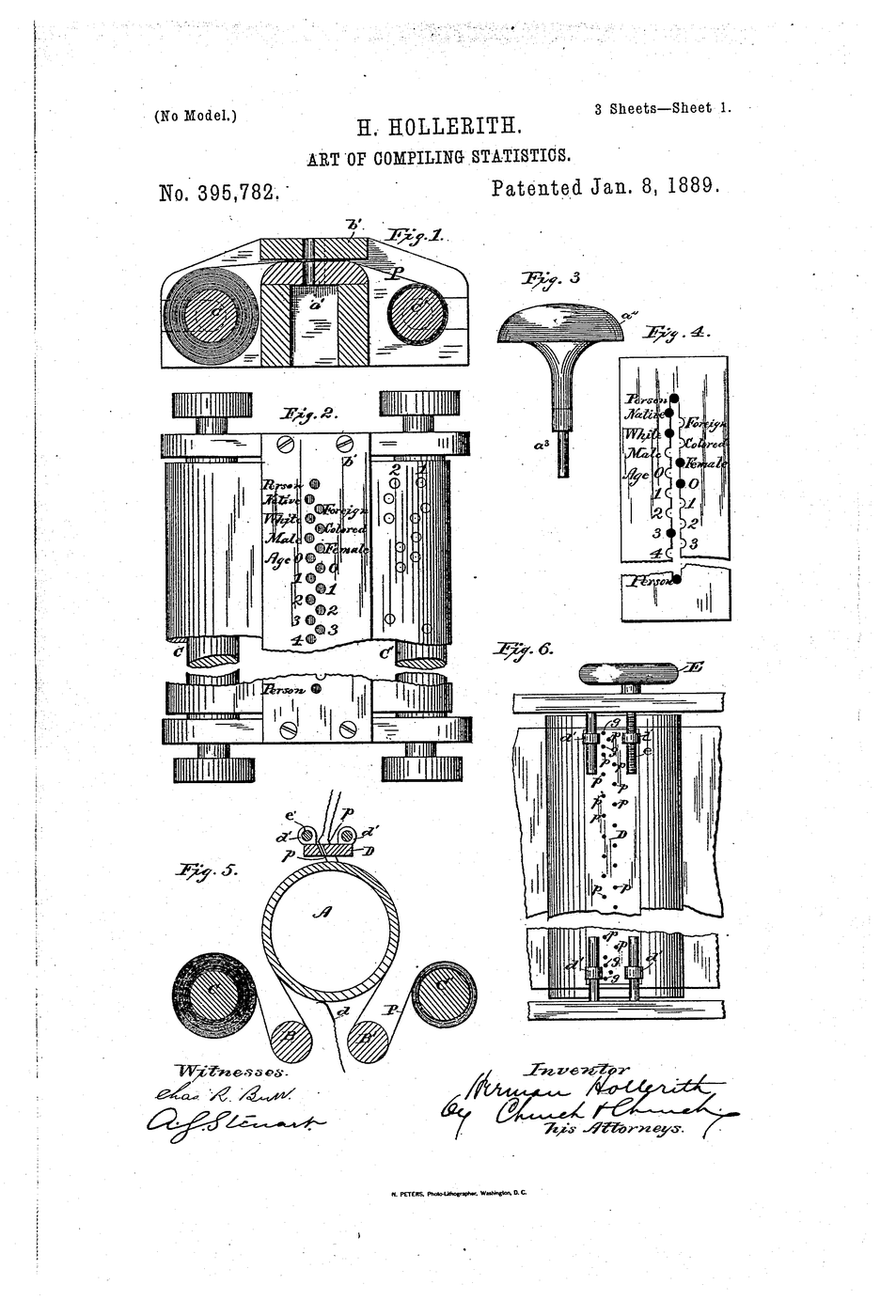
The corporate ending is a genuine coincidence worth stating. Bundy Manufacturing was one of the firms combined in 1911 into the Computing-Tabulating-Recording Company, which was renamed IBM in 1924. Herman Hollerith's Tabulating Machine Company — the punched-strip census machine elsewhere in this collection — was another. Two separate late-1880s inventions for capturing facts mechanically rather than by clerk, from inventors who did not work together, ended up inside the same company. What links them is not technology but a shared premise: a record made by a machine at the moment of the event beats a record written afterwards by a person.
Why the key does the work. The clock is the least interesting part — clocks were entirely ordinary in 1890. The invention is that identity, authority and timing are collapsed into a single physical act by the person with the strongest interest in the result being right. There is no timekeeper to bribe, distract or blame, and the worker cannot later be told he remembers his own arrival wrongly. Step 2 versus step 12 shows the throughput gain; the dispute-resolution gain is the one that sold the machine.
Its limitation is the one it still has. Step 13 is not a flaw in this model — it is the flaw. A token-based system authenticates the token. "Buddy punching", where one worker clocks in for an absent colleague, appeared immediately and persisted for over a century, and it is precisely why modern time clocks moved to fingerprints and face recognition. The mechanism removed the dispute about when and left the dispute about who.
What it meant for work. This is a good place to be honest rather than triumphal. Making labour precisely measurable is what makes it precisely payable — and also precisely disciplinable. The time clock arrives alongside scientific management and the fight over the length of the working day, and it served both sides: it is the instrument that proves an employer withheld twenty minutes' pay, and the instrument that docks a worker for arriving four minutes late. A measuring device is rarely neutral about what it measures.
مواد
5- 1 شیٹپلیس ہولڈر
- 1 ٹکڑاپلیس ہولڈر
- 1 میٹرپلیس ہولڈر
- پلیس ہولڈر
- 1 ٹکڑاپلیس ہولڈر
درکار اوزار
1- پلیس ہولڈر
متعلقہ بلیو پرنٹ
یہ بلیو پرنٹ علم بانٹتے ہیں — تکنیک، مواد یا اصول

CC0 پبلک ڈومین
یہ بلیو پرنٹ CC0 کے تحت جاری کیا گیا ہے۔ آپ اجازت لیے بغیر اس کام کو نقل، ترمیم، تقسیم اور کسی بھی مقصد کے لیے استعمال کرنے کے لیے آزاد ہیں۔
میکر کی حمایت کریں ان کے بلیو پرنٹ کے ذریعے پروڈکٹس خرید کر جہاں وہ میکر کمیشن وینڈرز کی طرف سے مقرر، کماتے ہیں، یا اس بلیو پرنٹ کی نئی تکرار بنائیں اور آمدنی شیئر کرنے کے لیے اسے اپنے بلیو پرنٹ میں کنکشن کے طور پر شامل کریں۔