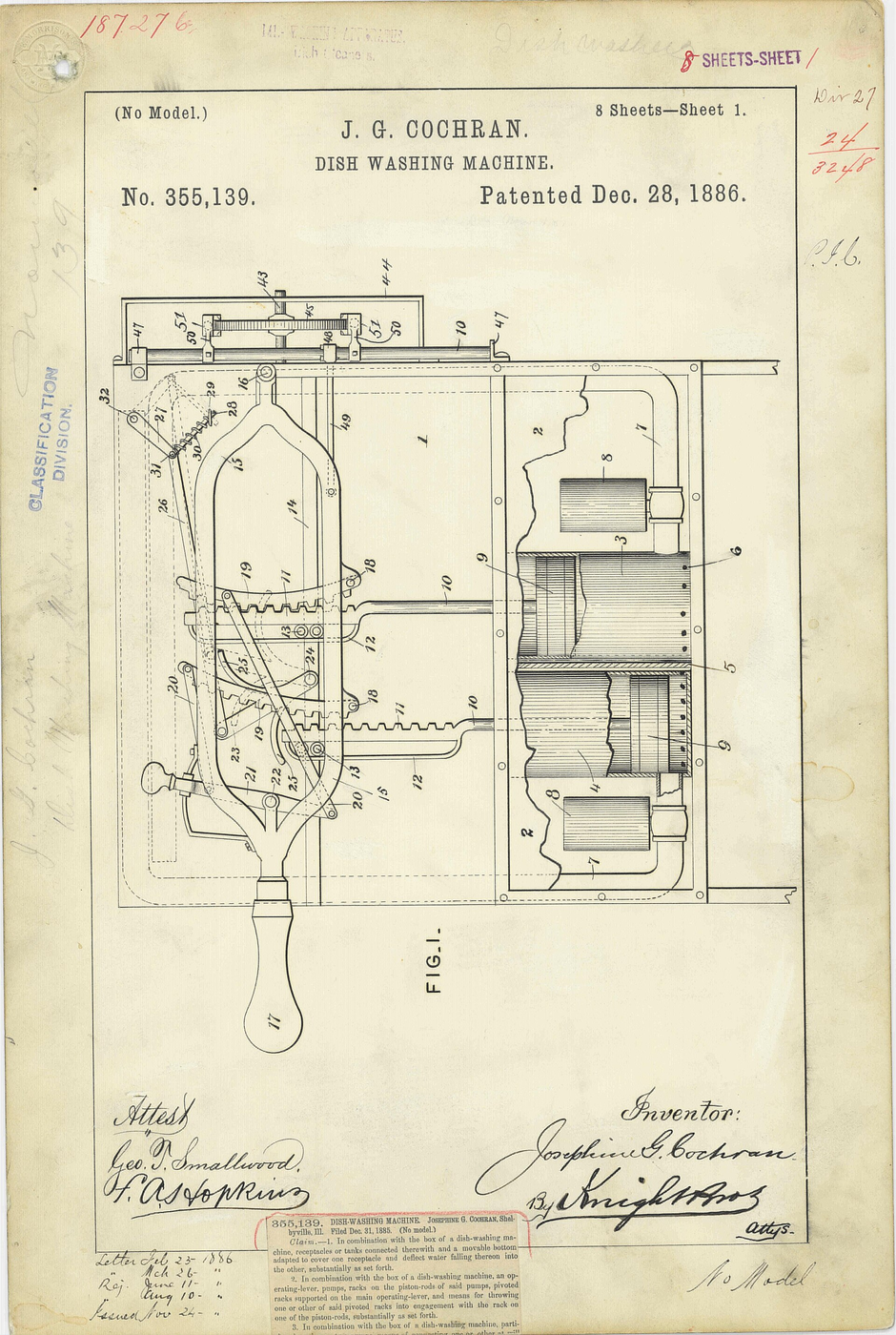


Cochran Dish-Washing Machine
Every dishwashing machine before 1886 scrubbed. They had brushes, paddles or agitators that dragged something across the plate, and they chipped china as reliably as they cleaned it.
Josephine Cochran's machine touches nothing. The plates sit still in wire compartments cut to fit them, and jets of hot soapy water are pumped up from below. Pressure does the work that friction used to. Nothing rubs, so nothing chips — and that was the specification, because she was trying to stop her servants breaking her heirloom china.
US Patent 355,139, granted 28 December 1886. The wire rack sized to the dish, the pump-driven jets, the enclosed copper boiler: three ideas that are still exactly how your dishwasher works, arranged by someone who had never built a machine before.
ہدایات
Hot water under pressure scalds
Hot water under pressure scalds
This machine circulates water hot enough to cut grease. Fit the lid before starting the pump and never open an enclosure that is still under pressure.
Read US 355,139 and find the wire compartments
Read US 355,139 and find the wire compartments
Study the drawings. The claim that matters is the wire rack with compartments shaped to the dishes — everything else serves it.
Measure the actual dishes you intend to wash
Measure the actual dishes you intend to wash
Record plate diameter, cup height and saucer depth. Cochran measured hers first and built the rack to them — the machine is designed around the load, not the other way round.
درکار اوزار:
 پیمانہ
Bend wire compartments to those measurements
Bend wire compartments to those measurements
Form each pocket from wire so a plate stands on edge and cannot shift. A plate that can move will knock against its neighbour — the whole no-breakage claim rests on this.
اس مرحلے کے لیے مواد:
 فولادی تار5 میٹر
Stand the plates on edge, not flat
Stand the plates on edge, not flat
Vertical plates shed water and let jets reach both faces. Stacked flat, the top one shields every plate beneath it.
Build the rack as a wheel that sits in the boiler
Build the rack as a wheel that sits in the boiler
Assemble the compartments around a central hub so the whole load lifts in and out as one piece and sits clear of the bottom.
Make a copper tub to take the rack
Make a copper tub to take the rack
Form and seam a tub deep enough that the rack clears the water reservoir below it. Copper because it takes heat fast and does not taint the water.
اس مرحلے کے لیے مواد:
 تانبے کی چادر1 شیٹ
Fit a pump that draws from the sump
Fit a pump that draws from the sump
A hand-cranked or motor-driven pump lifts water from the bottom reservoir and delivers it to the jets. The original was hand-powered — a motor is a convenience, not a change of principle.
Aim the jets upward from beneath the rack
Aim the jets upward from beneath the rack
Drill a manifold so streams strike the undersides and inner faces. Water falls back to the sump and is pumped round again — the same charge is reused for the whole cycle.
اس مرحلے کے لیے مواد:
 تانبے کی نلکی2 میٹر
Fit a coarse strainer over the sump
Fit a coarse strainer over the sump
Food debris must not reach the pump. Without a filter the machine cheerfully re-sprays the scraps it just removed.
درکار اوزار:
 موٹے تار جال کی چھلنی
Heat the water properly before the first jet
Heat the water properly before the first jet
Bring the charge to genuinely hot before pumping. Temperature is doing the work friction used to, and lukewarm water simply moves grease around.
اس مرحلے کے لیے مواد:
 کیسٹائل صابن (مائع)20 ملی لیٹر
Run a wash cycle and then a clean rinse
Run a wash cycle and then a clean rinse
Pump soapy water for several minutes, drain it, refill with clean hot water and pump again. Rinsing is a separate charge, not a longer wash.
Let residual heat dry the load
Let residual heat dry the load
Open the lid and leave the rack in place. Crockery hot from the rinse dries itself in minutes with no towel — a side effect of hot water that hand-washing never gets.
Test the actual claim: run china and inspect the rims
Test the actual claim: run china and inspect the rims
Wash plates you care about and examine every edge afterwards. If anything is chipped, a compartment is too loose — fix the rack, not the jets.
Compendium — pressure instead of friction
Compendium — pressure instead of friction
The patent. US 355,139, "Dish-Washing Machine", granted 28 December 1886 to Josephine G. Cochran of Shelbyville, Illinois. Google Patents' OCR renders her surname "Coohran"; contemporary sources spell it both Cochran and Cochrane, and the patent document itself reads Cochran. She was the granddaughter of John Fitch, an early steamboat inventor, and she designed the machine after her own china was chipped by servants — reportedly saying that if nobody else was going to invent a dishwasher, she would do it herself.
Why the rack is the invention. Earlier machines — there had been patents since 1850 — used brushes or paddles that scrubbed the dishes, and they were slow, ineffective and destructive. Cochran's insight was that a jet of hot soapy water at pressure cleans without contact, so the machine's job reduces to holding each dish still, in the open, at an angle that lets water reach every surface and drain off it. The compartments cut to fit specific dishes are the first claim in the patent for exactly that reason, and a modern dishwasher basket is the same idea in plastic.
Who actually bought it. Not households. It won an award at the 1893 Chicago World's Columbian Exposition, and the early customers were hotels and restaurants — places with enough dishes and enough labour cost to justify the machine, and with hot water already on tap. Domestic sales stayed poor for decades because most homes lacked the hot water supply the design assumes, and because dishwashing was unpaid labour whose cost nobody counted. Her company eventually became part of KitchenAid, now within Whirlpool.
What has and has not changed. The modern machine adds a rotating spray arm, a heating element, a detergent dispenser and a drying cycle. The architecture — vertical dishes in a shaped rack, recirculating jets from below, a sump with a filter, a hot rinse — is Cochran's, and it works for the reason she identified: the cleaning agent is hot water under pressure, and every part that touches a plate is a part that can break it.
مواد
4- 5 میٹرپلیس ہولڈر
- 1 شیٹپلیس ہولڈر
- 2 میٹرپلیس ہولڈر
- 20 ملی لیٹرپلیس ہولڈر
یہ بلوپرنٹ بناتا ہے
متعلقہ بلیو پرنٹ
یہ بلیو پرنٹ علم بانٹتے ہیں — تکنیک، مواد یا اصول

CC0 پبلک ڈومین
یہ بلیو پرنٹ CC0 کے تحت جاری کیا گیا ہے۔ آپ اجازت لیے بغیر اس کام کو نقل، ترمیم، تقسیم اور کسی بھی مقصد کے لیے استعمال کرنے کے لیے آزاد ہیں۔
میکر کی حمایت کریں ان کے بلیو پرنٹ کے ذریعے پروڈکٹس خرید کر جہاں وہ میکر کمیشن وینڈرز کی طرف سے مقرر، کماتے ہیں، یا اس بلیو پرنٹ کی نئی تکرار بنائیں اور آمدنی شیئر کرنے کے لیے اسے اپنے بلیو پرنٹ میں کنکشن کے طور پر شامل کریں۔