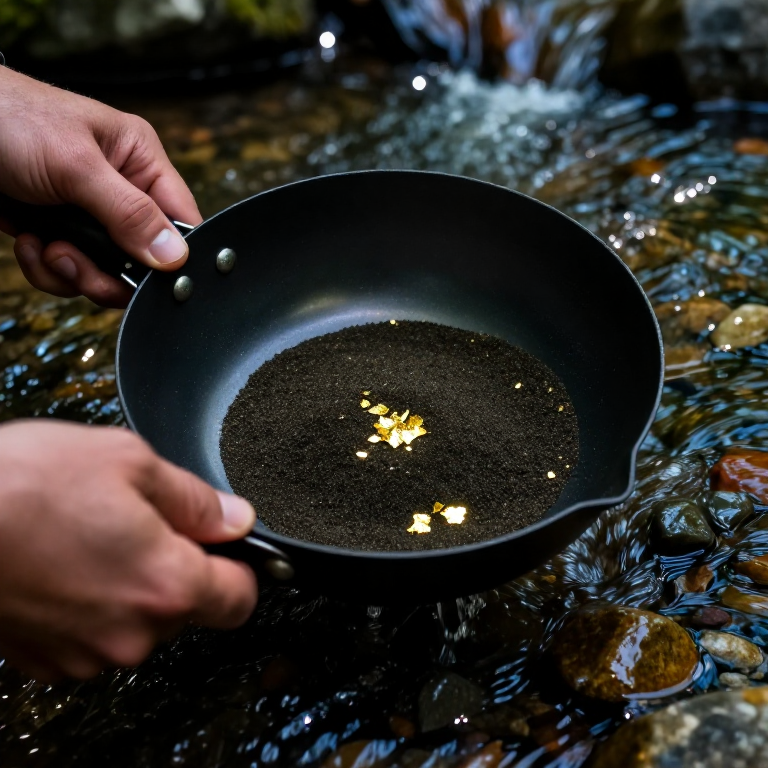


Panning for Gold — Finding Native Metal
ہدایات
The Physics of Gold Panning
The Physics of Gold Panning
Why Gold Sinks
Gold panning is a gravity separation technique. It works because gold is absurdly dense:
| Material | Density (g/cm³) |
|---|---|
| Sand (quartz) | 2.65 |
| Iron pyrite ("fool's gold") | 5.01 |
| Black sand (magnetite) | 5.18 |
| Lead | 11.34 |
| Gold | 19.30 |
Gold is 7.3× denser than sand. When you agitate a pan of mixed sediment in water, gravity pulls gold to the bottom while lighter materials wash over the rim. No chemistry needed — pure physics.
Where Gold Accumulates
Water transports gold downstream from its source (veins in quartz rock). Gold settles where water slows:
- Inside bends of rivers (slower water = deposition)
- Behind large boulders (eddy zones)
- Bedrock cracks (gold drops into crevices and stays)
- Below waterfalls (plunge pools concentrate heavy material)
اس مرحلے کے لیے مواد:
 Gold Pan1 pc
 Gold Panning Kit1 کٹ
 Gold (Reference)1 حوالہ
درکار اوزار:
 Classifier/sieve (1/4 inch)
 Snuffer bottle or tweezers
 Glass vial
Collecting and Classifying Material
Collecting and Classifying Material
Sampling
- Dig material from bedrock level — gold works its way down through gravel over time. Surface gravel is mostly barren.
- Fill your classifier (sieve) with the excavated material and place it over your pan.
- Pour water through the classifier — fine material falls into the pan, large rocks stay in the classifier.
- Check the large rocks for visible gold before discarding. Gold sometimes lodges in rock crevices.
Quantity
Fill the pan ¾ full with classified material. Too full and you'll lose gold over the rim. Too little wastes time.
اس مرحلے کے لیے مواد:
Gold Pan1 pcGold (Reference)1 حوالہGold Panning Kit1 کٹThe Panning Technique
The Panning Technique
Step-by-Step Panning
- Submerge: Hold the pan underwater and break up any clay lumps with your fingers. Gold trapped in clay won't separate.
- Shake: While submerged, shake the pan vigorously side-to-side (NOT circular). This stratifies the material — heavy gold sinks, light sand rises.
- Tilt and wash: Tilt the pan slightly away from you. Gently swirl water across the surface, washing the lightest sand over the rim.
- Re-shake: Every 3-4 washes, level the pan and shake again to re-stratify.
- Reduce: Continue the wash-shake cycle until only heavy concentrates remain — black sand (magnetite) and hopefully gold.
- Final check: Swirl a thin film of water across the remaining black sand. Gold appears as bright yellow flakes or specks against the dark background.
Common Mistakes
- Circular motion: Creates a vortex that lifts gold OUT of the pan. Always shake side-to-side.
- Rushing: Patience is everything. A proper pan takes 10-15 minutes.
- Shallow water: Always work with the pan submerged. Surface panning loses fine gold.
اس مرحلے کے لیے مواد:
Gold Pan1 pcGold Panning Kit1 کٹGold (Reference)1 حوالہRecovery and Assessment
Recovery and Assessment
Identifying Real Gold
| Test | Gold | Fool's Gold (Pyrite) |
|---|---|---|
| Color | Bright yellow, same in shade/sun | Brassy, sparkling only in direct light |
| Shape | Rounded, flattened flakes (water-worn) | Angular, cubic crystals |
| Hardness | Soft — bends with fingernail | Hard — scratches metal |
| Streak | Yellow streak on ceramic | Black/green streak |
| Density | Stays at bottom through heavy agitation | Washes away with sand |
Recovery
Use a snuffer bottle (squeeze, touch to gold flake, release — suction picks it up) or wet tweezers. Transfer to a glass vial with a small amount of water.
Innovation Connection
Gold panning shows that native metals exist — metals that occur pure in nature. This discovery (probably accidental) planted the seed: "if this shiny stuff comes from rocks, what else is hiding in rocks?" The answer required fire — and that leads to Blueprint: Smelting Copper from Malachite.
اس مرحلے کے لیے مواد:
Gold Pan1 pcGold Panning Kit1 کٹGold (Reference)1 حوالہمواد
3- 1 ٹکڑاپلیس ہولڈر
- 1 کٹپلیس ہولڈر
- 1 حوالہپلیس ہولڈر
درکار اوزار
3- پلیس ہولڈر
- پلیس ہولڈر
- پلیس ہولڈر
CC0 پبلک ڈومین
یہ بلیو پرنٹ CC0 کے تحت جاری کیا گیا ہے۔ آپ اجازت لیے بغیر اس کام کو نقل، ترمیم، تقسیم اور کسی بھی مقصد کے لیے استعمال کرنے کے لیے آزاد ہیں۔
میکر کی حمایت کریں ان کے بلیو پرنٹ کے ذریعے پروڈکٹس خرید کر جہاں وہ میکر کمیشن وینڈرز کی طرف سے مقرر، کماتے ہیں، یا اس بلیو پرنٹ کی نئی تکرار بنائیں اور آمدنی شیئر کرنے کے لیے اسے اپنے بلیو پرنٹ میں کنکشن کے طور پر شامل کریں۔