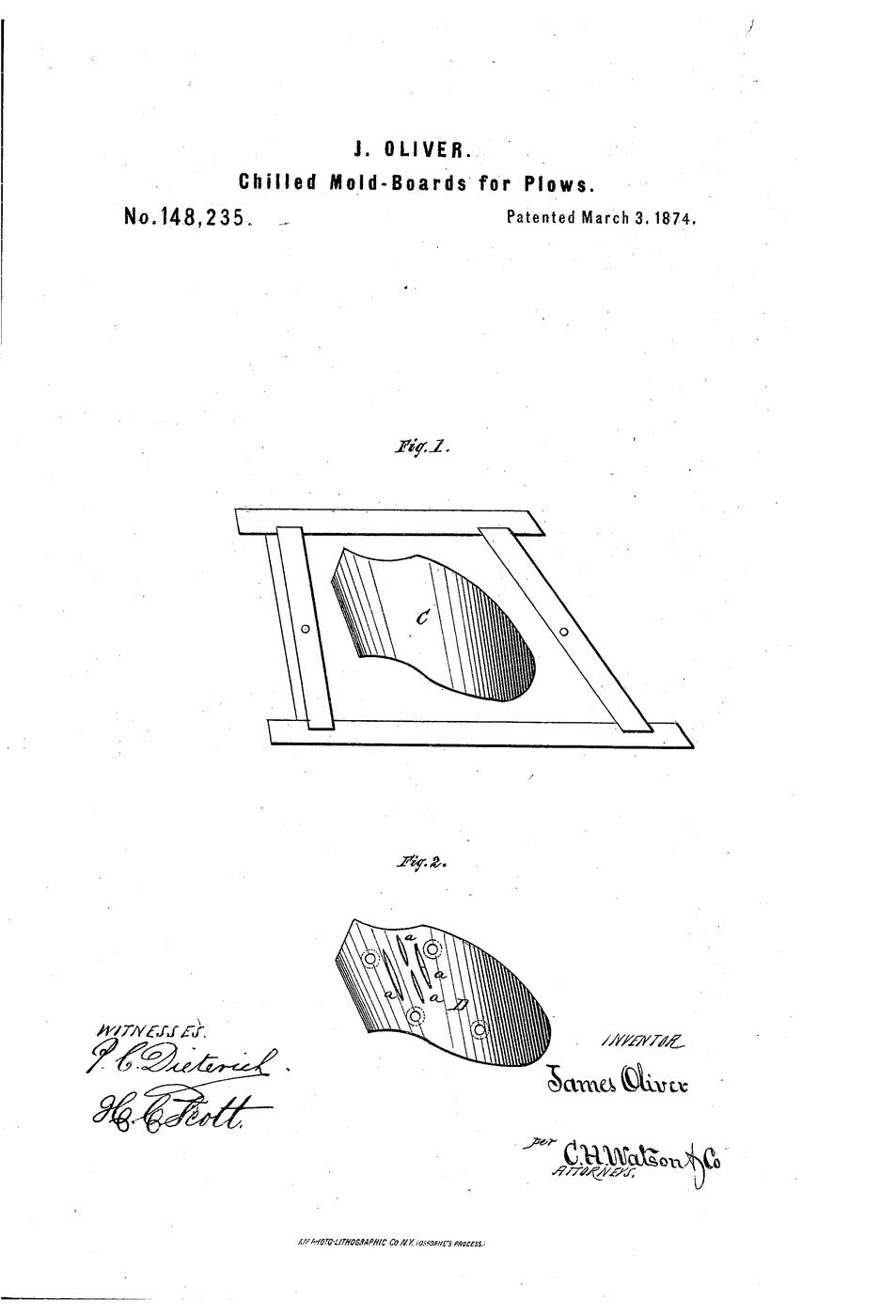


Chilled Plow
The deep, sticky soils of the American prairie broke the plows that opened them. Wooden and ordinary cast-iron mold-boards were too soft: the soil scoured them, wore them dull, and — worst — clung to them, so a farmer had to stop every few paces to scrape the plow clean. A plow that soil sticks to cannot plow.
The answer is a mold-board whose working face is glass-hard and mirror-smooth, so soil slides off and abrasion cannot dull it. Pour molten iron against a cold iron block — a chill — and the face freezes almost instantly, forming an intensely hard skin, while the back cools slowly and stays tough.
But chilling fights back: the hard face contracts more than the soft back, so the casting warps. Oliver's specific patented fix is to cast grooves into the back of the mold-board, which relieve the strain and stop it twisting out of shape.
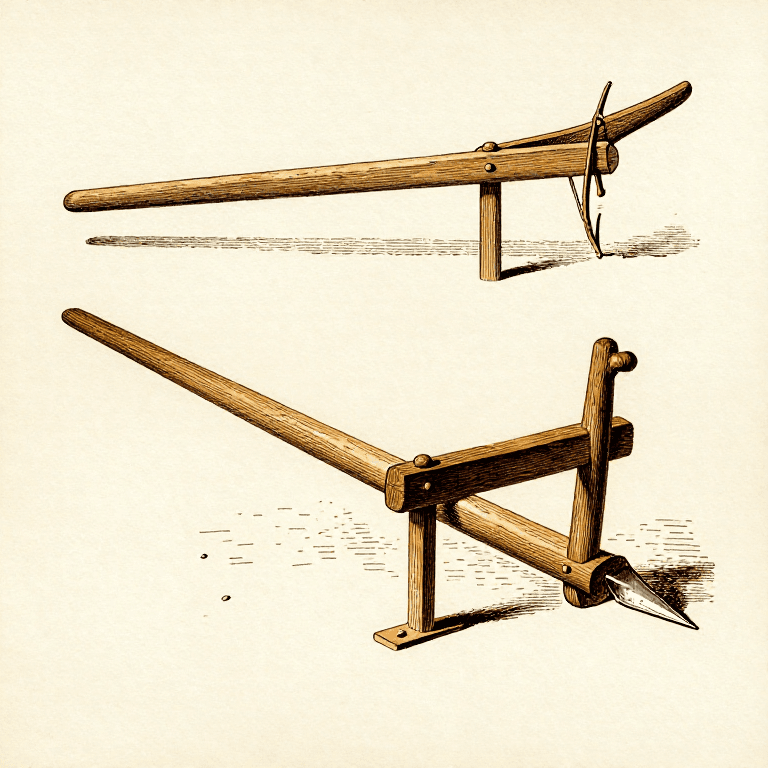
US Patent 148,235, "Improvement in chilled mold-boards for plows", granted 3 March 1874 to James Oliver of South Bend, Indiana.
ہدایات
Read what US 148,235 actually claims
Read what US 148,235 actually claims
The chilling of iron was already known. Oliver's specific claim is casting grooves in the BACK of the mold-board to prevent it warping as it chills. Note the exact, narrow claim.
Glasses on — chilled iron is brittle
Glasses on — chilled iron is brittle
A hard chilled surface can spall sharp chips under a hammer. Glasses on for the hardness tests.
درکار اوزار:
 شفاف حفاظتی عینک
Drag a wooden board through damp soil
Drag a wooden board through damp soil
Pull a plain wooden block through wet, heavy soil. Soil clings to it and builds up, and it drags harder as it loads. This is the problem that stopped the prairie plows.
اس مرحلے کے لیے مواد:
 سخت لکڑی کا ٹکڑا1 شیٹ
Understand chilling: fast cooling makes hard iron
Understand chilling: fast cooling makes hard iron
When molten iron freezes fast against a cold chill, the carbon stays combined and the surface sets glass-hard (white iron). Cool slowly and you get soft grey iron. Speed of cooling sets the hardness.
Compare a hard face and a soft face for stickiness
Compare a hard face and a soft face for stickiness
Drag a rough surface and a hard, polished metal surface through the same wet soil. Soil clings to the rough one and slides off the smooth hard one. Smoothness plus hardness is what makes a plow self-scour.
اس مرحلے کے لیے مواد:
 نرم فولاد کی گول سلاخ1 ٹکڑا
Scratch-test hard versus soft
Scratch-test hard versus soft
Drag a steel point across a hardened surface and a soft one under the same load. The hard face barely marks; the soft one grooves. That resistance is why a chilled plow keeps its edge in gritty soil.
درکار اوزار:
 قابلِ ترتیب زاویہ پیما
Model the warping with two strips
Model the warping with two strips
The chilled face contracts more than the un-chilled back. Model this: bond a strip that shrinks to one that does not, and watch the pair curl toward the shrinking side. That curl is the warp Oliver had to defeat.
See why warping ruins a mold-board
See why warping ruins a mold-board
A warped mold-board will not seat flat on the plow standard. Oliver's spec says many castings were "unfit for use" or needed grinding and filing. A precise curved shape that comes out twisted is scrap.
Cut relief grooves in the back of a test piece
Cut relief grooves in the back of a test piece
On a stiff plate, cut grooves across the back where it would rest on the standard. Grooves let the strained metal relieve itself instead of bowing the whole piece.
اس مرحلے کے لیے مواد:
 پلائی ووڈ کی چادر1 شیٹ
درکار اوزار:
 لوہا کاٹنے کی آری
Compare grooved and ungrooved for flatness
Compare grooved and ungrooved for flatness
Stress a grooved plate and an identical solid one the same way. The grooved one stays flatter — the relief works. This is exactly Oliver's claim in miniature.
درکار اوزار:
 ورنیئر کیلیپر
Polish the working face and test scouring
Polish the working face and test scouring
Polish the hard face smooth and drag it through wet soil again. It stays clean — the soil scours itself off. A self-scouring plow does not need stopping to clean.
درکار اوزار:
 باریک ریتیوں کا سیٹ
Weigh the pull, clean versus clogged
Weigh the pull, clean versus clogged
Measure the force to drag the clean hard face and the soil-clogged wooden one. Less clinging means less draught — easier on the horse and faster across the field.
درکار اوزار:
 قوت پیما (کمانی ترازو)
History & Context — the plow that broke the prairie cheaply
History & Context — the plow that broke the prairie cheaply
The patent. US 148,235, "Improvement in chilled mold-boards for plows", granted 3 March 1874 to James Oliver of South Bend, Indiana — one of some forty-five plow patents he took out. Oliver was Scottish-born, emigrated as a boy, and spent decades perfecting the casting of chilled plows.
Read the claim narrowly, because the popular story overstates it. "Chilling" cast iron — freezing the face fast against a cold iron chill to harden it — was an established foundry technique before this patent. What US 148,235 actually claims is the fix for chilling's side effect: the hard, fast-cooled face contracts more than the soft back, so the casting warps and many come out unusable (steps 7 and 8). Oliver's answer is to cast grooves into the back where the mold-board rests on the standard, relieving the strain so the piece stays true (steps 9 and 10). It is a small, precise manufacturing improvement — exactly the kind of unglamorous fix that turns a good idea into a mass-producible product.
Why the chilled plow mattered — and how it differs from Deere's. The prairie's real enemy was not toughness but stickiness: rich, moist soil clung to wood and grey cast iron so badly the plow had to be scraped constantly. John Deere's famous answer (1837) was a polished steel mold-board that soil slid off. Oliver's chilled cast iron reached the same self-scouring, wear-resistant hard surface a different way — by casting it, which was far cheaper than forging steel and could be mass-produced in a foundry. So the two are not rivals for one crown: Deere made the self-scouring steel plow, Oliver made the self-scouring plow affordable to every farmer. Step 11 shows the self-scouring; step 12 shows why it also meant less draught for the horse.
What it enabled. A cheap, hard, self-scouring plow is one of the machines that made the American grain belt possible — millions of acres of tough prairie sod turned into wheat and corn fields, feeding the industrial cities and the export trade. It pairs directly with the other machines of this batch: the plow opens the ground, the drill and planter seed it, the reaper and binder cut it, and the thresher frees the grain. The Oliver Chilled Plow Works grew into one of the largest plow makers in the world on the back of the modest grooves you cut in step 9.
مواد
3- 1 شیٹپلیس ہولڈر
- 1 ٹکڑاپلیس ہولڈر
- 1 شیٹپلیس ہولڈر
درکار اوزار
6- پلیس ہولڈر
- پلیس ہولڈر
- پلیس ہولڈر
- پلیس ہولڈر
- پلیس ہولڈر
- پلیس ہولڈر
متعلقہ بلیو پرنٹ
یہ بلیو پرنٹ علم بانٹتے ہیں — تکنیک، مواد یا اصول


CC0 پبلک ڈومین
یہ بلیو پرنٹ CC0 کے تحت جاری کیا گیا ہے۔ آپ اجازت لیے بغیر اس کام کو نقل، ترمیم، تقسیم اور کسی بھی مقصد کے لیے استعمال کرنے کے لیے آزاد ہیں۔
میکر کی حمایت کریں ان کے بلیو پرنٹ کے ذریعے پروڈکٹس خرید کر جہاں وہ میکر کمیشن وینڈرز کی طرف سے مقرر، کماتے ہیں، یا اس بلیو پرنٹ کی نئی تکرار بنائیں اور آمدنی شیئر کرنے کے لیے اسے اپنے بلیو پرنٹ میں کنکشن کے طور پر شامل کریں۔