

Phillips Screw
A slotted screw is a nineteenth-century object driven by a nineteenth-century method: line the blade up by eye, hold it there with one hand, hold the screw with the other, and hope. The blade wanders out of the slot, chews the head, and skates across the work. It cannot be started one-handed and it cannot be driven by a machine that has no eyes.
A cross-shaped recess fixes the alignment problem geometrically. The driver has only one way to sit, and the tapered walls pull it to the centre as it engages. Present a powered driver anywhere near the head and it finds its own way in.
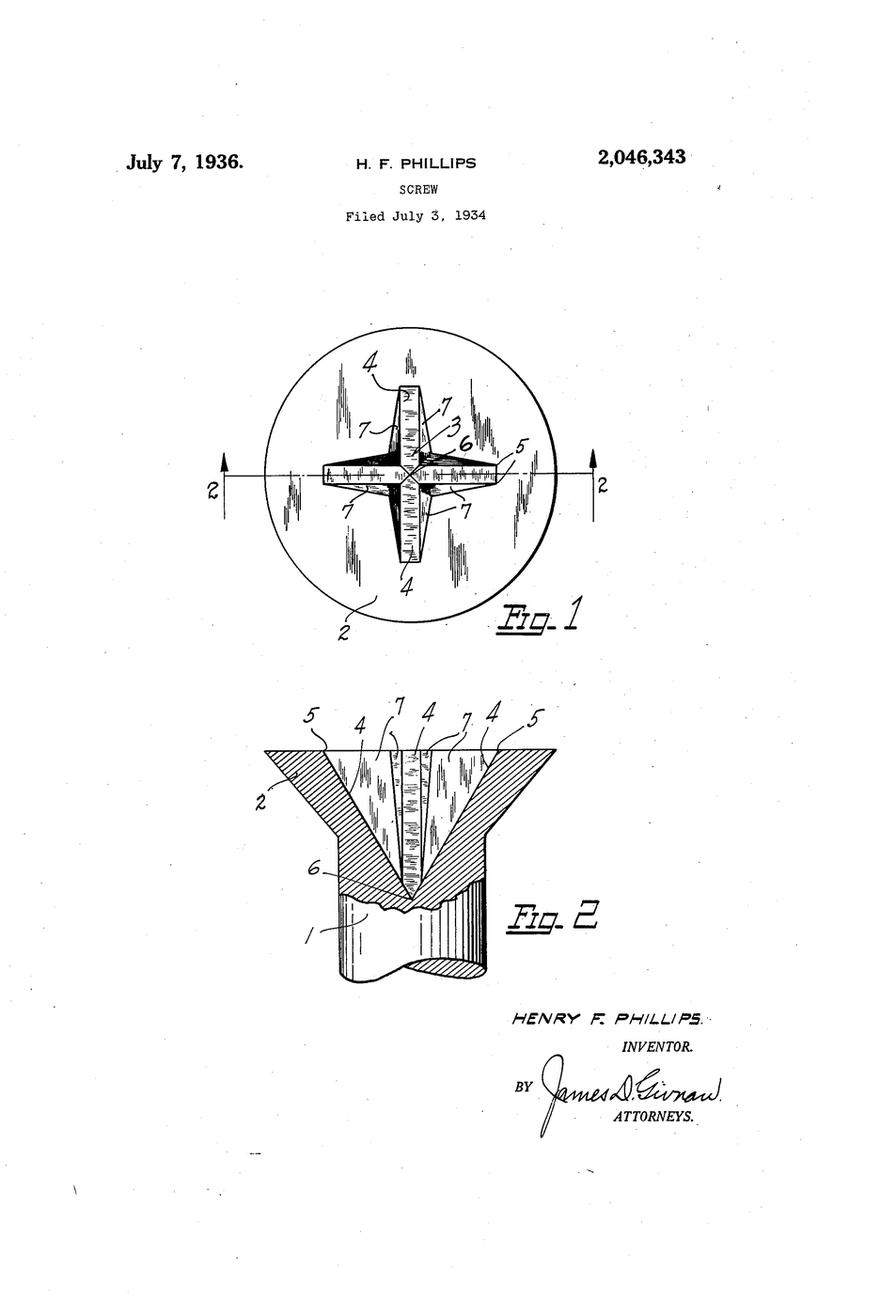
The second half is how the recess is made. It is punched, not cut — one blow of a die, no machining, and the cold working leaves the head harder than it started.
US Patent 2,046,343, titled simply "Screw", filed 3 July 1934 and granted 7 July 1936 to Henry F. Phillips.
ہدایات
Read US 2,046,343 and note how the recess is formed
Read US 2,046,343 and note how the recess is formed
Phillips specifies flat-bottomed grooves whose geometry allows the recess to be made by a simple punching operation, which also work-hardens the head. Manufacture is claimed, not just shape.
Start a slotted screw one-handed
Start a slotted screw one-handed
Hold only the screwdriver and try to start a slotted screw into softwood. It falls off. Time how long it takes to get it biting.
اس مرحلے کے لیے مواد:
 لکڑی کا پیچ #8 × ۱ انچ10 ٹکڑے
Do the same with a cross-recess screw
Do the same with a cross-recess screw
Repeat one-handed with a Phillips screw and driver. It seats and stays. Record both times — the difference is the invention's entire commercial case.
Approach a head off-centre deliberately
Approach a head off-centre deliberately
Bring the driver in at an angle and off to one side. The tapered recess walls drag the tip to the middle. This is self-centring, and no slot does it.
Drive twenty of each into softwood
Drive twenty of each into softwood
Run twenty slotted and twenty cross-recess screws. Count how many times the driver slipped out of each.
Inspect the damage the slips caused
Inspect the damage the slips caused
Look at the wood beside the slotted screws. A blade escaping a slot travels sideways at speed and scores the workpiece — the cost is not only lost time.
Tighten a cross-recess screw until it stops
Tighten a cross-recess screw until it stops
Keep turning past seating. At some torque the driver rises out of the recess and spins. This is cam-out, and it is the most argued-about property of the design.
Do the same with a slotted screw
Do the same with a slotted screw
Keep driving a slotted screw. It does not cam out; it either drives on, twists off, or the blade destroys the slot. Note which failure you get.
Repeat cam-out with a worn driver
Repeat cam-out with a worn driver
Use a rounded, worn tip. Cam-out happens far earlier and chews the recess. Most of the design's bad reputation comes from worn drivers, not from screws.
Punch a cross into soft metal
Punch a cross into soft metal
Hammer a cross-shaped punch into a scrap of soft metal or thick foil. One blow, full shape, no cutting and no swarf.
اس مرحلے کے لیے مواد:
 نرم فولاد کی گول سلاخ1 ٹکڑا
درکار اوزار:
 چپٹے منہ کا پلاس
Compare with cutting a slot
Compare with cutting a slot
Saw a slot in a second piece. It takes longer, removes material and leaves a weaker head. Punching displaces metal instead of removing it.
Feel the hardness around the punched cross
Feel the hardness around the punched cross
Scratch-test beside the punched recess and beside the sawn slot. The punched region resists more — cold working hardened it, which the patent claims as a benefit.
Try a cross-recess screw with a flat blade
Try a cross-recess screw with a flat blade
Drive one with a slotted screwdriver. It engages two arms only, cams out almost immediately and rounds the recess. The system is a matched pair, not a screw.
History & Context — the screw that suited the assembly line
History & Context — the screw that suited the assembly line
The patent. US 2,046,343, "Screw", filed 3 July 1934 and granted 7 July 1936 to Henry F. Phillips of Portland, Oregon.
Phillips was a promoter more than an originator, and that is not a criticism. Cross-recess screw heads had been proposed before; the widely repeated account is that Phillips acquired and substantially developed an earlier design rather than conceiving it from nothing, and his real achievement was making it manufacturable and then getting it adopted. Screw manufacturers initially refused it as too difficult to produce. The breakthrough was General Motors, which used the screws on the 1936 Cadillac and found the assembly-line savings decisive; the rest of the industry followed within a few years.
Why an assembly line cared so much. Three properties matter when a screw is driven by a machine or a worker doing it a thousand times a shift. It can be started with one hand, so the other hand holds the part. It self-centres, so a powered driver does not need a person aiming it. And it resists the driver wandering, so it does not score painted bodywork. Steps 3 to 6 measure exactly these, and the numbers are why a car company would re-tool for a fastener.
The cam-out argument, stated honestly. It is very commonly claimed that Phillips designed cam-out deliberately as a torque limiter, to stop early powered drivers over-tightening and stripping threads before torque-limiting clutches existed. This is disputed. Other accounts hold that cam-out is a side effect of a recess shaped for punching and self-centring, and that Phillips regarded it as a defect to be minimised — later designs such as Pozidriv exist specifically to reduce it. The patent text itself emphasises maximum bearing surface and manufacturability, not torque limiting. Both stories are repeated confidently; the document supports the second more than the first. Step 7 lets you form your own view, and step 9 shows how much of the effect is simply tool wear.
What came after. The cross recess is now one design among many — Pozidriv adds ribs to resist cam-out, Torx uses a six-lobe star with near-vertical walls to eliminate it almost entirely, Robertson's square socket predates Phillips and beats it on grip. Phillips won not by being the best transmitter of torque but by arriving at the moment mass production needed a self-centring fastener, and by being adopted by an industry large enough to make it a standard. Step 13's mismatch is the lasting lesson: a screw drive is a system, and half of it lives in your hand.
مواد
2- 10 ٹکڑےپلیس ہولڈر
- 1 ٹکڑاپلیس ہولڈر
درکار اوزار
1- پلیس ہولڈر
CC0 پبلک ڈومین
یہ بلیو پرنٹ CC0 کے تحت جاری کیا گیا ہے۔ آپ اجازت لیے بغیر اس کام کو نقل، ترمیم، تقسیم اور کسی بھی مقصد کے لیے استعمال کرنے کے لیے آزاد ہیں۔
میکر کی حمایت کریں ان کے بلیو پرنٹ کے ذریعے پروڈکٹس خرید کر جہاں وہ میکر کمیشن وینڈرز کی طرف سے مقرر، کماتے ہیں، یا اس بلیو پرنٹ کی نئی تکرار بنائیں اور آمدنی شیئر کرنے کے لیے اسے اپنے بلیو پرنٹ میں کنکشن کے طور پر شامل کریں۔