

Reinforced Concrete (Twisted Rebar)
Everyone in the 1880s knew that putting iron into concrete helped — concrete is strong squeezed and weak pulled, iron the reverse, so steel in the tension zone lets the pair span far more than either alone. But the partnership had a hidden flaw: a smooth iron rod, if the concrete cracks and the load rises, simply slips inside the concrete. The bar and the concrete slide past each other, and the reinforcement stops working.
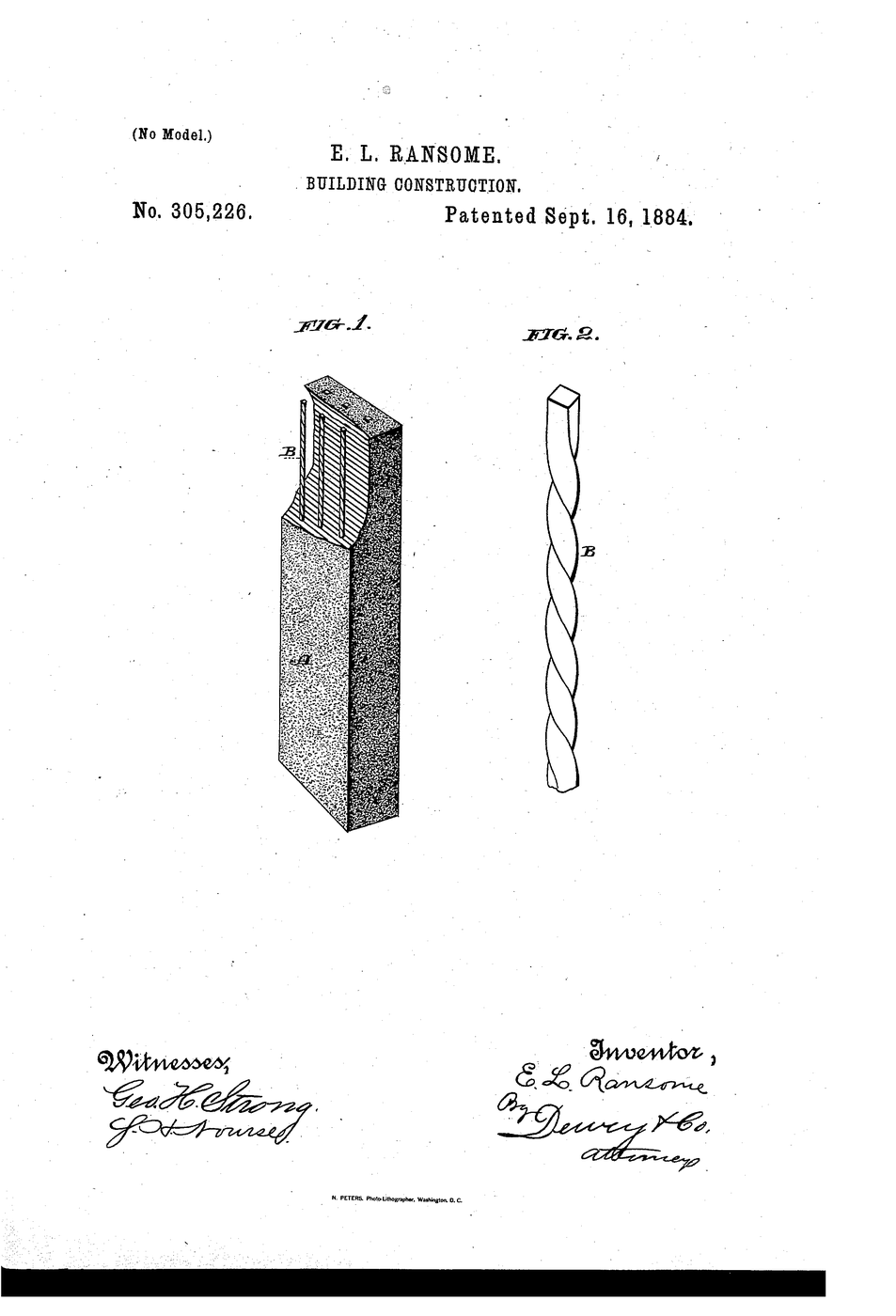
Ransome's patent is not "reinforced concrete" — it is the fix for the slip. He twists the reinforcing bar. A square rod given a spiral twist can no longer slide through the set concrete: its ridges key into the material "at every point from end to end," so the bond runs the whole length of the bar, not just at the ends.
That bond along the entire bar is what makes the steel and concrete act as one. Untwisted rods anchored only by end nuts let the middle pull loose; twisted rods lock everywhere.
US Patent 305,226, "Building construction", granted 16 September 1884 to Ernest L. Ransome of San Francisco, California.
ہدایات
Read the exact claim: the twist, not the reinforcing
Read the exact claim: the twist, not the reinforcing
Reinforcing concrete with iron was already known. Ransome claims twisting the bar so it bonds "at every point from end to end." The bond is the invention. Note that carefully.
Break a plain plaster beam and see it fail in tension
Break a plain plaster beam and see it fail in tension
Cast a small beam of plaster (standing in for concrete), let it set, and bend it. It snaps cleanly on the bottom (tension) face. Concrete is a biscuit in tension.
اس مرحلے کے لیے مواد:
 پلاسٹر آف پیرس500 گرام
درکار اوزار:
 قوت پیما (کمانی ترازو)
Cast a second beam with a SMOOTH wire in the bottom
Cast a second beam with a SMOOTH wire in the bottom
Lay a straight smooth wire along the tension face and cast around it. This is reinforcement without Ransome's fix.
اس مرحلے کے لیے مواد:
 جست چڑھی فولادی تار1 میٹر
Bend it and watch the wire slip
Bend it and watch the wire slip
Load the beam. It cracks — and the smooth wire pulls through the cracked plaster rather than holding the crack shut. Reinforcement that slips is barely reinforcement.
Twist a length of square wire or bar
Twist a length of square wire or bar
Grip a square-section rod (or twist several wires together) and give it a firm spiral twist along its length. Now it has ridges running the whole way.
اس مرحلے کے لیے مواد:
 نرم فولادی سریا #۴1 ٹکڑا
درکار اوزار:
 پلاس (کمبی نیشن پلائر)
Cast a third beam with the TWISTED bar
Cast a third beam with the TWISTED bar
Cast an identical beam with the twisted bar in the tension face. Let it set fully.
Bend it and compare
Bend it and compare
Load the twisted-bar beam. It cracks but holds together and carries far more — the bar cannot slip, so the steel actually takes the tension. Compare all three beams.
Do a pull-out test: smooth versus twisted
Do a pull-out test: smooth versus twisted
Set a smooth wire and a twisted bar each partway into a plaster block. Pull each out with the scale and record the force. The twisted bar takes much more to pull free. That is the bond, measured.
Look at how the twist keys into the plaster
Look at how the twist keys into the plaster
Break open a pull-out block. The twisted bar leaves a spiral impression — the plaster filled the ridges and locked the bar mechanically, all along its length.
Put the bar in the wrong place
Put the bar in the wrong place
Cast a beam with the twisted bar in the TOP (compression) face and bend it. It fails almost like plain plaster — the steel does nothing in the compression zone. Reinforcement only helps where there is tension.
Cure a beam properly and test its strength
Cure a beam properly and test its strength
Real concrete gains strength as it cures wet over days. Keep a twisted-bar beam damp and test it later — it is stronger than one dried out fast. Water is part of the recipe, not just mixing.
Note what modern rebar looks like
Note what modern rebar looks like
Look at a piece of real rebar: it is covered in rolled-on ribs. Those ribs do exactly what Ransome's twist did — bond the bar to the concrete at every point. His idea, refined into a rolling pattern.
History & Context — the twist that made the bond
History & Context — the twist that made the bond
The patent. US 305,226, "Building construction", granted 16 September 1884 to Ernest L. Ransome of San Francisco. To read it correctly you have to be precise about the claim: Ransome did not invent reinforced concrete. Embedding iron in concrete to take tension was already being done by Joseph Monier, François Hennebique, William Wilkinson and Thaddeus Hyatt, among others, from the 1850s on. What Ransome patented is narrower and, in its way, more fundamental — the bond between the steel and the concrete.
Why the bond is the crux. Reinforced concrete only works if the steel and concrete move together: when the concrete cracks in tension (which it always eventually does), the load must transfer across the crack into the steel, and that can only happen if the bar cannot slide. A smooth bar, held only by end anchorages, does slide — the reinforcement in the middle of the span simply pulls loose, exactly as step 4 shows. Ransome's fix is elegant and cheap: take a square rod and twist it, so its corners spiral down the length and key mechanically into the set concrete "at every point from end to end," as the patent puts it. Now the bond is continuous, the steel takes its tension everywhere, and the pair truly act as one composite material. Steps 7 to 9 are that difference, measured and then broken open to see the spiral lock.
What he built with it. Ransome used his twisted-bar concrete to build some of the first important reinforced-concrete structures in America — warehouses, the Alvord Lake Bridge in San Francisco (1889, still standing), and industrial buildings that famously survived the 1906 earthquake and fire when masonry around them collapsed and burned. That fireproof, earthquake-resistant performance is a large part of why reinforced concrete became the material of the twentieth-century city.
The idea that outlived the twist. Twisting was soon replaced by a better manufacturing method — rolling ribs directly onto the bar as it is formed — but the principle is identical, and it is why every piece of modern deformed rebar is covered in ridges (step 12). Ransome's real legacy is not a shape but a requirement written into every concrete code in the world: the reinforcement must bond to the concrete along its length. It sits directly downstream of Portland cement (which makes the concrete) and alongside prestressing (which puts the whole thing into permanent compression) — three ideas that together made concrete the most-used building material on Earth.
مواد
3- 500 گرامپلیس ہولڈر
- 1 میٹرپلیس ہولڈر
- 1 ٹکڑاپلیس ہولڈر
درکار اوزار
2- پلیس ہولڈر
- پلیس ہولڈر
متعلقہ بلیو پرنٹ
یہ بلیو پرنٹ علم بانٹتے ہیں — تکنیک، مواد یا اصول




CC0 پبلک ڈومین
یہ بلیو پرنٹ CC0 کے تحت جاری کیا گیا ہے۔ آپ اجازت لیے بغیر اس کام کو نقل، ترمیم، تقسیم اور کسی بھی مقصد کے لیے استعمال کرنے کے لیے آزاد ہیں۔
میکر کی حمایت کریں ان کے بلیو پرنٹ کے ذریعے پروڈکٹس خرید کر جہاں وہ میکر کمیشن وینڈرز کی طرف سے مقرر، کماتے ہیں، یا اس بلیو پرنٹ کی نئی تکرار بنائیں اور آمدنی شیئر کرنے کے لیے اسے اپنے بلیو پرنٹ میں کنکشن کے طور پر شامل کریں۔