فن
خوبصورتی اور تندرستی
دستکاری
ثقافت اور تاریخ
تفریح
ماحول
خوراک اور مشروبات
ریورس انجینئرنگ
سائنسز
کھیل
ٹیکنالوجی
پہننے والے آلات
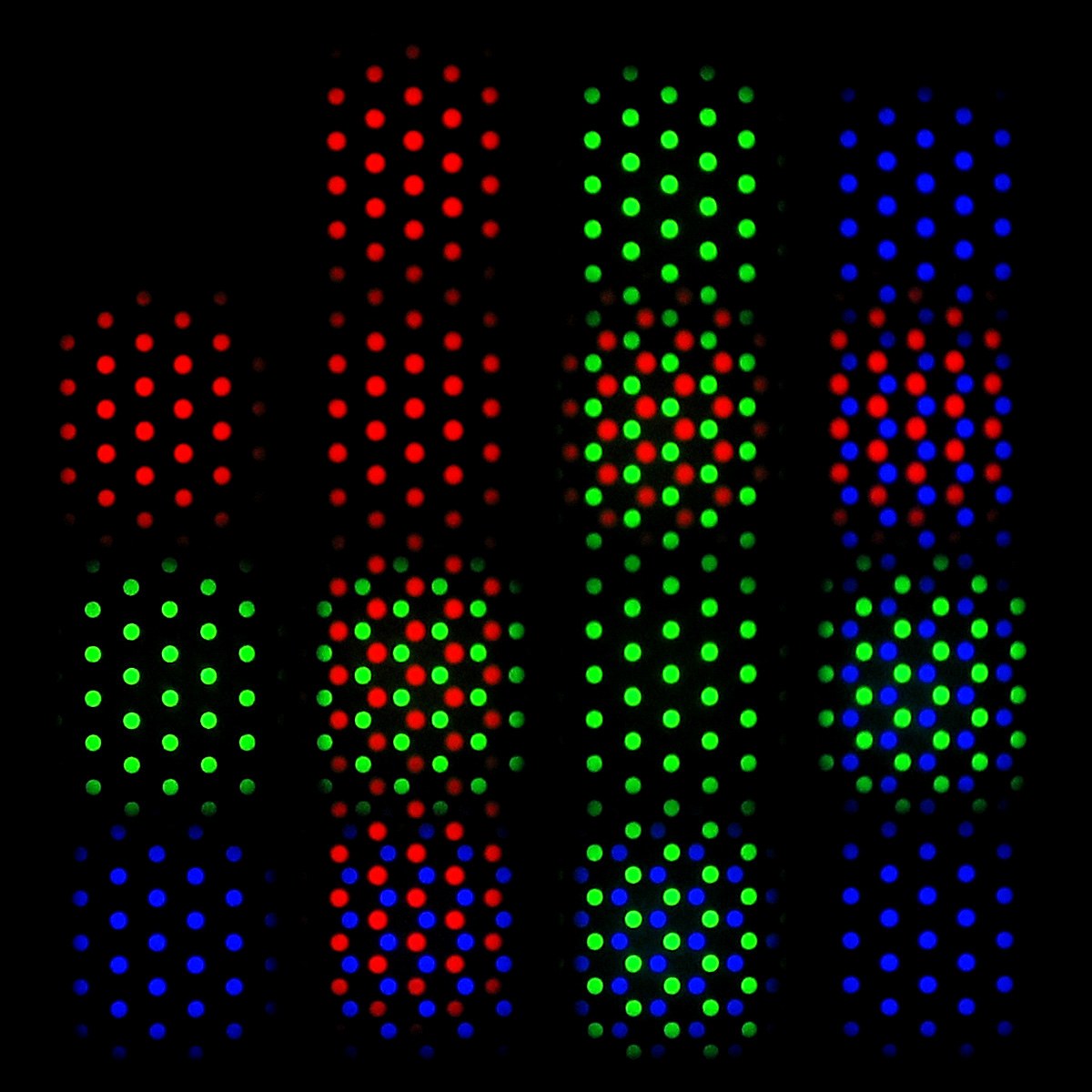


The Shadow-Mask Colour CRT
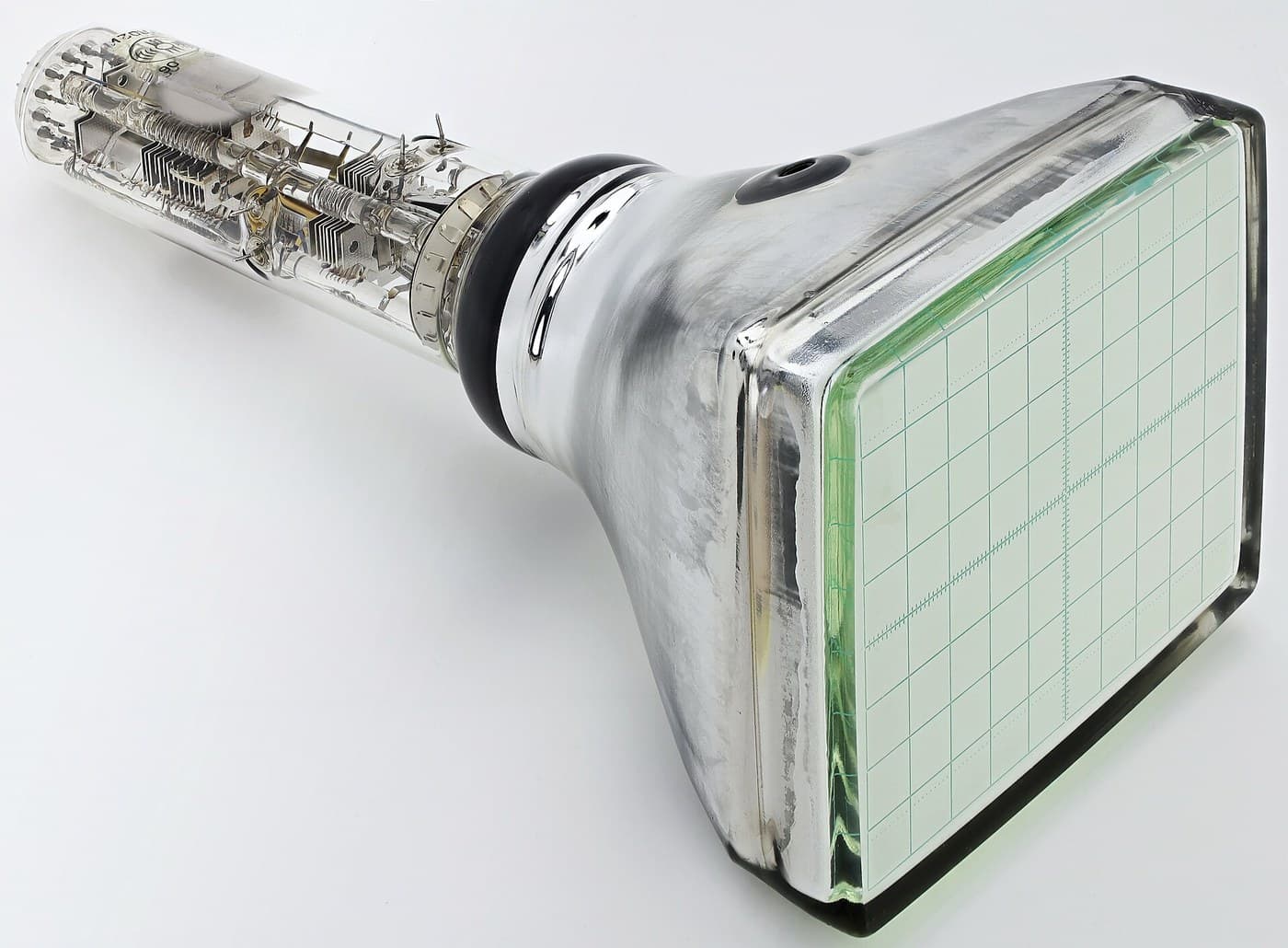
A monochrome cathode ray tube has one gun and one phosphor and asks only one question: where is the beam. Colour asks a harder one. There are now three phosphors interleaved on the screen, a few tenths of a millimetre apart, and three beams that must each strike their own phosphor and never a neighbour — over the whole screen, at every deflection angle, while the tube heats up and the Earth's magnetic field pulls on the beams.
RCA's answer, demonstrated in 1950 and shipped in the CT-100 in 1954, is one of the most audacious pieces of engineering in consumer history. Put a steel sheet with a third of a million holes in it a centimetre behind the screen. Arrange the three guns so their beams arrive at every hole from three slightly different angles. Then a beam passing through a hole can only land in one place — geometry alone decides which phosphor it hits, and geometry cannot be knocked out of adjustment by a drifting amplifier.
The idea is called colour selection by shadowing, and it is why the mask is called a shadow mask: it does not filter or steer anything, it simply blocks the parts of each beam that would land on the wrong dot.
The price is brutal, and worth stating up front because it drove every subsequent development. The mask is a sheet of steel with holes in it, and the holes are a small fraction of the area. It stops between eighty and eighty-five percent of the beam current before it reaches the screen. Everything you see on a shadow-mask tube is made by the fifteen or twenty percent that got through, and the rest is turned into heat in a steel sheet suspended a centimetre from the glass — which then expands, and moves the holes, and puts the beams back on the wrong dots.
You will not build one. You will take a salvaged colour tube, find the mask, measure its pitch and its open area, deflect the beams with a magnet and watch the colour break, and compute what that stopped current does to the mask's temperature.
SAFETY, AND THIS IS NOT OPTIONAL: a CRT holds a charge on its anode coating for weeks after it was last powered, at up to 25 kV, and the tube itself is a large evacuated glass envelope. Read the first step in full before touching one.
اعلیٰ
6 hours
ہدایات
1
1
What you already know, and what colour adds
What you already know, and what colour adds
The monochrome tube is embedded below rather than referenced, because everything in it is still true here and this blueprint only adds one part. Read it first if you have not: the gun, the accelerating anode, the deflection yoke, the phosphor and the aluminised backing are all unchanged.
WHAT COLOUR ADDS is three of the first thing and one new thing.
THREE GUNS. In the 1950 RCA arrangement they sit at the corners of an equilateral triangle in the neck — the delta gun — so the three beams approach the screen from three directions separated by about one degree. From 1972 the industry moved to the in-line arrangement, three guns side by side in a horizontal row, which made convergence dramatically easier because the errors then lie in one plane instead of two.
THE PHOSPHOR SCREEN is no longer a uniform coating. It is several hundred thousand triads of three dots, deposited photographically: coat the faceplate with phosphor in a light-sensitive binder, expose it THROUGH THE TUBE'S OWN SHADOW MASK from a lamp placed where that colour's gun will be, wash away the unexposed part, repeat for the other two. That is the elegant part of the whole design. The mask is used as its own photographic master, so the dots are positioned by the same geometry that will later be used to hit them, and a mask and a screen are married for life. Swapping a mask between tubes does not work and never did.
The three phosphors, and these are worth knowing because two of them are still the reason certain colours are hard: blue is silver-activated zinc sulfide, green is copper-and-aluminium-activated zinc sulfide, and red — the difficult one — was originally a dim manganese-activated zinc phosphate until europium-activated yttrium compounds arrived in the mid 1960s and roughly tripled the red output. Colour television before europium looked noticeably different from colour television after it.
THE MASK is the new part, and it is the next step.
درکار اوزار:
 رنگین CRT نلی
2
2
Open a tube safely, find the mask, measure the pitch
Open a tube safely, find the mask, measure the pitch
DISCHARGE FIRST, AND ASSUME IT IS CHARGED. The anode connector under the rubber cup on the side of the bell is the top of a capacitor formed by the glass with conductive coatings on both faces. It holds tens of kilovolts and it holds them for weeks. It will also RE-CHARGE ITSELF after a first discharge as the glass depolarises, which is why one discharge is not enough.
Clip an earth lead to the tube's external dag coating or to the metal band around the rim. Take an insulated screwdriver with a long shaft, connect the earth lead to its shank through a 1 megohm resistor if you have one, slide the blade under the anode cup, and touch the connector. Expect a crack. Leave it shorted for a minute, remove it, wait five minutes, and DO IT AGAIN. Do it a third time before you put a hand anywhere near it.
IMPLOSION. The envelope is at vacuum and it is large. Modern tubes have a tensioned steel band bonded round the rim specifically to make them fail by cracking rather than by imploding, but do not test it. Wear a full face shield and heavy gloves, keep the tube face-down on a blanket, and never lift or carry it by the neck — the neck is thin, and a snapped neck vents the tube instantly.
If you are not going to open one, everything below can be done on an intact tube through the faceplate with a loupe. That is the recommended route, and you lose only the mask temperature measurement.
FIND THE MASK. Look into the face of an unpowered colour tube from a few centimetres with a bright torch at a shallow angle and a 10x loupe. You will see the triads: three round dots in a triangle, or on a later in-line tube three vertical stripes. Behind them, slightly out of focus, is the mask. Rock your head side to side and the mask holes move against the dots — that parallax is the whole mechanism made visible, and it is the clearest demonstration in this blueprint.
MEASURE THE PITCH. Put a steel rule against the faceplate and count triads over 10 mm with the loupe, or photograph the screen through a macro lens with the rule in frame and count in software. Domestic tubes ran a dot pitch between about 0.25 mm and 0.8 mm depending on size and era; computer monitors went finer, to 0.21 mm in the best of them. Record the number, because the next step needs it.
MEASURE THE OPEN AREA. On a removed mask, backlight it and photograph it against a scale. Measure a hole diameter and the hole spacing. Open area is the total hole area over the total sheet area, and it will come out somewhere between fifteen and twenty percent. On an intact tube, take the manufacturer's figure of 0.18 and note that you assumed it.
CONFIRM THE MASK IS STEEL AND WHAT THAT COSTS. Bring a small magnet near the faceplate of a POWERED tube showing a white field, from 100 mm away, and move it slowly. The colour will bloom and tear into blotches of red and green and blue. You have deflected the beams before the mask so they now pass through the holes at the wrong angles and land on the wrong dots. Remove the magnet: the blotches STAY. The mask itself is now magnetised.
That is why every colour set has a degaussing coil round the face and a positive-temperature-coefficient thermistor that drives a decaying alternating current through it at every switch-on. A shadow mask is a large piece of low-carbon steel sitting in the Earth's field, and simply turning a television to face a different direction is enough to shift the beams. Degauss it by switching the set off and on a few times with a minute between, and the picture will come back.
درکار اوزار:
 رنگین کیتھوڈ شعاع نلی (پرانے آلے سے نکالی، سایہ نقاب والی)
 بلند برقی دباؤ کا تخلیہ تار
 مکبر لوپ
 عددی خردبین
 نیوڈیمیم مقناطیس سیٹ
 پیمانہ
 تجربہ گاہی حفاظتی چشمہ
 CRT نلی خالی کرنے کا اوزار
 دستی عدسہ ۱۰ گنا
3
3
What the mask costs, in watts and in kelvin
What the mask costs, in watts and in kelvin
Jupyter نوٹ بک لوڈ ہو رہی ہے…
درکار اوزار:
 ڈیسک ٹاپ کمپیوٹر
درکار اوزار
11- پلیس ہولڈر
- پلیس ہولڈر
- پلیس ہولڈر
- پلیس ہولڈر
- پلیس ہولڈر
- پلیس ہولڈر
- پلیس ہولڈر
- پلیس ہولڈر
- پلیس ہولڈر
- پلیس ہولڈر
متعلقہ بلیو پرنٹ
یہ بلیو پرنٹ علم بانٹتے ہیں — تکنیک، مواد یا اصول

CC0 پبلک ڈومین
یہ بلیو پرنٹ CC0 کے تحت جاری کیا گیا ہے۔ آپ اجازت لیے بغیر اس کام کو نقل، ترمیم، تقسیم اور کسی بھی مقصد کے لیے استعمال کرنے کے لیے آزاد ہیں۔
میکر کی حمایت کریں ان کے بلیو پرنٹ کے ذریعے پروڈکٹس خرید کر جہاں وہ میکر کمیشن وینڈرز کی طرف سے مقرر، کماتے ہیں، یا اس بلیو پرنٹ کی نئی تکرار بنائیں اور آمدنی شیئر کرنے کے لیے اسے اپنے بلیو پرنٹ میں کنکشن کے طور پر شامل کریں۔