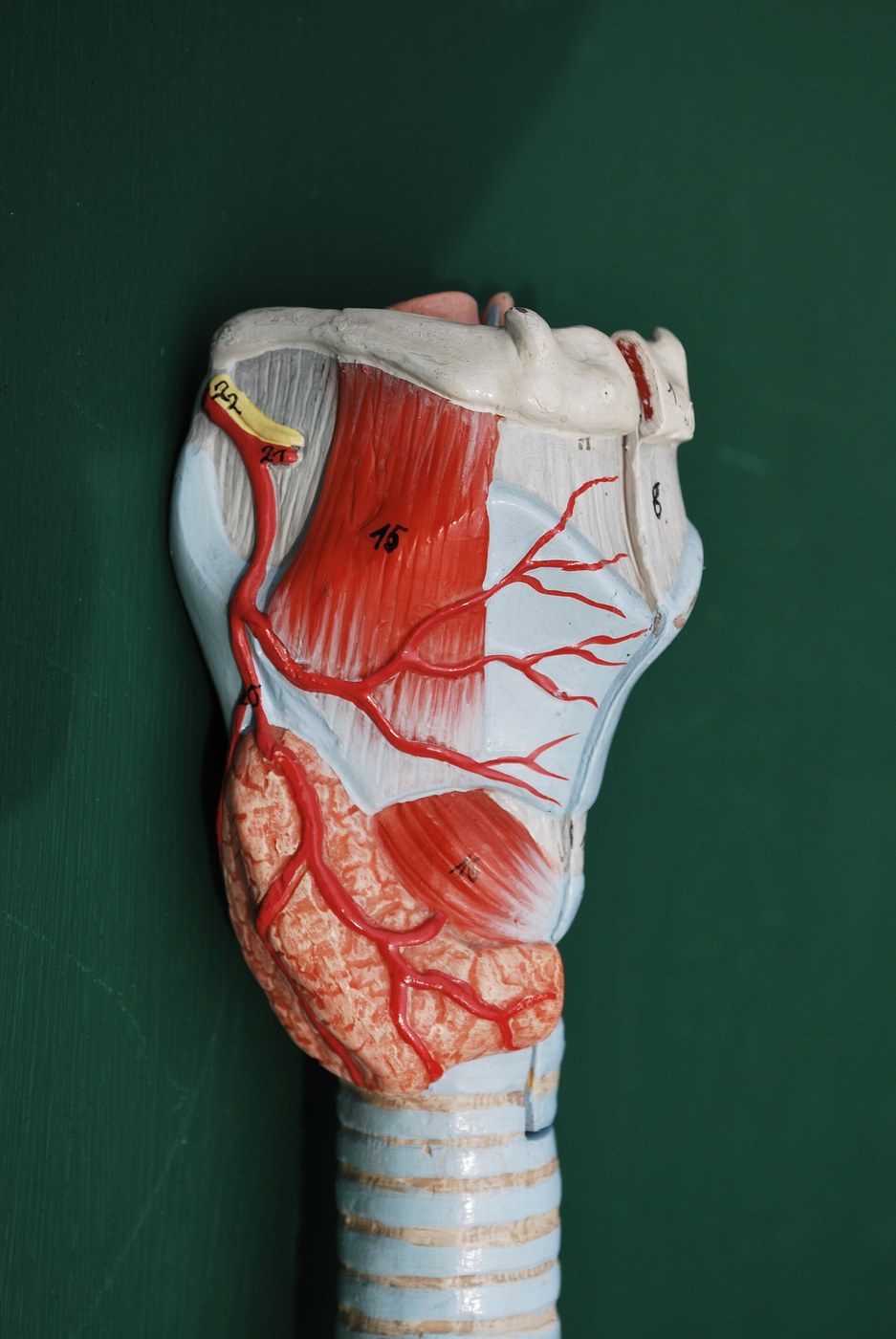


The Larynx Model
Your voice is not made by your throat muscles vibrating on command. Nothing in you moves at 150 times a second under nerve control.
What actually happens is that two folds of tissue are brought close together and held there, and then air is pushed through the gap. Pressure below builds until it forces the folds apart; air rushes through; the folds are pulled back together by their own elasticity and by the drop in pressure in the fast-moving jet between them; the pressure builds again. The cycle repeats, self-sustaining, driven by steady airflow, at a rate set by how tense and how massive the folds are. That is the myoelastic-aerodynamic theory of phonation, and it is the same physics as a trumpeter's lips or a party blower.
Two consequences follow that surprise most people. The muscles set the conditions, not the rhythm — you tension the folds and the oscillation frequency follows. And the larynx makes a buzz, not a voice: the vowel you hear is that buzz filtered by the shape of the throat, mouth and lips above it, which is why you can change vowel without changing pitch, and change pitch without changing vowel.
Build a working model from a tube and a stretched membrane, measure how tension changes pitch, and then add a mouth on top and watch the vowels appear.
ہدایات
Make the simplest possible oscillator
Make the simplest possible oscillator
Flatten one end of a drinking straw and cut the flattened end into a narrow triangle, leaving two thin flaps.
Press your lips lightly on the flaps and blow steadily.
Expect a buzz, and expect it to take a couple of attempts.
Nothing here vibrates because you told it to. Steady airflow through a narrow slot with springy walls produces oscillation on its own — that is the entire mechanism, in one straw.
اس مرحلے کے لیے مواد:
 کاغذی نلکیاں (پینے کی)10 ٹکڑے
درکار اوزار:
 چھوٹا ہاتھ آرا
Build the two-fold model
Build the two-fold model
Cut a balloon into a flat sheet and stretch two strips across the open end of a short rigid tube, leaving a narrow slit between them along the middle. Fix the edges with tape or a rubber band.
Blow through the tube.
Expect a buzz when the slit is nearly closed and silence when it is wide open.
The gap must be small enough that airflow can pull the folds together. Too far apart and the air simply passes through — which is exactly what breathing is.
اس مرحلے کے لیے مواد:
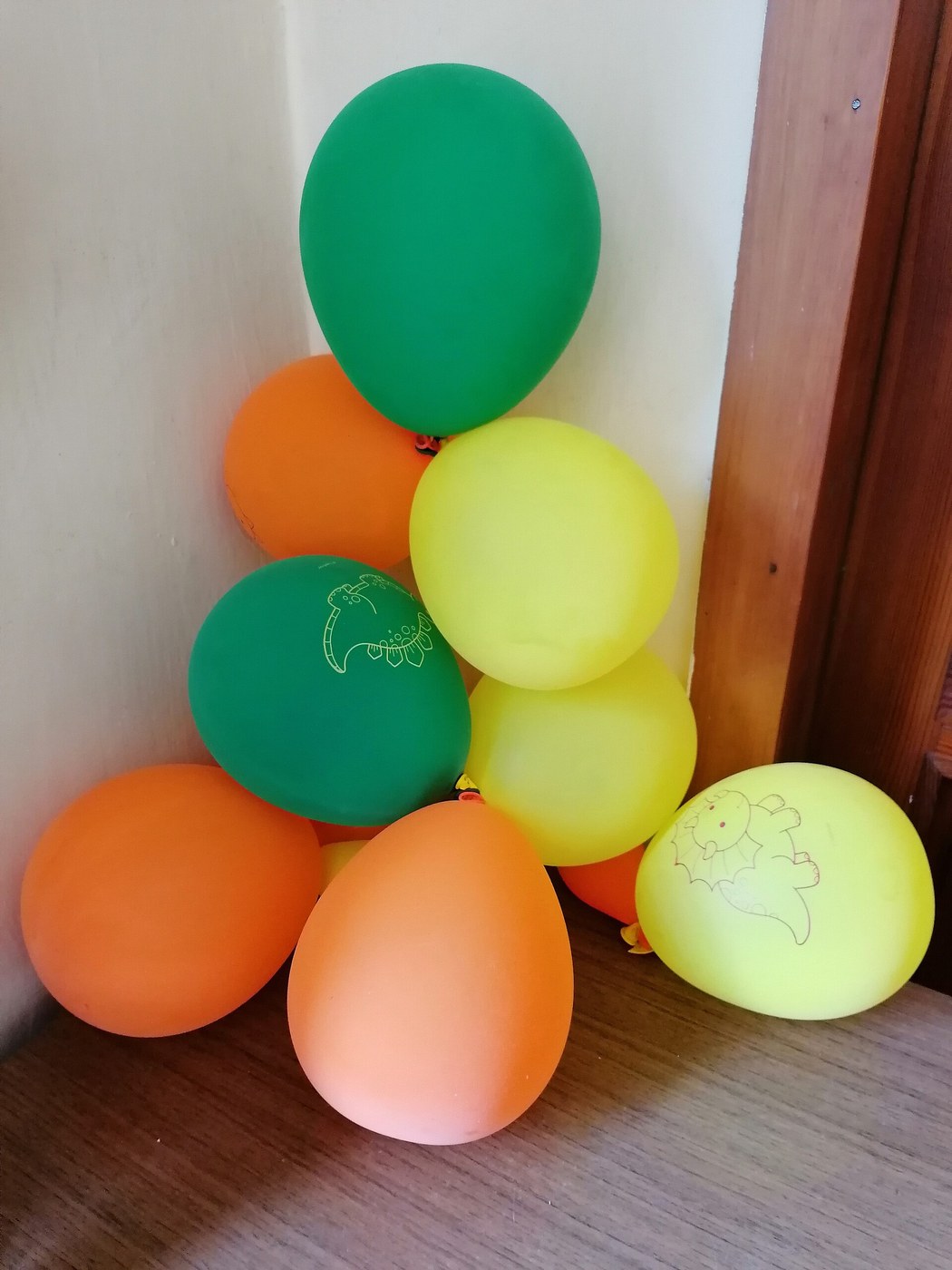 غبارے10 ٹکڑے
 سلیکون نلی1 میٹر
Change tension, measure pitch
Change tension, measure pitch
Stretch the membrane strips tighter, in three or four measured steps, marking the stretched length each time. Blow at a steady rate and record the pitch with a tuner or phone frequency app.
Plot pitch against stretch.
Expect tighter to be higher, reliably.
This is how you sing a higher note — cricothyroid muscles stretch and thin the folds. The nerve signal sets tension; the frequency is a consequence.
درکار اوزار:
 فیتہ پیما
 خانہ دار کاغذ
Change mass, and change pressure
Change mass, and change pressure
Swap in thicker membrane strips at the same tension and record the pitch. Then, with one setup fixed, blow gently and then hard and record both.
Expect thicker to be lower at the same tension, and expect harder blowing to raise pitch a little and loudness a lot.
Pitch is mostly tension and mass; loudness is mostly pressure. They are not independent, which is why untrained singers get louder as they go higher.
Add the vocal tract
Add the vocal tract
Hold a wider tube or a cupped hand above the buzzing model as a resonator, and change its length and opening while the buzz stays the same.
Expect the pitch to stay put while the timbre changes markedly — some versions will sound close to a vowel.
The larynx is the source; the tract above it is the filter. Vowels are made entirely by the filter, which is why you can whisper a recognisable vowel with no vocal fold vibration at all.
Measure your own voice against the model
Measure your own voice against the model
Using the same app, record your own lowest comfortable pitch, your highest, and your speaking pitch. Do the same for two other willing people.
Compare the range with the model's range as you changed tension.
Put a hand lightly on your throat and hum, then whisper the same word.
Expect vibration during the hum and none during the whisper — proof that the source can be switched off while the filter keeps working.
درکار اوزار:
 اسٹاپ واچ
Compendium — the theory and what it replaced
Compendium — the theory and what it replaced
The older idea was that the folds twitched. The neurochronaxic theory held that each vibration cycle was triggered by its own nerve impulse. It was taken seriously into the 1950s and it is wrong — nerve firing rates and muscle contraction times cannot approach the frequencies of ordinary speech, let alone singing. The myoelastic-aerodynamic theory replaced it: the folds are set into self-sustaining oscillation by the interaction of subglottal pressure, the elastic and inertial properties of the tissue, and the aerodynamic forces of the flow itself. The muscles set the boundary conditions; the physics does the rest, exactly as in your straw.
The Bernoulli effect is part of the story but not all of it. Popular accounts stop at "fast-moving air has lower pressure, which sucks the folds back together". That contributes, but a purely Bernoulli-driven system would lose as much energy on closing as it gained on opening and would not sustain. The oscillation is sustained because the folds do not move as a rigid pair — the vocal fold has a soft, pliable cover over a stiffer body, and a travelling wave runs upward through that cover, so the gap is convergent (wider at the bottom) while opening and divergent while closing. The pressure distribution therefore differs between the two halves of the cycle, and net energy flows from the airstream into the tissue. That asymmetry, not Bernoulli alone, is why voices work.
Source-filter is the other half. The buzz at the larynx is harmonically rich; the tract above resonates at frequencies set by its shape, boosting some harmonics and suppressing others. Those peaks are formants, and the first two largely determine which vowel a listener hears. This is why helium changes your voice without changing your pitch — the speed of sound is higher, so the formants move up while the folds oscillate at the same rate. It also explains why a voice is recognisable: the source is generic, and the filter is individual anatomy.
What a balloon model gets wrong. Real vocal folds are layered — epithelium, a soft superficial lamina propria, ligament, muscle — and it is that layering that produces the travelling wave, which a uniform rubber sheet cannot reproduce. Real folds are actively adjusted in tension, length, thickness and separation by several muscle groups, continuously and independently. And the model has no lungs: breath support, subglottal pressure regulation and the whole business of singing are absent. The model is honest about mechanism and silent about control — which is the right trade for a bench build.
Safe practice. Blowing hard against a closed model raises pressure in your chest and can make you light-headed. Blow gently, do not compete on volume, and never share a mouthpiece. Nothing here is a voice-training exercise or a substitute for one.
مواد
3- 10 ٹکڑےپلیس ہولڈر
- 10 ٹکڑےپلیس ہولڈر
- 1 میٹرپلیس ہولڈر
منسلک بلیو پرنٹ مواد

متعلقہ بلیو پرنٹ
یہ بلیو پرنٹ علم بانٹتے ہیں — تکنیک، مواد یا اصول



CC0 پبلک ڈومین
یہ بلیو پرنٹ CC0 کے تحت جاری کیا گیا ہے۔ آپ اجازت لیے بغیر اس کام کو نقل، ترمیم، تقسیم اور کسی بھی مقصد کے لیے استعمال کرنے کے لیے آزاد ہیں۔
میکر کی حمایت کریں ان کے بلیو پرنٹ کے ذریعے پروڈکٹس خرید کر جہاں وہ میکر کمیشن وینڈرز کی طرف سے مقرر، کماتے ہیں، یا اس بلیو پرنٹ کی نئی تکرار بنائیں اور آمدنی شیئر کرنے کے لیے اسے اپنے بلیو پرنٹ میں کنکشن کے طور پر شامل کریں۔