Understanding Uranium from Uraninite — The Element That Changed Everything
Uranium (U, element 92) is the heaviest naturally occurring element in significant quantities and the element that ushered in the nuclear age. Martin Heinrich Klaproth — the same chemist who named titanium — discovered uranium in 1789 by analyzing pitchblende (uraninite, UO₂) from the Joachimsthal silver mines in Bohemia. He named it after the planet Uranus, which had been discovered just eight years earlier by William Herschel.
For over a century after its discovery, uranium was a chemical curiosity with no practical use beyond coloring glass and ceramics a vivid fluorescent yellow-green. Everything changed in 1896 when Henri Becquerel discovered that uranium salts spontaneously emitted penetrating rays — the discovery of radioactivity. This led to Marie and Pierre Curie's isolation of radium and polonium from uranium ore, to Rutherford's discovery of the atomic nucleus, and ultimately to nuclear fission (Hahn and Strassmann, 1938) and the atomic bomb.
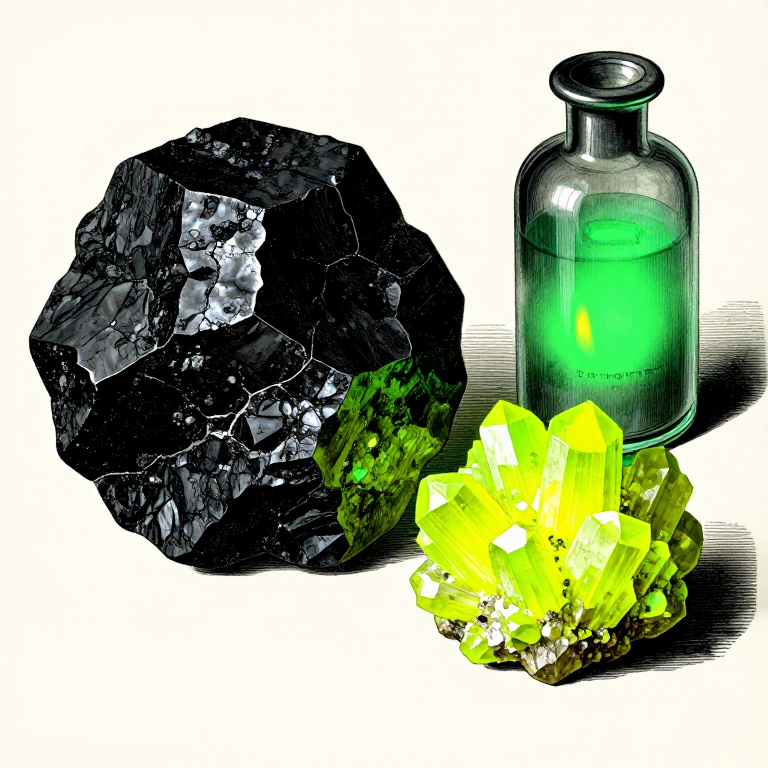
Uraninite (UO₂, uranium dioxide) is the primary uranium mineral, containing up to 88.1% uranium by mass. It occurs in hydrothermal veins, granitic pegmatites, and sedimentary deposits (sandstone-hosted uranium). Uraninite is radioactive and must be handled with appropriate precautions.
EXTREME HAZARD — RADIOACTIVE AND TOXIC: Uranium is both a chemical toxin (heavy metal, damages kidneys) and a radioactive hazard. Uraninite emits alpha particles, beta particles, and gamma rays from uranium and its decay chain (radium, radon gas, polonium). Handling uraninite requires radiation monitoring, respiratory protection (to prevent radon and uranium dust inhalation), and compliance with nuclear material regulations in your jurisdiction. This blueprint is educational only — do not attempt uranium extraction.
ہدایات
Understand uranium's nuclear and chemical properties
Uranium (U, element 92) is a dense, silvery-white, weakly radioactive metal with a density of 19.1 g/cm³ (almost as dense as gold), melting point of 1132 °C, and Mohs hardness of 6. It is an actinide — the first element in the actinide series, which fills the 5f electron shell. Uranium has three naturally occurring isotopes: ²³⁸U (99.274%, half-life 4.47 billion years), ²³⁵U (0.720%, half-life 704 million years), and ²³⁴U (0.005%, half-life 245,000 years).
Uranium-235 is the isotope that changed history. It is fissile — when struck by a slow (thermal) neutron, its nucleus splits into two lighter nuclei, releasing an enormous amount of energy (approximately 200 MeV per fission) and 2–3 additional neutrons. These neutrons can trigger further fissions in a chain reaction. Controlled chain reactions power nuclear reactors; uncontrolled chain reactions produce nuclear explosions. The first controlled chain reaction was achieved by Enrico Fermi at the University of Chicago on December 2, 1942.
Chemically, uranium is reactive — it oxidizes in air, reacts slowly with water, dissolves in acids, and forms compounds in the +3, +4, +5, and +6 oxidation states. The +6 state (uranyl ion, UO₂²⁺) is the most stable in oxidizing conditions and produces the characteristic fluorescent yellow-green color of uranium glass and ceramics.
Identify uraninite and secondary uranium minerals
Uraninite (UO₂) occurs as black, opaque, submetallic to pitch-black cubic crystals or massive aggregates (the massive form is traditionally called 'pitchblende'). Key identification features: Mohs hardness 5–6, specific gravity 7.5–10.0 (extremely variable due to alteration and radiation damage), and a brownish-black streak. Uraninite is noticeably radioactive and will cause a Geiger counter to click significantly above background.
More commonly encountered are secondary uranium minerals — brightly colored alteration products formed when uraninite weathers in oxidizing, water-rich environments. These include autunite (Ca(UO₂)₂(PO₄)₂·10H₂O, vivid fluorescent yellow-green tabular crystals), torbernite (Cu(UO₂)₂(PO₄)₂·12H₂O, emerald-green square plates), carnotite (K₂(UO₂)₂(VO₄)₂·3H₂O, bright canary-yellow powdery crusts), and uranophane (Ca(UO₂)₂(SiO₃OH)₂·5H₂O, yellow needle-like crystals).
Many secondary uranium minerals are intensely fluorescent under short-wave ultraviolet light (254 nm) — autunite's vivid green fluorescence is particularly spectacular. This fluorescence was historically used in uranium prospecting: a UV lamp in a dark mine or on exposed rock at night reveals uranium-bearing minerals that would be invisible in daylight. Major uranium deposits include Cigar Lake (Saskatchewan, Canada), Olympic Dam (Australia), Rössing (Namibia), and the Athabasca Basin (Canada).
درکار اوزار:
Geological Hammer
Hand Lens (10x)Understand uranium processing — from ore to yellowcake
Understand uranium processing — from ore to yellowcake
Commercial uranium extraction involves crushing the ore, leaching with sulfuric acid (H₂SO₄) or alkaline carbonate solution to dissolve the uranium as uranyl sulfate (UO₂SO₄) or uranyl carbonate complex (UO₂(CO₃)₃⁴⁻), then purifying and precipitating the uranium as 'yellowcake' — ammonium diuranate ((NH₄)₂U₂O₇) or uranium oxide concentrate (U₃O₈), a bright yellow powder.
Yellowcake is not weapons-grade material — it contains natural uranium with only 0.72% ²³⁵U. For use in most power reactors, the uranium must be enriched to 3–5% ²³⁵U using gaseous diffusion or gas centrifuge technology. Weapons-grade uranium requires enrichment to over 90% ²³⁵U — an enormously difficult and expensive process that requires thousands of centrifuges operating in cascade. The difficulty of enrichment is the primary barrier to nuclear weapons proliferation.
None of these processes can be performed at small scale legally or safely. Uranium is a controlled nuclear material in virtually every jurisdiction. Even possession of significant quantities of natural uranium ore may require licensing in some countries. The processing of uranium generates radon gas (²²²Rn, a radioactive noble gas with a 3.8-day half-life) at every stage, creating a continuous inhalation hazard that requires specialized ventilation.
Understand uranium glass and ceramic glazes
Before the nuclear age, uranium's primary use was as a colorant. Uranium oxide, added to glass or ceramic glazes at 1–2% concentration, produces a distinctive fluorescent yellow-green color that glows brilliantly under ultraviolet light. Uranium glass (also called Vaseline glass for its color resemblance to petroleum jelly) was produced from the 1830s through the 1940s and is now a popular collectible.
The fluorescence mechanism: UO₂²⁺ ions in glass absorb ultraviolet light and re-emit it as visible green light at approximately 520 nm. This fluorescence is intense and characteristic — a UV flashlight will instantly identify uranium glass. Uranium was also used in orange and red ceramic glazes (Fiesta ware, produced 1936–1944 and 1959–1969) and as a yellow pigment in pottery.
Uranium glass and ceramic items are mildly radioactive but not hazardous for display or occasional use. A typical uranium glass piece emits radiation at levels comparable to a few hours of natural background radiation per year of continuous contact. However, using uranium glass for food or drink is inadvisable, as trace uranium can leach into acidic liquids. Uranium colorant use was banned during World War II (all uranium was diverted to the Manhattan Project) and resumed briefly afterward before being largely abandoned due to regulatory concerns.
Understand the discovery of radioactivity
Henri Becquerel's 1896 discovery of radioactivity was accidental. He was studying phosphorescence — the phenomenon by which certain minerals glow after exposure to sunlight. He hypothesized that phosphorescent uranium salts might emit X-rays (recently discovered by Röntgen in 1895) when stimulated by sunlight. He placed uranium potassium sulfate crystals on a photographic plate wrapped in black paper and exposed them to sunlight, expecting the uranium's phosphorescence to produce X-ray-like exposure.
When overcast weather prevented his planned experiment, he stored the wrapped plate and uranium salt together in a dark drawer. Days later, he developed the plate anyway — and found a strong exposure. The uranium had fogged the photographic plate without any sunlight stimulus, meaning the radiation was spontaneous, not phosphorescence-driven. This was the discovery of radioactivity — the first evidence that atoms could spontaneously emit energy from their nuclei.
Becquerel's discovery triggered a cascade of research: the Curies isolated radium and polonium from pitchblende (1898), Rutherford identified alpha and beta radiation (1899), Rutherford and Soddy described radioactive decay chains (1902), and Rutherford discovered the atomic nucleus (1911). Uranium ore — a curiosity mineral from Bohemian silver mines — became the key that unlocked nuclear physics, nuclear energy, and nuclear weapons. No other mineral specimen has had a comparable impact on human civilization.
Safety considerations and documentation
DO NOT attempt to collect, process, or concentrate uranium minerals without understanding and complying with all applicable nuclear material regulations in your jurisdiction. In many countries, possession of uranium ore above certain quantities requires registration or licensing. Processing uranium ore concentrates or possesses uranium beyond naturally occurring mineral specimens may constitute a criminal offense.
Small mineral specimens of uraninite, autunite, torbernite, and other uranium minerals are legally sold by mineral dealers in most jurisdictions and pose negligible radiation risk when stored appropriately (sealed container, away from living spaces, not handled frequently). However, grinding, crushing, or heating uranium minerals releases radioactive dust and radon gas — never process uranium minerals without professional-grade containment and radiation monitoring.
Document your understanding of uranium's chemistry, mineralogy, and historical impact. The uranium story spans from Klaproth's 1789 identification of a new element in Bohemian pitchblende, through a century of obscurity, to Becquerel's accidental discovery of radioactivity, to the Manhattan Project, to the 440+ nuclear power reactors operating worldwide today. Element 92 arguably shaped the 20th century more profoundly than any other element in the periodic table.
درکار اوزار
2- پلیس ہولڈر
- پلیس ہولڈر
منسلک بلیو پرنٹ مواد
متعلقہ بلیو پرنٹ
یہ بلیو پرنٹ علم بانٹتے ہیں — تکنیک، مواد یا اصول
Related blueprints
Other builds that share materials, tools, or techniques with this one.


CC0 پبلک ڈومین
یہ بلیو پرنٹ CC0 کے تحت جاری کیا گیا ہے۔ آپ اجازت لیے بغیر اس کام کو نقل، ترمیم، تقسیم اور کسی بھی مقصد کے لیے استعمال کرنے کے لیے آزاد ہیں۔
میکر کی حمایت کریں ان کے بلیو پرنٹ کے ذریعے پروڈکٹس خرید کر جہاں وہ میکر کمیشن وینڈرز کی طرف سے مقرر، کماتے ہیں، یا اس بلیو پرنٹ کی نئی تکرار بنائیں اور آمدنی شیئر کرنے کے لیے اسے اپنے بلیو پرنٹ میں کنکشن کے طور پر شامل کریں۔