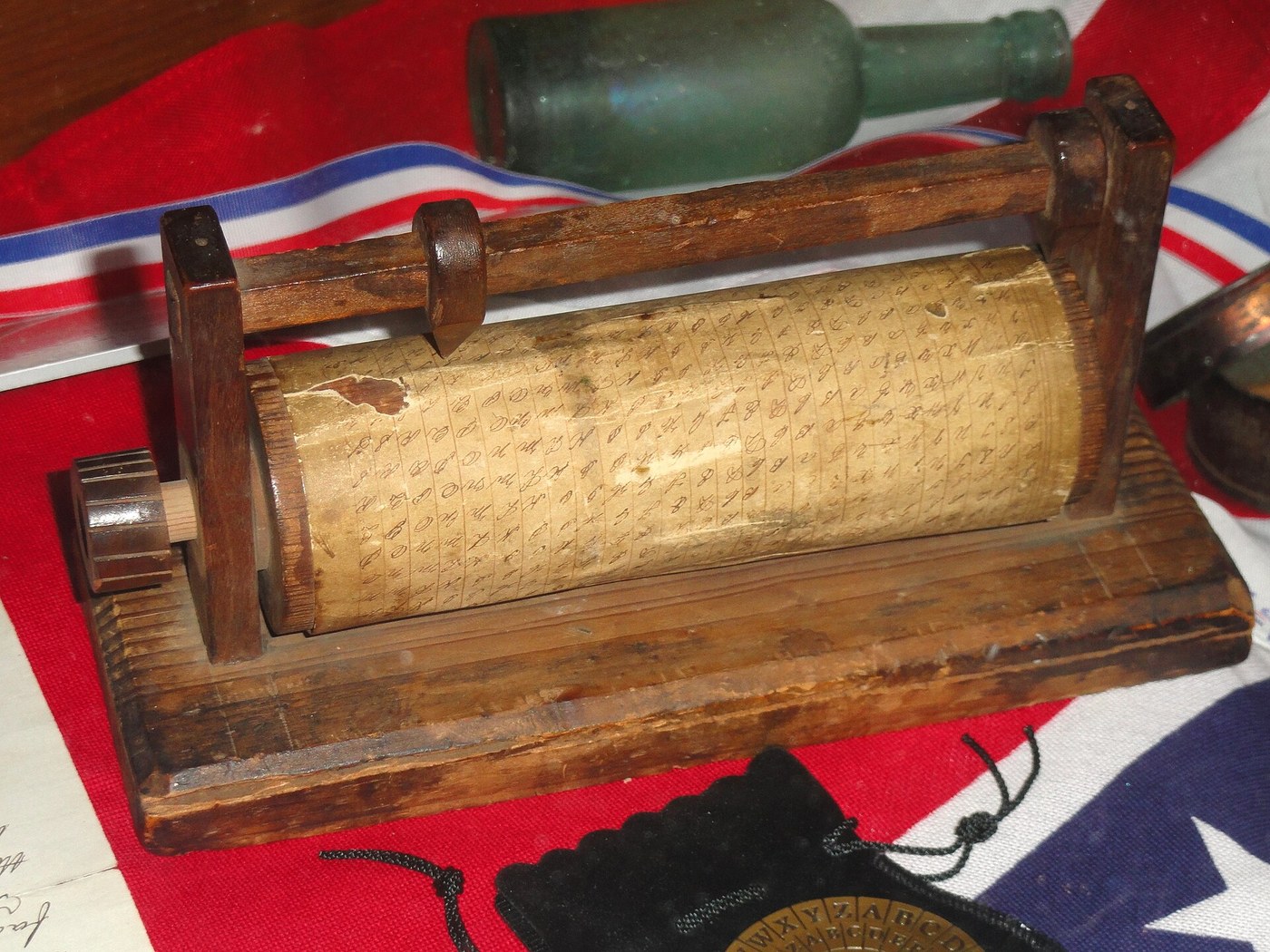


Vigenère Cipher
ہدایات
Encrypt with a keyword
Encrypt with a keyword
Key over message, letter by letter.
- Choose a keyword and write it repeatedly above your plaintext.
- For each column, shift the plaintext letter by the key letter's position (A=0, B=1, …).
- Wrap around from Z to A.
اس مرحلے کے لیے مواد:
 خانہ دار کاغذ1 pad
 گریفائٹ پنسلوں کا سیٹ1 سیٹ
Confirm the defence works
Confirm the defence works
Attack your own ciphertext the old way and watch it fail.
- Tally letter frequencies over a long Vigenère ciphertext.
- Chart them.
- Try to identify E.
Find the period with Kasiski's method
Find the period with Kasiski's method
The keyword repeats, and repetition leaves fingerprints.
- Search the ciphertext for repeated sequences of three or more letters.
- Measure the distance between each pair of repeats.
- Take the common factors of those distances.
Split and conquer
Split and conquer
With the period known, the whole thing collapses.
- If the key length is 5, take every 5th letter to form five separate strings.
- Each string was encrypted with ONE fixed shift — a Caesar cipher.
- Run frequency analysis on each string independently and recover each shift.
- Assemble the shifts into the keyword.
History and context
History and context
The name is wrong. The cipher was described by Giovan Battista Bellaso in 1553. Blaise de Vigenère published a stronger autokey cipher in 1586, and the nineteenth century attached his name to Bellaso's simpler scheme. It is a durable misattribution and worth correcting whenever it comes up.
The break has a priority story too. Charles Babbage appears to have solved it around 1854, apparently prompted by a challenge in a journal, and never published — possibly at the request of British intelligence during the Crimean War, though that explanation is inference rather than documented fact. Friedrich Kasiski published the method independently in 1863, and it carries his name.
Fixing the period fixes the cipher — completely. If the key is truly random, as long as the message, and never reused, the result is the one-time pad, which Shannon proved in 1949 to be information-theoretically unbreakable. Every weakness of Vigenère is a consequence of the key repeating; remove the repetition and the security is absolute. The catch is that distributing key material as long as everything you will ever send is usually harder than the problem you were solving.
Where the mistakes still happen: reusing a one-time pad destroys it entirely, and this is not a historical curiosity — the Venona project decrypted Soviet traffic for years because of duplicated pad pages. The lesson that a cipher's guarantee depends on an operational discipline, not just on the mathematics, is the one that keeps having to be relearned.
مواد
2- 1 padپلیس ہولڈر
- پلیس ہولڈر
متعلقہ بلیو پرنٹ
یہ بلیو پرنٹ علم بانٹتے ہیں — تکنیک، مواد یا اصول
CC0 پبلک ڈومین
یہ بلیو پرنٹ CC0 کے تحت جاری کیا گیا ہے۔ آپ اجازت لیے بغیر اس کام کو نقل، ترمیم، تقسیم اور کسی بھی مقصد کے لیے استعمال کرنے کے لیے آزاد ہیں۔
میکر کی حمایت کریں ان کے بلیو پرنٹ کے ذریعے پروڈکٹس خرید کر جہاں وہ میکر کمیشن وینڈرز کی طرف سے مقرر، کماتے ہیں، یا اس بلیو پرنٹ کی نئی تکرار بنائیں اور آمدنی شیئر کرنے کے لیے اسے اپنے بلیو پرنٹ میں کنکشن کے طور پر شامل کریں۔