

Toothbrush
A brush with a flat head and densely packed bristles cleans the front of a tooth and nothing else. Teeth are not a flat surface — they are an arch of oval objects with gaps between them, and the places that decay are precisely the places a flat brush cannot reach: between the teeth, along the gum line, and the far side of the back molars.
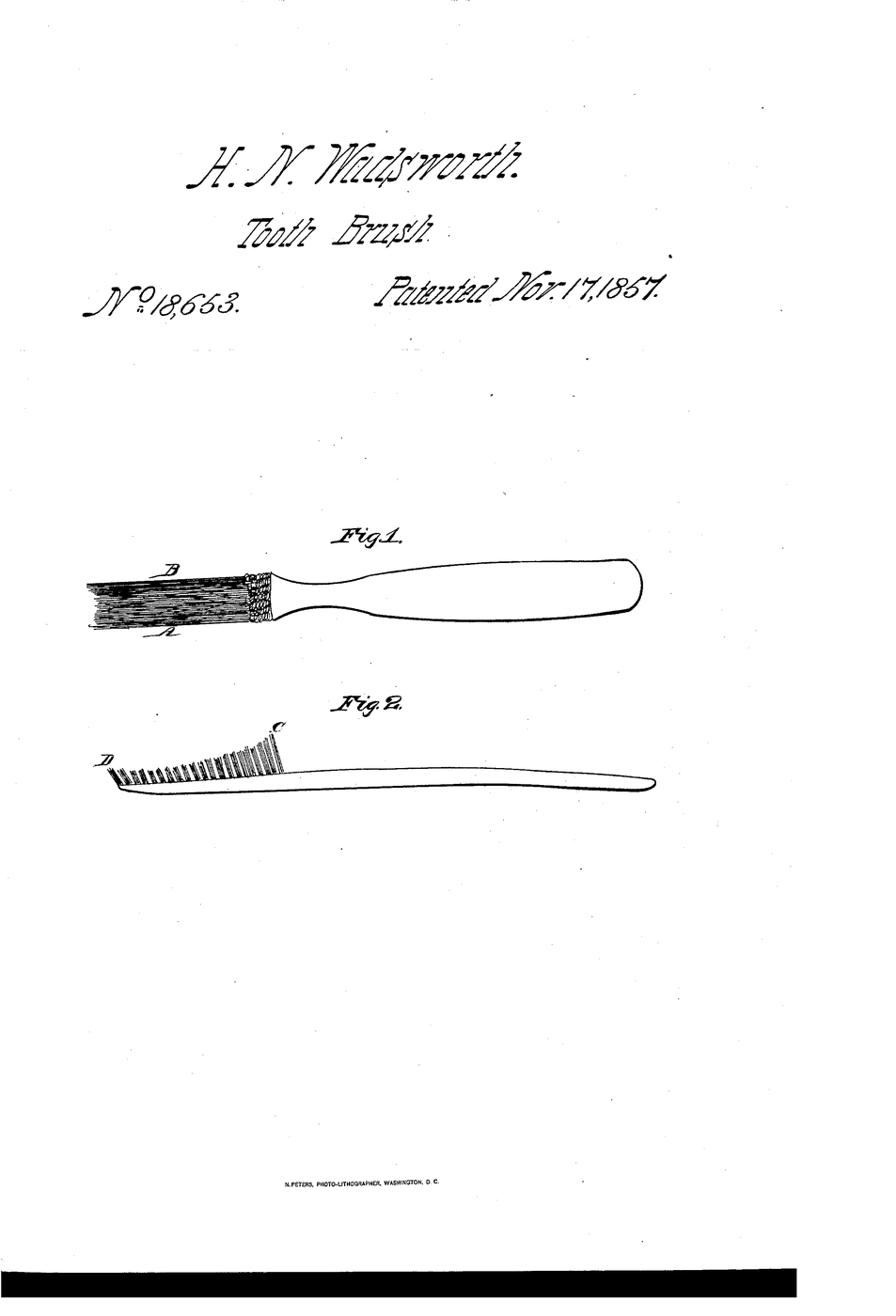
Wadsworth's brush is shaped to the mouth rather than to the hand. The head curves from heel to point to follow the dental arch. The bristle face is concave, so it wraps the oval of each tooth instead of touching one line on it. And the bristles are deliberately separated into spaced bunches — because tufts with room around them can flex and enter the gaps, while a solid block of bristle simply skates across the top.
US Patent 18,653, "Tooth-Brush", granted 17 November 1857 to H. Nichols Wadsworth — the first United States patent for a toothbrush. He also gives the back a thin rounded wedge so the head can be pushed between the cheek and the molars.
ہدایات
Build this to study, and brush with a modern brush
Build this to study, and brush with a modern brush
A home-made brush is a teaching object. Do not put it in your mouth — natural bristle and untreated wood harbour bacteria and cannot be sanitised. All the tests below use a model, not teeth.
Read US 18,653 and note the word separating
Read US 18,653 and note the word separating
Wadsworth claims "separating the bunches of bristles more than in the common brush" to give elasticity and let them enter between the teeth. Spacing is the claim, not softness.
Make a tooth model with real gaps
Make a tooth model with real gaps
Glue a curved row of wooden beads or dowel offcuts to a base, leaving 1 mm gaps. Coat them with a thin layer of coloured modelling clay to stand in for plaque.
درکار اوزار:
 ہوا میں سوکھنے والی مٹی
Brush the model with a dense flat brush
Brush the model with a dense flat brush
Use any stiff flat-headed brush and ten strokes. Photograph the result. The tops are clean and the gaps are untouched — that is the failure being fixed.
Cut the handle blank
Cut the handle blank
Cut a hardwood strip about 170 × 15 × 8 mm. Long enough to reach the back molars without the hand blocking the mouth.
اس مرحلے کے لیے مواد:
 لکڑی کی چولیں1 ٹکڑا
درکار اوزار:
 دستکاری کا چاقو
Curve the head from heel to point
Curve the head from heel to point
Shape the head into a shallow arc in plan view, following the curve of a dental arch. Hold it against your model — the arc should match.
Hollow the bristle face concave
Hollow the bristle face concave
Carve a shallow lengthwise hollow into the face that will carry the bristles. This is what lets the tufts wrap the oval of a tooth instead of touching its crown only.
درکار اوزار:
 باریک ریتیوں کا سیٹ
Thin the back into a rounded wedge
Thin the back into a rounded wedge
Taper the back of the head to a slim rounded section. Wadsworth wants it to slip between the cheek muscle and the molars — a thick head simply will not go there.
Drill two rows of widely spaced holes
Drill two rows of widely spaced holes
Drill 2 mm holes in two staggered rows with generous gaps between them. Resist the urge to pack them — the spacing is the invention.
Tuft the holes with bristle
Tuft the holes with bristle
Fold a small bundle of natural or nylon bristle over a fine wire staple and pull it tightly into each hole. Each tuft should stand upright and independent.
اس مرحلے کے لیے مواد:
 جست چڑھی فولادی تار1 میٹر
 گز کے بال (گھوڑے کے بال)1 ٹکڑا
درکار اوزار:
 چپٹے منہ کا پلاس
Trim the point tufts shorter and angled
Trim the point tufts shorter and angled
Cut the tufts nearest the tip shorter, and angle them so they project past the end of the head. The patent specifies this — it is how you reach behind the last molar.
Brush the model again and compare
Brush the model again and compare
Ten strokes with your brush on a freshly coated model, photographed the same way as step 4. Compare how much clay is removed from between the beads.
Press a single tuft and watch it splay
Press a single tuft and watch it splay
Push one tuft onto a bead and watch it spread around the curve. Now push a tuft in a densely packed brush — its neighbours hold it rigid. Space is what allows flex.
Leave it wet overnight and inspect it
Leave it wet overnight and inspect it
Wet the bristles and leave the brush lying flat. Natural bristle stays damp for hours because it is hollow — note that, because it is the reason the material had to change.
History & Context — the first US patent, not the first toothbrush
History & Context — the first US patent, not the first toothbrush
The patent. US 18,653, "Tooth-Brush", granted 17 November 1857 to H. Nichols Wadsworth. Application and grant share a date, so only the grant is cited.
⚠ This is the first American toothbrush patent, not the first toothbrush, and the difference matters. Bristle toothbrushes were made in China by the fifteenth century using hog bristle set into bone or bamboo, and mass production in Europe dates from William Addis in England around 1780 — the standard account has him drilling a bone with holes and tufting it with bristle while in prison. Wadsworth's contribution is a shaped brush: curved to the arch, concave to the tooth, wedged at the back, and above all spaced rather than packed. Everything he claims is about geometry.
Why spacing beats density. The instinct is that more bristle cleans more, and it is wrong. Bristles clean by bending around a surface and dragging across it; a bristle that cannot bend simply presses. In a dense block, each filament is braced by its neighbours, so the whole head behaves like a stiff pad and rides over the tops of the teeth. Separated tufts are free to splay, so they follow the curve of the enamel and enter the interdental gaps where decay actually starts. Step 13 shows this directly, and it is why modern brush heads still use discrete tufts with visible gaps rather than a continuous field.
The material was the unsolved half. Wadsworth had only animal hair — usually hog bristle, which is hollow, absorbs water, dries slowly, holds bacteria, softens unpredictably and falls out. Step 14 demonstrates the problem in one night. It was not fixed until 1938, when DuPont's nylon gave a solid, non-absorbent, uniformly stiff filament that could be cut to a controlled length and rounded at the tip. Nylon is arguably a bigger improvement to toothbrushing than any change in head shape, and it came eighty years after this patent.
Brushing was not yet a habit. Regular daily toothbrushing did not become normal in the United States until the mid-twentieth century, pushed hard by army hygiene training during the Second World War. A patent in 1857 is therefore for a minority product; the Roman tooth powders elsewhere in this collection served a population that mostly cleaned teeth with cloth, twigs and abrasive powders, if at all. The object arrived long before the practice.
مواد
3- 1 ٹکڑاپلیس ہولڈر
- 1 میٹرپلیس ہولڈر
- 1 ٹکڑاپلیس ہولڈر
درکار اوزار
4- پلیس ہولڈر
- پلیس ہولڈر
- پلیس ہولڈر
- پلیس ہولڈر
متعلقہ بلیو پرنٹ
یہ بلیو پرنٹ علم بانٹتے ہیں — تکنیک، مواد یا اصول

CC0 پبلک ڈومین
یہ بلیو پرنٹ CC0 کے تحت جاری کیا گیا ہے۔ آپ اجازت لیے بغیر اس کام کو نقل، ترمیم، تقسیم اور کسی بھی مقصد کے لیے استعمال کرنے کے لیے آزاد ہیں۔
میکر کی حمایت کریں ان کے بلیو پرنٹ کے ذریعے پروڈکٹس خرید کر جہاں وہ میکر کمیشن وینڈرز کی طرف سے مقرر، کماتے ہیں، یا اس بلیو پرنٹ کی نئی تکرار بنائیں اور آمدنی شیئر کرنے کے لیے اسے اپنے بلیو پرنٹ میں کنکشن کے طور پر شامل کریں۔