SZTUKA
Piękno i dobre samopoczucie
RZEMIOSŁO
KULTURA I HISTORIA
ROZRYWKA
ŚRODOWISKO
JEDZENIE I NAPOJE
INŻYNIERIA ODWROTNA
NAUKI
LEKKOATLETYKA
TECHNOLOGIA
URZĄDZENIA DO NOSZENIA
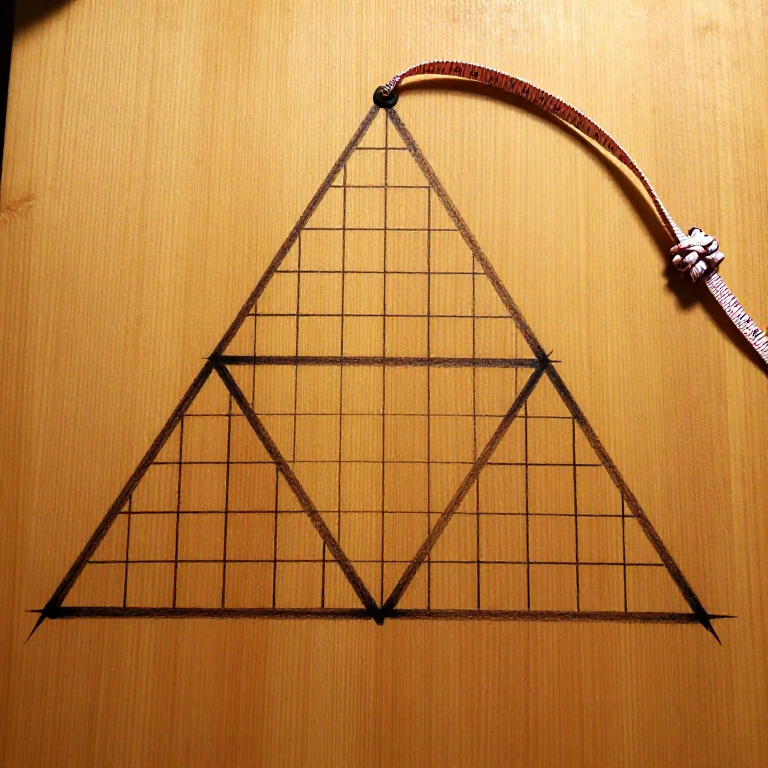


Proving the Pythagorean Theorem by Cutting Squares — a² + b² = c²
The most famous rule in geometry says that in any right-angled triangle, the square built on the longest side equals the two squares on the shorter sides added together: a² + b² = c². The school of Pythagoras proved it around 530 BC. This blueprint proves it the maker's way — with a knotted cord, three cut squares, and a dissection you can hold in your hands. Seeing the pieces of the two small squares fit exactly into the big one is a proof that needs no algebra, and it doubles as the ancient builder's test for a true square corner.
Początkujący
2
Instrukcje
1
1
State the theorem
State the theorem
In a right-angled triangle, name the two short sides a and b and the longest side (the hypotenuse) c. The theorem says the square on c has exactly the same area as the squares on a and b together: a² + b² = c². You will prove this by area, not algebra.
2
2
Make a right angle with a cord
Make a right angle with a cord
Knot a loop of cord into twelve equal spaces. Peg it out as a triangle with sides of 3, 4 and 5 spaces; the corner between the 3 and 4 sides is a perfect right angle. This 3-4-5 trick is how builders have squared corners for thousands of years.
Potrzebne narzędzia:
 Bawełniany sznurek kuchenny
3
3
Lay out a right triangle
Lay out a right triangle
Using that right angle, mark a right triangle with legs 3 and 4 units on a board. Its hypotenuse comes out to exactly 5 units — a whole-number right triangle to make the areas easy to count.
Materiały do tego kroku:
 Deska z olszy czerwonej1 sztuka
Potrzebne narzędzia:
 Sznur traserski
4
4
Cut the three squares
Cut the three squares
Cut a square on each side of the triangle: 3×3, 4×4 and 5×5. Rule each into unit squares — 9, 16 and 25 of them. These three squares are the whole proof, made physical.
Potrzebne narzędzia:
 Piła ręczna
 Nóż
Nóż5
5
Count the areas
Count the areas
Count: the small squares hold 9 and 16 unit squares, together 25 — exactly the number in the big square on the hypotenuse. 9 + 16 = 25 is a² + b² = c² in plain counting.
6
6
Prove it by dissection
Prove it by dissection
Now cut the two smaller squares into pieces and lay them inside the largest square. They tile it exactly — no gaps, no overlaps. Because the pieces fit for reasons of shape, not luck, this works for every right triangle, not only 3-4-5.
Potrzebne narzędzia:
Nóż7
7
Test other triangles
Test other triangles
Repeat with other right triangles: the square on the hypotenuse always equals the sum of the other two. Change the corner so it is no longer a right angle, and the fit fails — which is exactly why the same rule can TEST whether a corner is truly square.
8
8
See why it matters
See why it matters
This single relationship underlies distance, surveying, navigation and building ever since. Any time you find a straight-line distance from two measurements at right angles, you are using Pythagoras — a 2,500-year-old proof you just held in your hands.
Materiały
3- 1 sztukaZastępnik
- 1 sztukaZastępnik
- 1 sztukaZastępnik
Wymagane narzędzia
4- Zastępnik
- Zastępnik
- Zastępnik
- Zastępnik
Powiązane blueprinty
Te blueprinty dzielą się wiedzą — technikami, materiałami lub zasadami
CC0 Domena publiczna
Ten plan jest udostępniany na licencji CC0. Możesz go swobodnie kopiować, modyfikować, rozpowszechniać i wykorzystywać do dowolnych celów, bez konieczności uzyskiwania zgody.
Wesprzyj Makera kupując produkty przez jego plan, za co zarabia Prowizja Makera ustalony przez sprzedawców, lub stwórz nową iterację tego planu i dołącz go jako połączenie w swoim własnym planie, aby dzielić się przychodami.