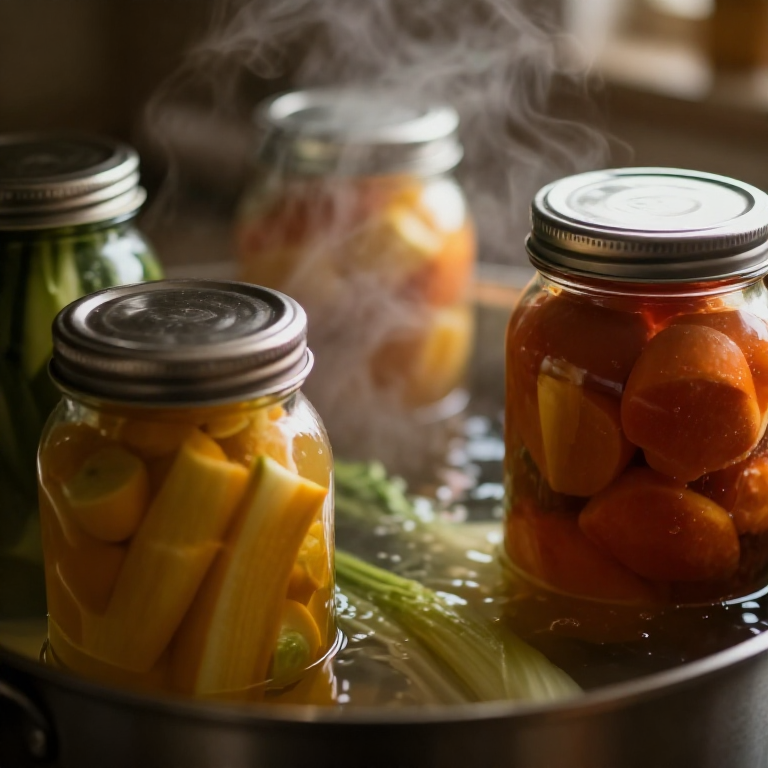


Preserving Food by Canning — Appert's Heat-and-Seal Method That Fed Armies
In 1810 a French confectioner named Nicolas Appert won a prize from Napoleon's government for solving a problem that had plagued every army and navy in history: how to keep food from spoiling. His answer was deceptively simple — pack food in a sealed container and heat it thoroughly. Food preserved this way kept for months, even years, and the modern canning industry was born.
Appert did not know why it worked; it would take Louis Pasteur, fifty years later, to show that heat kills the microbes that spoil food and the seal keeps new ones out. But the method worked perfectly without that knowledge. Soon glass jars gave way to soldered tin cans — lighter, unbreakable, and ideal for soldiers and sailors — and canned food spread around the world.
Canning sits alongside salting, drying, and smoking as one of humanity's great preservation methods, but it was the first to keep food fresh-tasting and the first born of the industrial age. One caution it shares with all low-acid preserving: ordinary boiling does not destroy the spores of botulism, so low-acid foods must be acidified or pressure-canned — a lesson learned long after Appert.
Instrukcje
Understand the principle
Understand the principle
Choose and prepare the food
Choose and prepare the food
Materiały do tego kroku:
 Fresh Produce2 kg
Prepare the jars
Prepare the jars
Materiały do tego kroku:
 Glass Jar6 sztuk
Pack the jars
Pack the jars
Materiały do tego kroku:
 Table Salt50 g
Seal the jars
Seal the jars
Materiały do tego kroku:
 Beeswax Pellets100 g
Heat in a boiling water bath
Heat in a boiling water bath
Materiały do tego kroku:
 Water8 litrów
Potrzebne narzędzia:
 Stock Pot
Time by the food
Time by the food
Potrzebne narzędzia:
 Thermometer
Cool and check the seal
Cool and check the seal
Potrzebne narzędzia:
 Jar Tongs
Reject any failures
Reject any failures
Store cool and dark
Store cool and dark
Move to the tin can
Move to the tin can
Materiały do tego kroku:
 Tin Can6 sztuk
Respect the botulism rule
Respect the botulism rule
Materiały
6- 2 kgZastępnik
- 6 sztukZastępnik
- 50 gZastępnik
- 100 gZastępnik
- 8 litrówZastępnik
- 6 sztukZastępnik
Powiązane blueprinty
Te blueprinty dzielą się wiedzą — technikami, materiałami lub zasadami



CC0 Domena publiczna
Ten plan jest udostępniany na licencji CC0. Możesz go swobodnie kopiować, modyfikować, rozpowszechniać i wykorzystywać do dowolnych celów, bez konieczności uzyskiwania zgody.
Wesprzyj Makera kupując produkty przez jego plan, za co zarabia Prowizja Makera ustalony przez sprzedawców, lub stwórz nową iterację tego planu i dołącz go jako połączenie w swoim własnym planie, aby dzielić się przychodami.