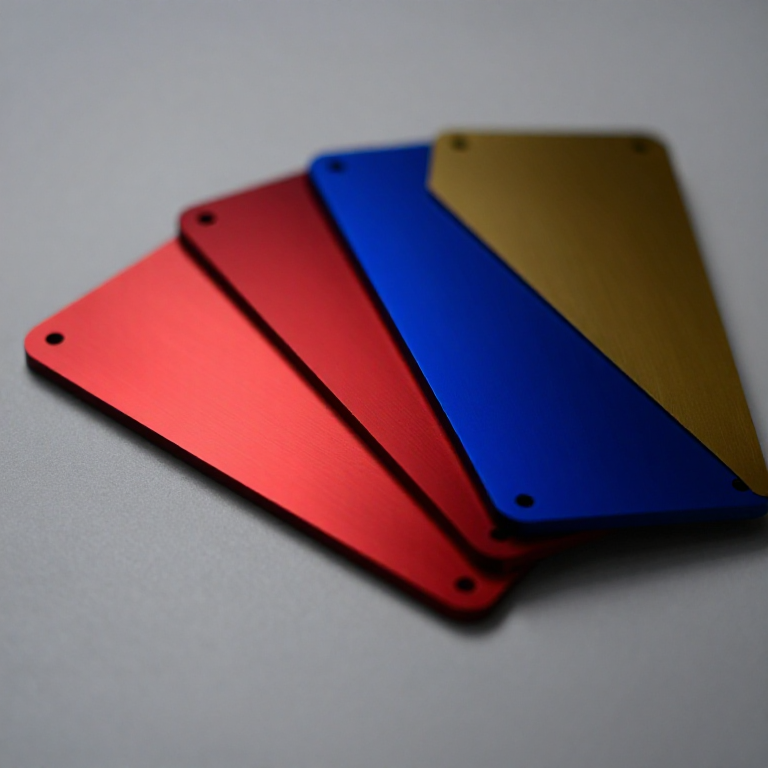


Anodising Aluminium
Aluminium already protects itself. Exposed to air it grows an oxide film a few nanometres thick, and that film is why aluminium does not rust away like iron. It is also far too thin to survive handling, and it offers nothing to a dye.
Anodising makes the metal grow that film deliberately, hundreds of times thicker. Make the aluminium the anode in an acid bath and the oxygen liberated at its surface converts the metal into aluminium oxide — not deposited on it, converted from it. The layer grows downward into the part as much as outward, so dimensions barely change, and it cannot flake off because there is no interface for it to part along.
The grown film is also porous, a dense array of fine tubes standing on the metal. That porosity is the whole commercial value: the pores take up dye, and are then sealed shut in boiling water. Every coloured aluminium object you own — a carabiner, a phone body, a cooking pot — is dyed in those pores.
The first commercial process is Bengough and Stuart's, using chromic acid: British priority GB 223,994 of 2 August 1923, and US 1,771,910, "Process of protecting surfaces of aluminum or aluminum alloys", filed 28 July 1924 and granted 29 July 1930 to Guy Dunstan Bengough and John McArthur Stuart of London. It was developed for the Air Ministry to stop seaplane parts corroding.
This blueprint uses sulfuric acid, not chromic. Chromic acid is hexavalent chromium — a confirmed human carcinogen. The original chemistry is described in the history step and is not to be attempted outside industrial containment.
Treści niebezpieczne
Ten blueprint zawiera niebezpieczne procedury. Zaloguj się i włącz niebezpieczne treści w ustawieniach konta, aby zobaczyć instrukcje krok po kroku.
Powiązane blueprinty
Te blueprinty dzielą się wiedzą — technikami, materiałami lub zasadami

CC0 Domena publiczna
Ten plan jest udostępniany na licencji CC0. Możesz go swobodnie kopiować, modyfikować, rozpowszechniać i wykorzystywać do dowolnych celów, bez konieczności uzyskiwania zgody.
Wesprzyj Makera kupując produkty przez jego plan, za co zarabia Prowizja Makera ustalony przez sprzedawców, lub stwórz nową iterację tego planu i dołącz go jako połączenie w swoim własnym planie, aby dzielić się przychodami.